Review
. 2022 Mar 28;14(7):1710.
doi: 10.3390/cancers14071710.

Immunomodulatory Properties of Immune Checkpoint Inhibitors-More than Boosting T-Cell Responses?

Affiliations
Review

Immunomodulatory Properties of Immune Checkpoint Inhibitors-More than Boosting T-Cell Responses?

Michael Kuske et al. Cancers (Basel). .

Abstract

The approval of immune checkpoint inhibitors (ICI) that serve to enhance effector T-cell anti-tumor responses has strongly improved success rates in the treatment of metastatic melanoma and other tumor types. The currently approved ICI constitute monoclonal antibodies blocking cytotoxic T-lymphocyte-associated protein (CTLA)-4 and anti-programmed cell death (PD)-1. By this, the T-cell-inhibitory CTLA-4/CD80/86 and PD-1/PD-1L/2L signaling axes are inhibited. This leads to sustained effector T-cell activity and circumvents the immune evasion of tumor cells, which frequently upregulate PD-L1 expression and modulate immune checkpoint molecule expression on leukocytes. As a result, profound clinical responses are observed in 40-60% of metastatic melanoma patients. Despite the pivotal role of T effector cells for triggering anti-tumor immunity, mounting evidence indicates that ICI efficacy may also be attributable to other cell types than T effector cells. In particular, emerging research has shown that ICI also impacts innate immune cells, such as myeloid cells, natural killer cells and innate lymphoid cells, which may amplify tumoricidal functions beyond triggering T effector cells, and thus improves clinical efficacy. Effects of ICI on non-T cells may additionally explain, in part, the character and extent of adverse effects associated with treatment. Deeper knowledge of these effects is required to further develop ICI treatment in terms of responsiveness of patients to treatment, to overcome resistance to ICI and to alleviate adverse effects. In this review we give an overview into the currently known immunomodulatory effects of ICI treatment in immune cell types other than the T cell compartment.

Keywords: CTLA-4; PD-1; PD-L1; emerging immune checkpoints; immune checkpoint inhibitors; immunological effects; immunotherapy; metastatic melanoma; tumor microenvironment.


Conflict of interest statement

The authors declare no conflict of interest.

Figures
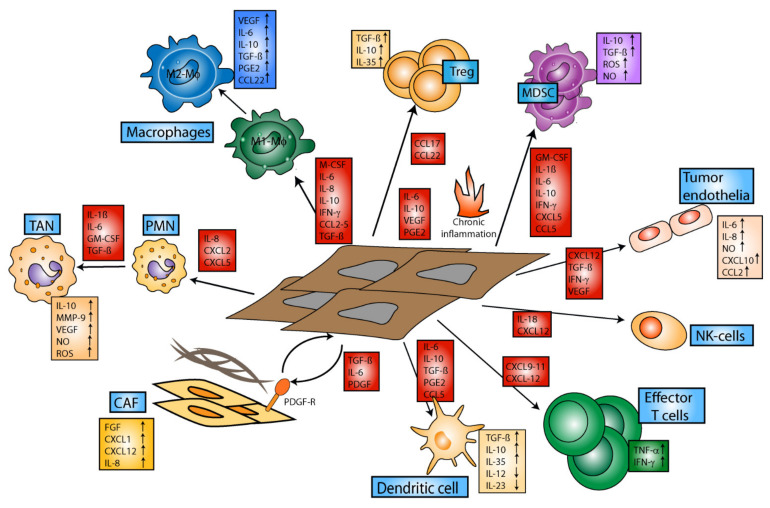
Figure 1
Figure 1
Tumor-induced immune modulation within the tumor microenvironment. Tumor cells secrete various cytokines, chemokines and soluble factors that generate a chronic inflammatory state within the TME that favors the accumulation of immunosuppressive cell types and impairs effector T cell function. Additionally, both immunosuppressive and effector immune cells, as well as non-immune cells such as cancer-associated fibroblasts and endothelial cells, contribute to the maintenance of this inflammatory micromilieu, hampering an effective anti-tumor immune response. Abbreviations: CAF = cancer-associated fibroblasts; IFN-g = interferon-gamma; Mo = macrophages; MDSCs = myeloid-derived suppressor cells; MMP-9 = matrix-metallopeptidase 9; NO = nitric oxide; PDGF-R = platelet-derived growth factor receptor; PGE2 = prostaglandine E2; PMN = polymorphonuclear neutrophils; ROS = reactive oxygen species; TAN = tumor-associated neutrophils; TGF-ß = transforming-growth factor beta; TNF-α = tumor necrosis factor alpha; VEGF = vascular endothelial growth factor.
Figure 2
Figure 2
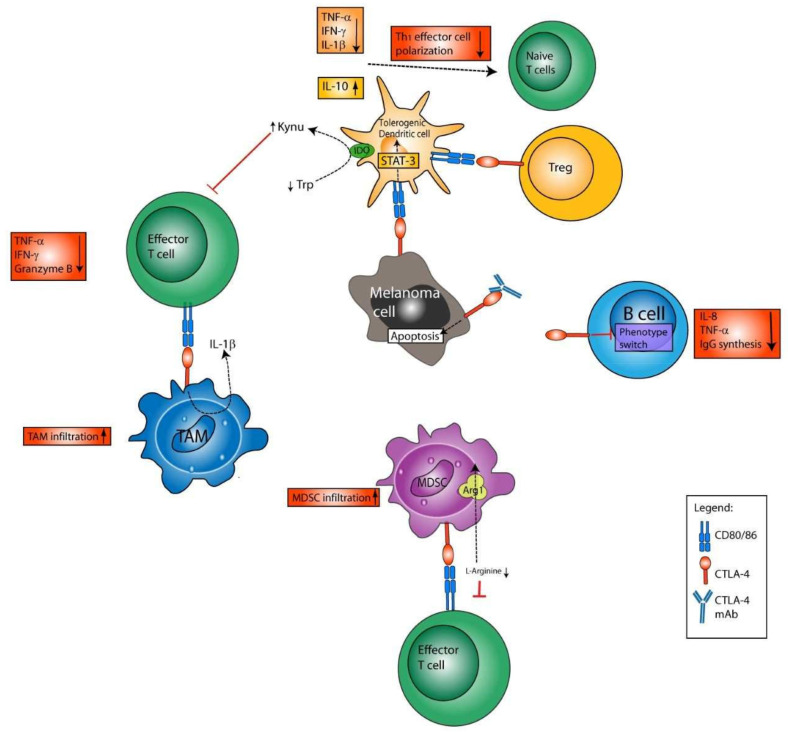
Immunomodulatory role of cytotoxic-T-lymphocyte antigen 4 (CTLA-4). CTLA-4 is expressed by regulatory T cells (Tregs), tumor-associated macrophages (TAM), myeloid-derived suppressor cells (MDSCs), dendritic cells (DCs), B cells and melanoma cells. The interaction of CTLA-4 on melanoma cells, as well as Tregs, with DC-bound CD80/CD86 resulted in the polarization of DCs towards a tolerogenic phenotype. Such DCs conferred depletion of tryptophan (Trp) from the microenvironment via IDO activation, and at the same time enhanced levels of Trp degradation products, termed kynurenins (Kynu). Both Trp depletion and Kynu impair activation/polarization of naïve T cells towards Th1 T effector cells and effector T cell functions. Further, tolerogenic DCs generate soluble anti-inflammatory agents, such as IL-10, which also contribute to T-cell impairment. Further, binding of CTLA-4 on TAMs and MDSCs with CD80/CD86 on T effector cells has been found to impair anti-tumor activity and enhance the infiltration of TAMs and MDSCs into the tumor microenvironment. Lastly, the binding of CTLA-4 on B cells, presumably via CD80/86 on activated T cells (not shown), has been found to reduce antibody synthesis and Ig class switch.
Figure 3
Figure 3
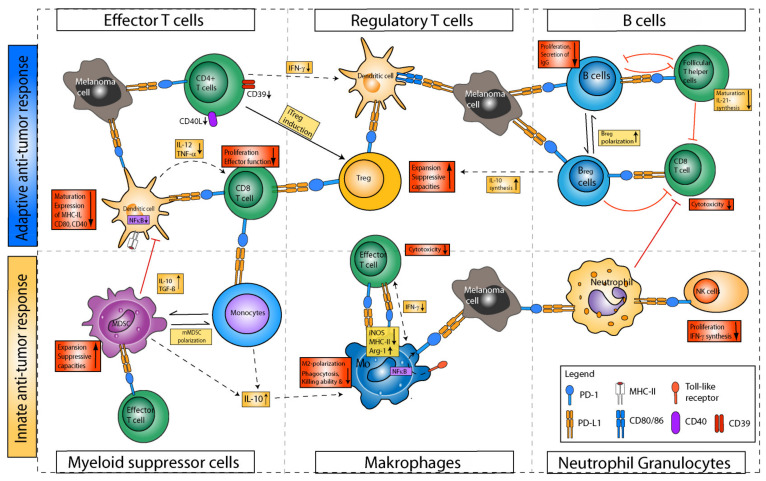
Immunomodulatory effects of the PD-1/PD-L1 axis. Besides CD8+ T cells, expression of checkpoint proteins PD-1 and PD-L1 has been reported on CD4+ T helper cells, regulatory T cells (Treg), B-cells, innate lymphoid cells, NK cells and various myeloid cells, such as dendritic cells (DC), macrophages, myeloid-derived suppressor-cells (MDSCs), polymorphonuclear neutrophils (PMNs) and monocytes. Overall, PD-1 expression on these immune cell types has been associated with an immunosuppressive phenotype impairing effector T cell functions, both directly, via ligand-–receptor interactions, and indirectly, by creating an immunosuppressive tumor microenvironment. For the majority of studies, these observations were made particularly under the conditions of an inflammatory microenvironment. In this schematic illustration, immunosuppressive activities conferred upon ligation of PD-1/PD-L1 are illustrated in bright red, while cytokine secretions induced via PD-1/PD-L1 signaling are pictured in yellow boxes. Indirect effects of PD-1/PD-L1 ligation are shown in dashed lines, while direct effects are illustrated without dashes.

References

    1. Schadendorf D., Hodi F.S., Robert C., Weber J.S., Margolin K., Hamid O., Patt D., Chen T.-T., Berman D.M., Wolchok J.D. Pooled Analysis of Long-Term Survival Data from Phase II and Phase III Trials of Ipilimumab in Unresectable or Metastatic Melanoma. J. Clin. Oncol. 2015;33:1889–1894. doi: 10.1200/JCO.2014.56.2736. - DOI - PMC - PubMed
    1. Franklin C., Livingstone E., Roesch A., Schilling B., Schadendorf D. Immunotherapy in melanoma: Recent advances and future directions. Eur. J. Surg. Oncol. 2017;43:604–611. doi: 10.1016/j.ejso.2016.07.145. - DOI - PubMed
    1. Carreau N.A., Pavlick A.C. Nivolumab and ipilimumab: Immunotherapy for treatment of malignant melanoma. Future Oncol. 2019;15:349–358. doi: 10.2217/fon-2018-0607. - DOI - PubMed
    1. Ottaviano M., Giunta E.F., Tortora M., Curvietto M., Attademo L., Bosso D., Cardalesi C., Rosanova M., De Placido P., Pietroluongo E., et al. BRAF Gene and Melanoma: Back to the Future. Int. J. Mol. Sci. 2021;22:3474. doi: 10.3390/ijms22073474. - DOI - PMC - PubMed
    1. Singh S., Numan A., Agrawal N., Tambuwala M.M., Singh V., Kesharwani P. Role of immune checkpoint inhibitors in the revolutionization of advanced melanoma care. Int. Immunopharmacol. 2020;83:106417. doi: 10.1016/j.intimp.2020.106417. - DOI - PubMed