Review
. 2022 Mar 30;14(7):1759.
doi: 10.3390/cancers14071759.

Lung Adenocarcinoma Tumor Origin: A Guide for Personalized Medicine

Affiliations
Review

Lung Adenocarcinoma Tumor Origin: A Guide for Personalized Medicine

Laetitia Seguin et al. Cancers (Basel). .

Abstract

Lung adenocarcinoma, the major form of lung cancer, is the deadliest cancer worldwide, due to its late diagnosis and its high heterogeneity. Indeed, lung adenocarcinoma exhibits pronounced inter- and intra-tumor heterogeneity cofounding precision medicine. Tumor heterogeneity is a clinical challenge driving tumor progression and drug resistance. Several key pieces of evidence demonstrated that lung adenocarcinoma results from the transformation of progenitor cells that accumulate genetic abnormalities. Thus, a better understanding of the cell of origin of lung adenocarcinoma represents an opportunity to unveil new therapeutic alternatives and stratify patient tumors. While the lung is remarkably quiescent during homeostasis, it presents an extensive ability to respond to injury and regenerate lost or damaged cells. As the lung is constantly exposed to potential insult, its regenerative potential is assured by several stem and progenitor cells. These can be induced to proliferate in response to injury as well as differentiate into multiple cell types. A better understanding of how genetic alterations and perturbed microenvironments impact progenitor-mediated tumorigenesis and treatment response is of the utmost importance to develop new therapeutic opportunities.

Keywords: LUAD; cell of origin; immune infiltration; lung progenitor; oncogenic driver.


Conflict of interest statement

The authors declare no conflict of interest.

Figures
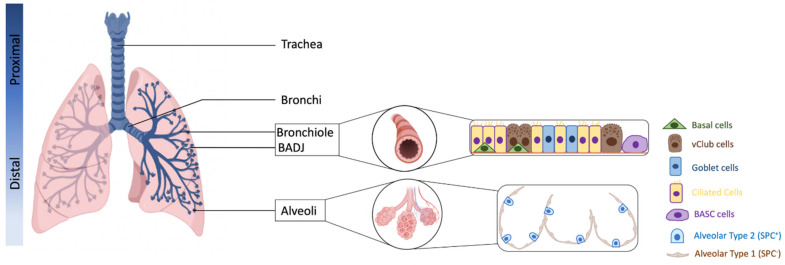
Figure 1
Figure 1
Schematic anatomy of the lung and cellular composition of the airway epithelium (created with BioRender.com, accessed on 15 February 2022).
Figure 2
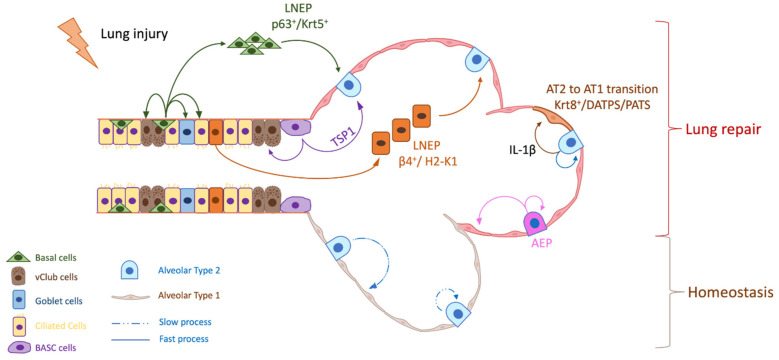
Figure 2
Multiple progenitors are involved in the lung epithelium repair mechanism (Created with BioRender.com, accessed on 15 February 2022). AEP: Alveolar Epithelial Progenitor, AT1: Alveolar Type 1, AT2: Alveolar Type 2, β4: Integrin Beta 4, DATPS: Damage-Associated Transient Progenitors, IL-1β: Interleukin 1 Beta, Krt5: Keratin 5, Krt8: Keratin 8, LNEP: Lineage-Negative Epithelial stem/Progenitor, PATS: Pre-Alveolar type-1 Transitional cell state, TSP1: Thrombospondin-1.
Figure 3
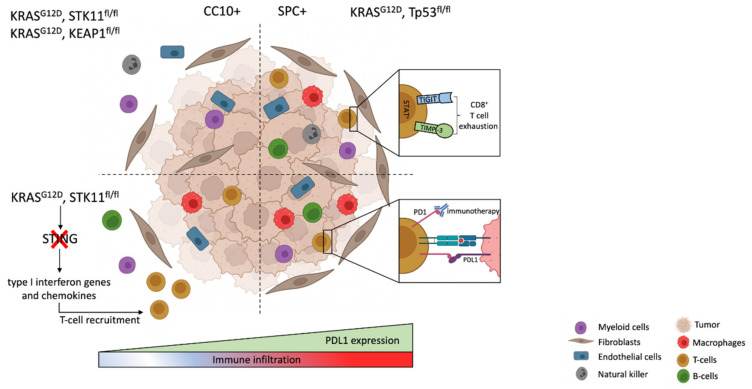
Figure 3
Cell of origin determines the immune microenvironment (created with BioRender.com, accessed on 15 February 2022).

References

    1. Chen Z., Fillmore C.M., Hammerman P.S., Kim C.F., Wong K.-K. Non-Small-Cell Lung Cancers: A Heterogeneous Set of Diseases. Nat. Rev. Cancer. 2014;14:535–546. doi: 10.1038/nrc3775. - DOI - PMC - PubMed
    1. Davidson M.R., Gazdar A.F., Clarke B.E. The Pivotal Role of Pathology in the Management of Lung Cancer. J. Thorac. Dis. 2013;5:S463–S478. doi: 10.3978/j.issn.2072-1439.2013.08.43. - DOI - PMC - PubMed
    1. Langer C.J., Besse B., Gualberto A., Brambilla E., Soria J.-C. The Evolving Role of Histology in the Management of Advanced Non-Small-Cell Lung Cancer. J. Clin. Oncol. 2010;28:5311–5320. doi: 10.1200/JCO.2010.28.8126. - DOI - PubMed
    1. Zito Marino F., Bianco R., Accardo M., Ronchi A., Cozzolino I., Morgillo F., Rossi G., Franco R. Molecular Heterogeneity in Lung Cancer: From Mechanisms of Origin to Clinical Implications. Int. J. Med. Sci. 2019;16:981–989. doi: 10.7150/ijms.34739. - DOI - PMC - PubMed
    1. Alexandrov L.B., Nik-Zainal S., Wedge D.C., Aparicio S.A.J.R., Behjati S., Biankin A.V., Bignell G.R., Bolli N., Borg A., Børresen-Dale A.-L., et al. Signatures of Mutational Processes in Human Cancer. Nature. 2013;500:415–421. doi: 10.1038/nature12477. - DOI - PMC - PubMed