


Advanced Bile Duct Cancers: A Focused Review on Current and Emerging Systemic Treatments
- PMID: 35406572
- PMCID: PMC8997852
- DOI: 10.3390/cancers14071800
Advanced Bile Duct Cancers: A Focused Review on Current and Emerging Systemic Treatments
Abstract
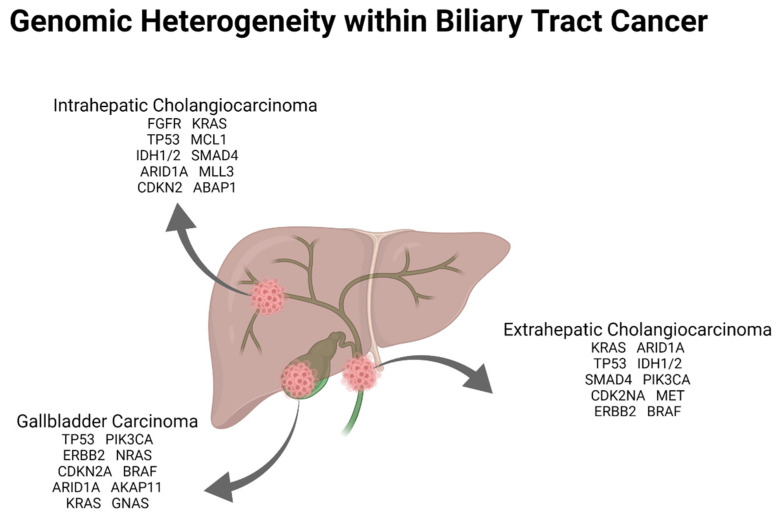
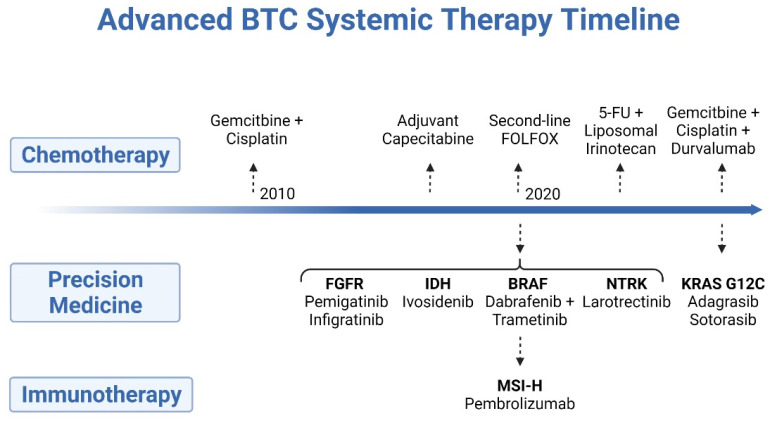
Cancers arising in the biliary tract are rare, with varied incidence depending on geographical location. As clinical presentation is typically vague with non-specific symptoms, a large proportion of patients present with unresectable or metastatic disease at diagnosis. When unresectable, the mainstay of treatment is cytotoxic chemotherapy; however, despite this, 5-year overall survival remains incredibly poor. Diagnostic molecular pathology, using next-generation sequencing, has identified a high prevalence of targetable alterations in bile duct cancers, which is transforming care. Substantial genomic heterogeneity has been identified depending on both the anatomical location and etiology of disease, with certain alterations enriched for subtypes. In addition, immune checkpoint inhibitors with anti-PD-1/PD-L1 antibodies in combination with chemotherapy are now poised to become the standard first-line treatment option in this disease. Here, we describe the established role of cytotoxic chemotherapy, targeted precision treatments and immunotherapy in what is a rapidly evolving treatment paradigm for advanced biliary tract cancer.
Keywords: cholangiocarcinoma; gallbladder cancer; immunotherapy; precision medicine; systemic therapy.
Conflict of interest statement
D.C. has no conflict of interest to declare. J.J.H. has received research funding from Bristol-Myers Squibb, Boehringer Ingelheim, Calithera, CytomX, Eli Lilly, Loxo, Genoscience, Novartis, Pfizer, Polaris, Yiviva, and Zymeworks and consulting from Adaptiimune, Bristol Myers Squib, Eisai, Exelexis, Eli Lilly, Imvax, Merck (DSMB), QED, and Zymeworks.
Figures
References
-
- Weinberg B.A., Xiu J., Lindberg M., Shields A.F., Hwang J.J., Poorman K., Salem M.E., Pishvaian M.J., Holcombe R.F., Marshall J.L., et al. Molecular profiling of biliary cancers reveals distinct molecular alterations and potential therapeutic targets. J. Gastrointest. Oncol. 2019;10:652–662. doi: 10.21037/jgo.2018.08.18. - DOI - PMC - PubMed
Publication types
Grants and funding
LinkOut - more resources
Full Text Sources
Research Materials
