Review
. 2022 Mar 29;11(7):1159.
doi: 10.3390/cells11071159.

STING Agonists/Antagonists: Their Potential as Therapeutics and Future Developments

Affiliations
Review

STING Agonists/Antagonists: Their Potential as Therapeutics and Future Developments

Danilo Guerini. Cells. .

Abstract

The cGAS STING pathway has received much attention in recent years, and it has been recognized as an important component of the innate immune response. Since the discovery of STING and that of cGAS, many observations based on preclinical models suggest that the faulty regulation of this pathway is involved in many type I IFN autoinflammatory disorders. Evidence has been accumulating that cGAS/STING might play an important role in pathologies beyond classical immune diseases, as in, for example, cardiac failure. Human genetic mutations that result in the activation of STING or that affect the activity of cGAS have been demonstrated as the drivers of rare interferonopathies affecting young children and young adults. Nevertheless, no data is available in the clinics demonstrating the therapeutic benefit in modulating the cGAS/STING pathway. This is due to the lack of STING/cGAS-specific low molecular weight modulators that would be qualified for clinical exploration. The early hopes to learn from STING agonists, which have reached the clinics in recent years for selected oncology indications, have not yet materialized since the initial trials are progressing very slowly. In addition, transforming STING agonists into potent selective antagonists has turned out to be more challenging than expected. Nevertheless, there has been progress in identifying novel low molecular weight compounds, in some cases with unexpected mode of action, that might soon move to clinical trials. This study gives an overview of some of the potential indications that might profit from modulation of the cGAS/STING pathway and a short overview of the efforts in identifying STING modulators (agonists and antagonists) suitable for clinical research and describing their potential as a "drug".

Keywords: STING; cGAS; drug discovery.


Conflict of interest statement

The author declares no conflict of interest. Author Danilo Guerini was employed by the company Novartis, AG.

Figures
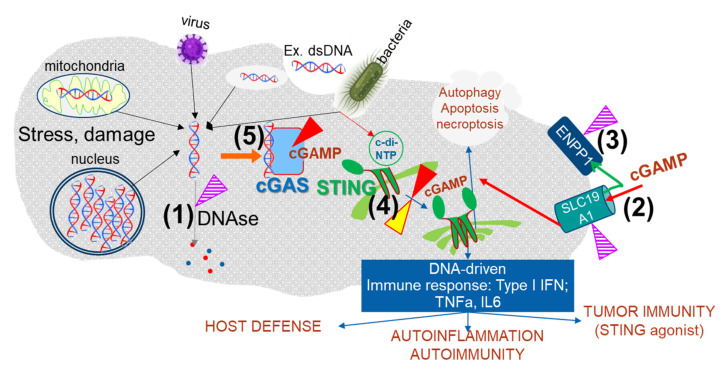
Figure 1
Figure 1
An increase in dsDNA in the cytosol can be the result of bacterial or viral infections. The entry of extracellular (ex.) DNA via endosomes results in the escape of partially digested DNA to the tightly controlled different DNAses, whose expression might vary from cell to cell. Bacteria might also activate the pathway by bypassing cGAS since cyclic dinucleotides produced by bacteria have been shown to bind to STING: cGAS (blue) is activated when cytosolic DNA is increased, and it synthetizes cGAMP. After binding cGAMP (red), STING dimerizes/multimerizes (green) and promotes the transcription of many cytokines belonging to the IFN type I family. The DNA-driven immune response is responsible for tumor immunity and plays a pivotal role in autoinflammation and autoimmunity. The cGAS/STING pathway can be modulated at different sites. Inhibition of the DNAses (1), the cGAMP transporters (shown using the example of SLC19A1) (2), or the cGAMP degrading enzymes ENPP1 (3) results in the increased activity of the pathway. Based on the current experience in drug discovery, it is unlikely that we will ever find low molecular weight compounds capable of stimulating at (1), (2), and (3); therefore, “inhibition” (violet-striped triangles) is to be considered the only therapeutic option. Using STING agonists (yellow triangle) (4) is the other option considered for activating the pathway. The activation of the cGAS/STING pathway has been shown to have a large potential for fighting tumors but might also be valuable in cases where a strong transient increase of the IFN response could help fight viral infection. Inhibition of the cGAS/STING pathway can be achieved with cGAS (5) or STING (4) specific inhibitors (red triangle). This intervention might be relevant for many autoinflammatory diseases that show an increase in IFN type I response. Evidence suggests that the cGAS/STING pathway controls autophagy and it has a role in apoptosis/necrosis. The relevance of these branches of the cGAS/STING pathway for their potential role in disease pathology is currently not well understood.

References

    1. Barber G.N. Innate immune DNA sensing pathways: STING, AIMII and the regulation of interferon production and inflammatory responses. Curr. Opin. Immunol. 2011;23:10–20. doi: 10.1016/j.coi.2010.12.015. - DOI - PMC - PubMed
    1. Ishikawa H., Barber G.N. STING is an endoplasmic reticulum adaptor that facilitates innate immune signalling. Nature. 2008;455:674–678. doi: 10.1038/nature07317. - DOI - PMC - PubMed
    1. Sun L., Wu J., Du F., Chen X., Chen Z.J. Cyclic GMP-AMP synthase is a cytosolic DNA sensor that activates the type I interferon pathway. Science. 2013;339:786–791. doi: 10.1126/science.1232458. - DOI - PMC - PubMed
    1. Cai X., Chiu Y.H., Chen Z.J. The cGAS-cGAMP-STING pathway of cytosolic DNA sensing and signaling. Mol. Cell. 2014;54:289–296. doi: 10.1016/j.molcel.2014.03.040. - DOI - PubMed
    1. Ishikawa H., Ma Z., Barber G.N. STING regulates intracellular DNA-mediated, type I interferon-dependent innate immunity. Nature. 2009;461:788–792. doi: 10.1038/nature08476. - DOI - PMC - PubMed
