


Comparative Clinical Value of Pharmacologic Therapies for B-Cell Chronic Lymphocytic Leukemia: An Umbrella Analysis
- PMID: 35407474
- PMCID: PMC8999707
- DOI: 10.3390/jcm11071868
Comparative Clinical Value of Pharmacologic Therapies for B-Cell Chronic Lymphocytic Leukemia: An Umbrella Analysis
Abstract
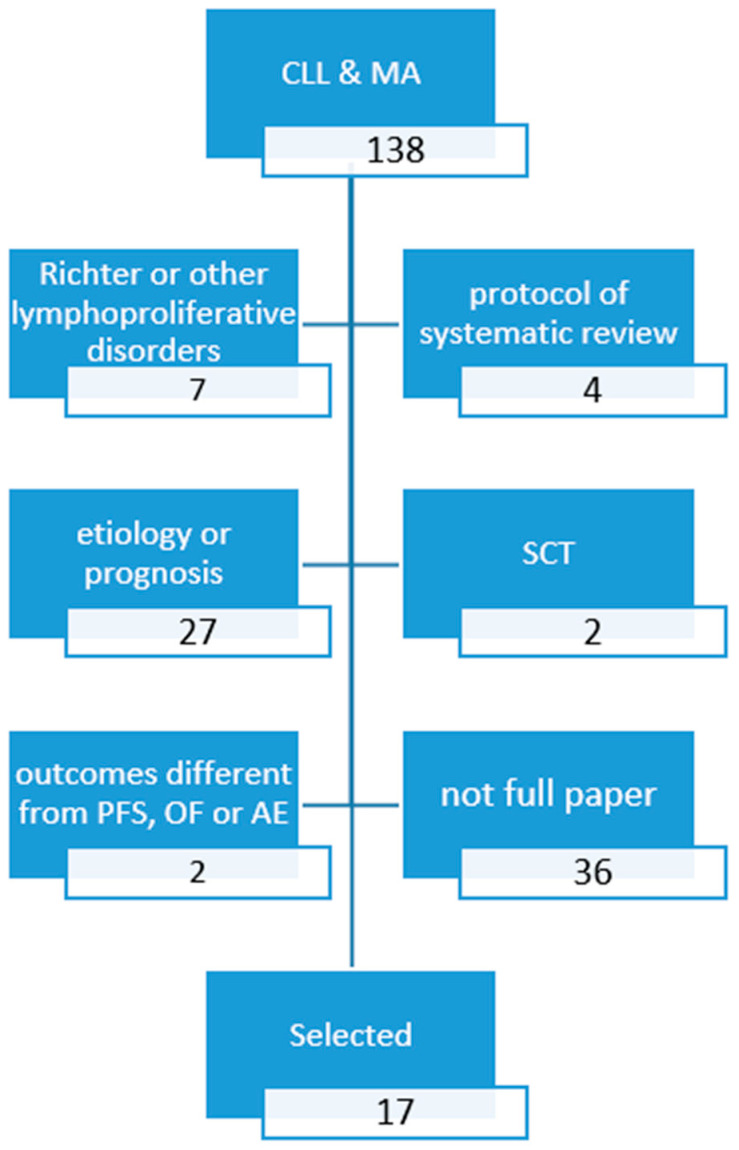
Several new drugs are progressively improving the life span of patients with B-cell chronic lymphocytic leukemia (CLL). However, the rapidly evolving standard of care precludes robust assessments of the incremental clinical value of further innovative drugs. Therefore, we systematically reviewed comparative evidence on newly authorized CLL drugs, as reported by standard and network meta-analyses (MA) published since 2016. Overall, 17 MAs addressed the relative survival or safety of naïve and/or refractory/relapsed (R/R) CLL patients. In R/R patients, therapies including BTK- and BCL2-inhibitors reported progression free survival (PFS) hazard ratios ranging from 0.08 to 0.24 (versus chemotherapy) and a significant advantage in overall survival (OS). In naïve patients, the PFS hazard ratios associated with four recent chemo-free therapies (obinutuzumab- and/or acalabrutinib-based) ranged from 0.11 to 0.61 versus current standard treatments (STs), without a significant OS advantage. Ten MAs addressed the risk of cardiovascular, bleeding, and infective events associated with BTK inhibitors, with some reporting a different relative safety in naïve and R/R patients. In conclusion, last-generation therapies for CLL consistently increase PFS, but not OS, and minimally decrease safety, as compared with STs. Based on available evidence, the patient-customized adoption of new therapies, rather than universal recommendations, seems desirable in CLL patients.
Keywords: acalabrutinib; chlorambucil; chronic lymphocytic leukemia; ibrutinib; meta-analysis; network meta-analysis; obinutuzumab; rituximab; venetoclax.
Conflict of interest statement
P.R., C.B. and M.C. have no conflict of interest to declare. M.M. received consultancy fees from Gilead Sciences SRL and speaker fees from Amgen.
Figures
References
-
- Weide R., Feiten S., Chakupurakal G., Friesenhahn V., Kleboth K., Köppler H., Lutschkin J., van Roye C., Thomalla J., Heymanns J. Survival improvement of patients with chronic lymphocytic leukemia (CLL) in routine care 1995–2007. Leuk. Lymphoma. 2020;61:557–566. doi: 10.1080/10428194.2019.1680840. - DOI - PubMed
-
- NCCN Guidelines for Professionals Chronic Lymphoytic Leukemia/Small Lymphocytic Lymphoma. Vers 2.2022. [(accessed on 27 January 2022)]. Available online: https://www.nccn.org/professionals/physician_gls/pdf/cll.pdf.
-
- Singh M., Mealing S., Baculea S., Cote S., Whelan J. Impact of novel agents on patient-relevant outcomes in patients with previously untreated chronic lymphocytic leukemia who are not eligible for fludarabine-based therapy. J. Med. Econ. 2017;20:1066–1073. doi: 10.1080/13696998.2017.1357563. - DOI - PubMed
-
- Mow E., Keech J., Naipaul R., Beca J.M., Gavura S., Kouroukis C.T. Impact of novel chronic lymphocytic leukemia drugs on public spending. J. Clin. Oncol. 2018;36((Suppl. S1)):103. doi: 10.1200/JCO.2018.36.30_suppl.103. - DOI
Publication types
LinkOut - more resources
Full Text Sources
