Review
. 2022 Mar 31;11(7):1938.
doi: 10.3390/jcm11071938.

Update of Pediatric Lipomatous Lesions: A Clinicopathological, Immunohistochemical and Molecular Overview

Affiliations
Review

Update of Pediatric Lipomatous Lesions: A Clinicopathological, Immunohistochemical and Molecular Overview

Eline Ameloot et al. J Clin Med. .

Abstract

Lipomatous neoplasms are a rare entity in the pediatric population, comprising less than 10% of soft tissue tumors in the first two decades of life. Some characteristics of pediatric adipocytic tumors are analogous to their adult counterparts, some pediatric lipomatous lesions however harbor unique features. In recent years, there have been significant advances in the understanding of the pathogenesis and hence in the classification and treatment of pediatric adipocytic tumors. This literature-based article will provide a review of the presently known clinicopathological, immunohistochemical and molecular features of pediatric lipomatous lesions.

Keywords: adipocytic; lipoblastoma; lipoblastomatosis; lipomatosis; liposarcoma; pediatric.


Conflict of interest statement

The authors declare no conflict of interest.

Figures
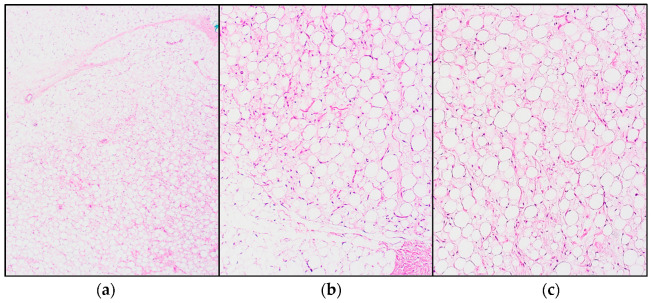
Figure 1
Figure 1
Histopathology of a lipoblastoma: (a) Overview showing lobulated sheets of adipocytes, separated by a fibrovascular septum (hematoxylin and eosin (H&E) staining); (b,c) Close up showing an image of the adipocytes with a spectrum of maturation, ranging from spindled mesenchymal cells to lipoblasts to mature adipocytes (H&E staining).
Figure 2
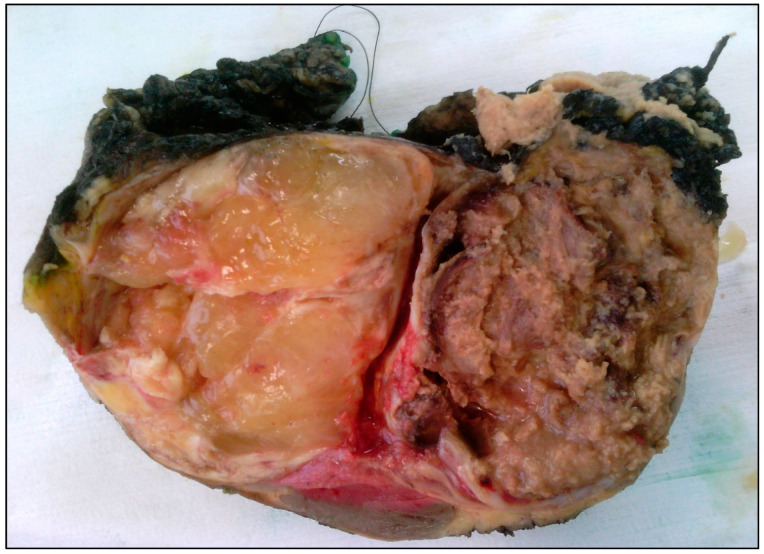
Figure 2
Macroscopic image of a pediatric low-grade myxoid liposarcoma, excised after neoadjuvant radiotherapy. On the left side of the specimen is a smooth, gelatinous area (characteristically seen in tumors of a lower grade). The right side of the specimen shows necrosis, as a result of the preoperative radiotherapy.
Figure 3
Figure 3
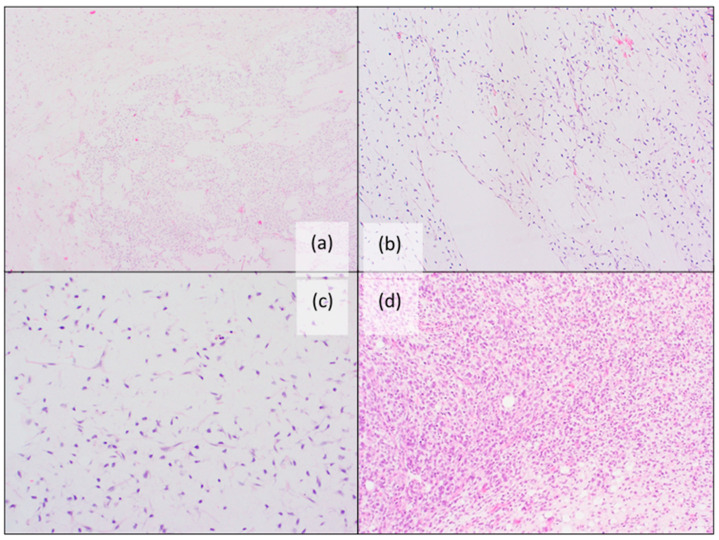
Histopathological features of myxoid liposarcoma: (a) Characteristic alveolar and edema-like growth pattern (H&E staining); (b,c) Myxoid stroma with arborizing “chicken-wire” vessels and lipoblasts (H&E staining); (d) High-grade MLPS with more than 5% cellular overlap, diminished myxoid matrix, less apparent capillary vasculature, a higher nuclear grade and increased mitotic activity (H&E staining).
Figure 4
Figure 4
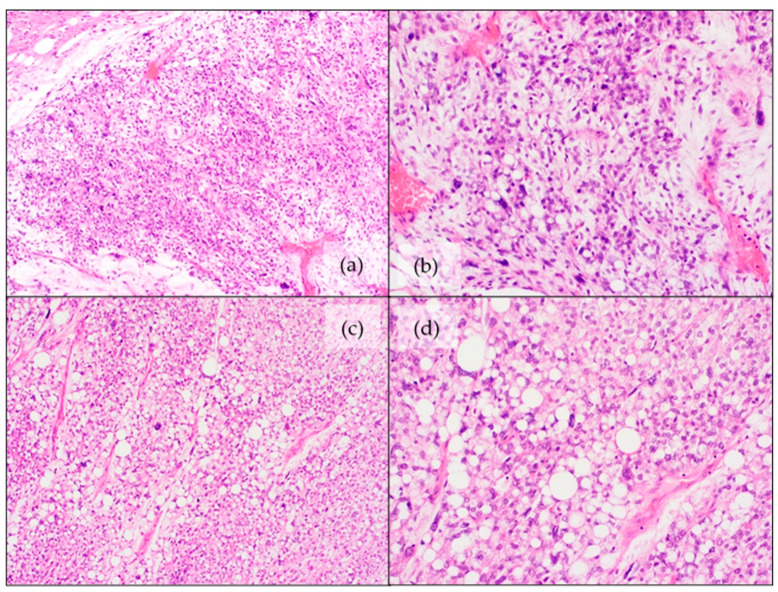
Histomorphological features of pleomorphic liposarcoma: (a,b) Overview and detail images with sporadic, pleomorphic lipoblasts (H&E staining); (c,d) Overview image and magnified displaying more pronounced pleomorphic lipoblasts (H&E staining).
Figure 5
Figure 5
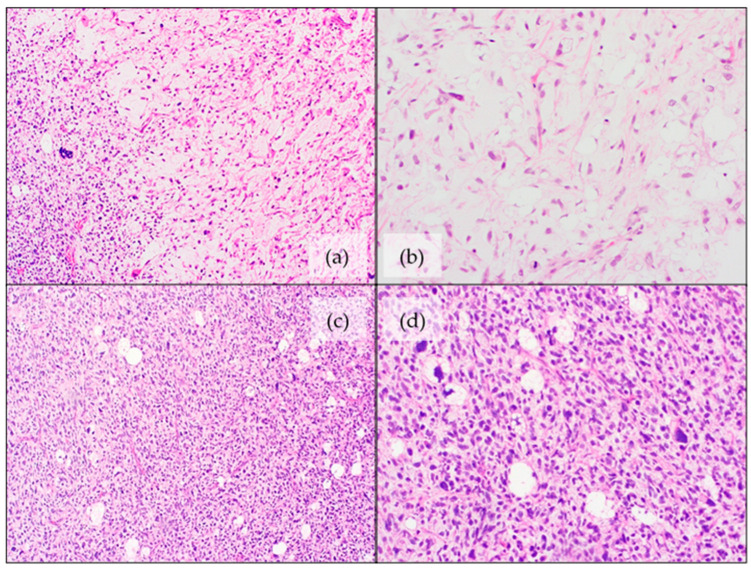
Histopathological features of myxoid pleomorphic liposarcoma: (a) Transition from a myxoid liposarcoma-like area to a pleomorphic liposarcoma-like area (H&E staining); (b) Detail image of myxoid liposarcoma-like zone with “chicken-wire” vessels and lipoblasts. There is “at random” atypia and increased mitotic activity (H&E staining); (c,d) Overview image and detailed image of pleomorphic liposarcoma-like area with severe cytonuclear atypia and pleomorphic lipoblasts (H&E staining).

References

    1. Coffin C.M., Alaggio R. Adipose and Myxoid Tumors of Childhood and Adolescence. Pediatr. Dev. Pathol. 2012;15:239–254. doi: 10.2350/10-05-0836-PB.1. - DOI - PubMed
    1. Han J.-W., Kim H., Youn J.K., Oh C., Jung S.-E., Park K.-W., Lee S.-C., Kim H.-Y. Analysis of clinical features of lipoblastoma in children. Pediatr. Hematol. Oncol. 2017;34:212–220. doi: 10.1080/08880018.2017.1354949. - DOI - PubMed
    1. Folpe A.L., Inwards C.Y. In: Bone and Soft Tissue Pathology E-Book: A Volume in the Foundations in Diagnostic Pathology Series. 2nd ed. Goldblum J.R., editor. Elsevier Health Sciences; Amsterdam, The Netherlands: 2022. p. 544.
    1. Coffin M.C., Lowichik A., Putnam A. Lipoblastoma (LPB): A clinicopathologic and immunohistochemical analysis of 59 cases. Am. J. Surg. Pathol. 2009;33:1705–1712. doi: 10.1097/PAS.0b013e3181b76462. - DOI - PubMed
    1. Mentzel T., Calonje E., Fletcher C.D. Lipoblastoma and lipoblastomatosis: A clinicopathological study of 14 cases. Histopathology. 1993;23:527–533. doi: 10.1111/j.1365-2559.1993.tb01238.x. - DOI - PubMed

LinkOut - more resources