Review
. 2022 Mar 22;23(7):3413.
doi: 10.3390/ijms23073413.

Toxic Potential of Cerrado Plants on Different Organisms

Affiliations
Review

Toxic Potential of Cerrado Plants on Different Organisms

Jamira Dias Rocha et al. Int J Mol Sci. .

Abstract

Cerrado has many compounds that have been used as biopesticides, herbicides, medicines, and others due to their highly toxic potential. Thus, this review aims to present information about the toxicity of Cerrado plants. For this purpose, a review was performed using PubMed, Science Direct, and Web Of Science databases. After applying exclusion criteria, 187 articles published in the last 20 years were selected and analyzed. Detailed information about the extract preparation, part of the plant used, dose/concentration tested, model system, and employed assay was provided for different toxic activities described in the literature, namely cytotoxic, genotoxic, mutagenic, antibacterial, antifungal, antiviral, insecticidal, antiparasitic, and molluscicidal activities. In addition, the steps to execute research on plant toxicity and the more common methods employed were discussed. This review synthesized and organized the available research on the toxic effects of Cerrado plants, which could contribute to the future design of new environmentally safe products.

Keywords: Brazilian savanna; chemical compounds; microorganisms; natural products; plant extract; tumor cells.


Conflict of interest statement

The authors report no conflicts of interest.

Figures

Figure 1
Figure 1
Summary of studies on the toxic activities of Cerrado plants included in the present review. The included manuscripts were screened to generate donut charts to visualize the proportions of (a) toxic activities studied, (b) plant families studied, (c) part of the plant studied, (d) type of extract or fraction studied, (e) classes of secondary metabolites studied, and (f) main techniques used to assess the toxicity of medicinal plants.
Figure 2
Figure 2
The bioactive properties of the Cerrado plant species that have been investigated in multiple studies. The most studied Cerrado species was Cochlospermum regium, while Eugenia dysenterica had the most diverse bioactive properties.
Figure 3
Figure 3
Most representative Cerrado species with toxic activity on different organisms according to this literature survey. (a) Cochlospermum regium (Mart. ex Schrank) Pilg. (“algodãozinho-do-campo”); (b) Annona crassiflora Mart (“araticum”); (c) Cupania cinerea Poepp. and Endl; (d) Casearia sylvestris Sw. var. sylvestris (“guaçatonga”); (e) Connarus suberosus Planch (“bico de papagaio”); (f) Solanum lycocarpum A.St.-Hil. (“lobeira”); (g) Eugenia dysenterica (Mart.) DC (“cagaita”); (h) Pyrostegia venusta (Ker Gawl.) Miers (“cipó-de-são-joão”); (i) Serjania lethalis A.St.-Hil. (“cipó-timbó”); (j) Lafoensia pacari A.St.-Hil. (“pacari”); and (k) Stryphnodendron adstringens (Mart.) Coville (“barbatimão”). All photographs were obtained from the Herbário da Universidade Estadual de Goiás (HUEG) and are available at https://www.gbif.org/pt/dataset/bbb1f181-3221-4a10-ad52-14f1da0dca26 (accessed on 23 October 2021).
Figure 4
Figure 4
Heatmap of the plant families included in the present review grouped according to the frequency of the important bioactive properties associated with each family.
Figure 5
Figure 5
Proposed workflow for the effective study of plant toxicity. The study of plant toxicity should be carefully designed with the following steps carefully considered: (a) Selection of species according to plant availability, chemotaxonomy/phylogenetics, or ethnopharmacology. (b) Selection of the part of the plant to be used. It is important to understand that environmental factors also affect the production of secondary metabolites in different parts of the plant. (c) Identification of species, collection, and deposition of the exsiccate into an herbarium. (d) Obtainment of extracts by percolation, Soxhlet extractor, or acid-base strategies. Various quality parameters are used to standardize the preparation of samples (pH, solids content, density, content of chemical markers, and viscosity). At this stage, it is common to investigate the chemical constituents of the extract. (e) Toxicological analysis of the plant material using different experimental methods (in silico, in vitro, and/or in vivo).
Figure 6
Figure 6
Mechanisms of action of secondary metabolites with cytotoxic effects. Secondary metabolites can interact specifically or not specifically with biomolecules, biomembranes, and other cellular components, disturbing the vital components of the cell.
Figure 7
Figure 7
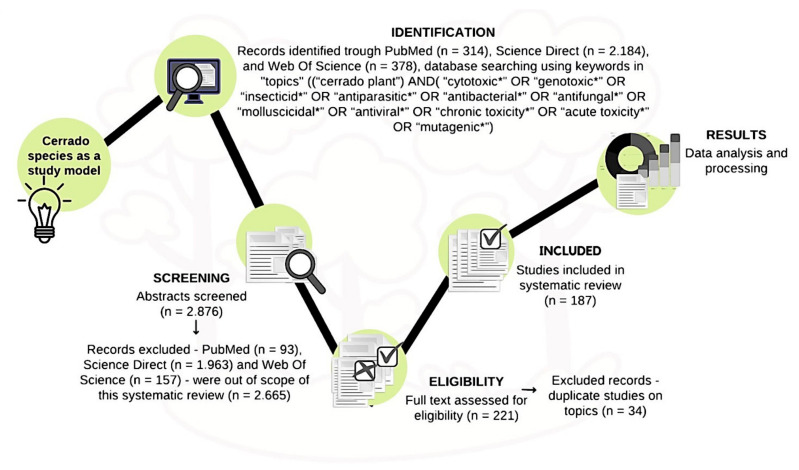
The experimental workflow used in the present review to identify articles containing information about Cerrado plants with toxic bioactivities. The workflow involved the identification, screening, eligibility assessment, and inclusion of available manuscripts from several online databases. During the search for the terms in the databases, the asterisk (*) was used as a wildcard and enabled the search of any letters in its place.

References

    1. Croteau R., Kutchan T.M., Lewis N.G. Natural Products (Secondary Metabolites) In: Buchanan B.B., Gruissem W., Jones R.L., editors. Biochemistry & Molecular Biology of Plants. American Society of Plant Physiologists; Rockville, MD, USA: 2000. pp. 1250–1318.
    1. Shakya P., Marslin G., Siram K., Beerhues L., Franklin G. Elicitation as a tool to improve the profiles of high-value secondary metabolites and pharmacological properties of Hypericum perforatum. J. Pharm. Pharmacol. 2019;71:70–82. doi: 10.1111/jphp.12743. - DOI - PMC - PubMed
    1. Madariaga-Mazón A., Osnaya-Hernández A., Chávez-Gómez A., García-Ramos J.C., Cortés-Guzmán F., Castillo-Pazos D.J., Martínez-Mayorga K. Distribution of toxicity values across different species and modes of action of pesticides from PESTIMEP and PPDB databases. Toxicol. Res. 2019;8:146–156. doi: 10.1039/C8TX00322J. - DOI - PMC - PubMed
    1. Da Costa R.C., Santana D.B., Araújo R.M., De Paula J.E., Do Nascimento P.C., Lopes N.P., Braz-Filho R., Espindola L.S. Discovery of the rapanone and suberonone mixture as a motif for leishmanicidal and antifungal applications. Bioorganic Med. Chem. 2014;22:135–140. doi: 10.1016/j.bmc.2013.11.044. - DOI - PubMed
    1. Rattan R.S. Mechanism of action of insecticidal secondary metabolites of plant origin. Crop. Prot. 2010;29:913–920. doi: 10.1016/j.cropro.2010.05.008. - DOI

LinkOut - more resources