Review
. 2022 Mar 24;23(7):3542.
doi: 10.3390/ijms23073542.

Polyploidy as a Fundamental Phenomenon in Evolution, Development, Adaptation and Diseases

Affiliations
Review

Polyploidy as a Fundamental Phenomenon in Evolution, Development, Adaptation and Diseases

Olga V Anatskaya et al. Int J Mol Sci. .

Abstract

DNA replication during cell proliferation is 'vertical' copying, which reproduces an initial amount of genetic information. Polyploidy, which results from whole-genome duplication, is a fundamental complement to vertical copying. Both organismal and cell polyploidy can emerge via premature cell cycle exit or via cell-cell fusion, the latter giving rise to polyploid hybrid organisms and epigenetic hybrids of somatic cells. Polyploidy-related increase in biological plasticity, adaptation, and stress resistance manifests in evolution, development, regeneration, aging, oncogenesis, and cardiovascular diseases. Despite the prevalence in nature and importance for medicine, agri- and aquaculture, biological processes and epigenetic mechanisms underlying these fundamental features largely remain unknown. The evolutionarily conserved features of polyploidy include activation of transcription, response to stress, DNA damage and hypoxia, and induction of programs of morphogenesis, unicellularity, and longevity, suggesting that these common features confer adaptive plasticity, viability, and stress resistance to polyploid cells and organisms. By increasing cell viability, polyploidization can provide survival under stressful conditions where diploid cells cannot survive. However, in somatic cells it occurs at the expense of specific function, thus promoting developmental programming of adult cardiovascular diseases and increasing the risk of cancer. Notably, genes arising via evolutionary polyploidization are heavily involved in cancer and other diseases. Ploidy-related changes of gene expression presumably originate from chromatin modifications and the derepression of bivalent genes. The provided evidence elucidates the role of polyploidy in evolution, development, aging, and carcinogenesis, and may contribute to the development of new strategies for promoting regeneration and preventing cardiovascular diseases and cancer.

Keywords: adaptation; aging; biological plasticity; carcinogenesis; cardiovascular disease; complexity; developmental programming; epigenetic changes; evolutionary conserved features; polyploidy; regeneration; stress resistance.


Conflict of interest statement

The authors declare no conflict of interest.

Figures
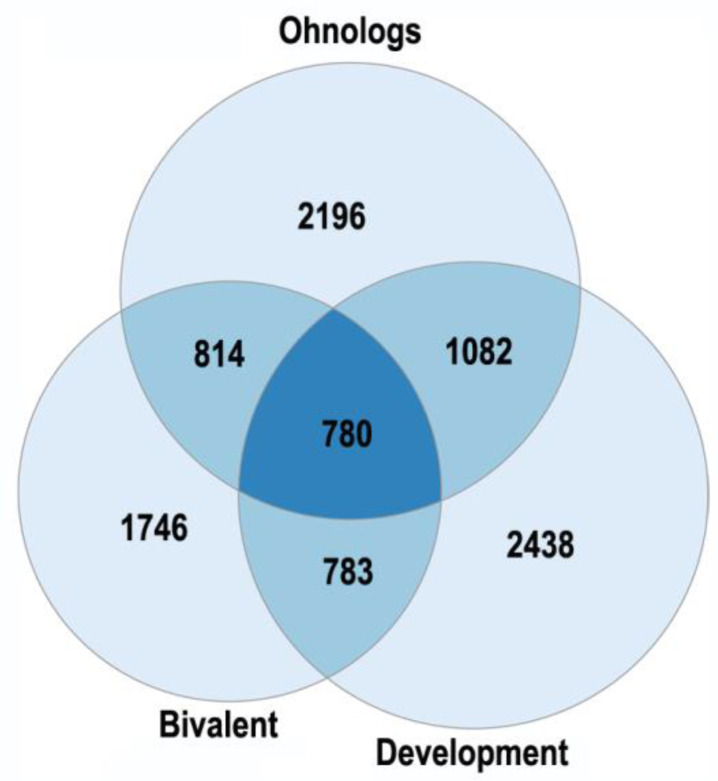
Figure 1
Figure 1
The enrichment of human ohnologs in bivalent genes and genes involved in multicellular organism development GO:0007275. Bivalent: p < 10−151, development: p < 10−67. The ohnologs (strict) were from [14]. The bivalent genes (Fantom-confirmed) were from [30]. The enrichment analysis was conducted as in [32].
Figure 2
Figure 2
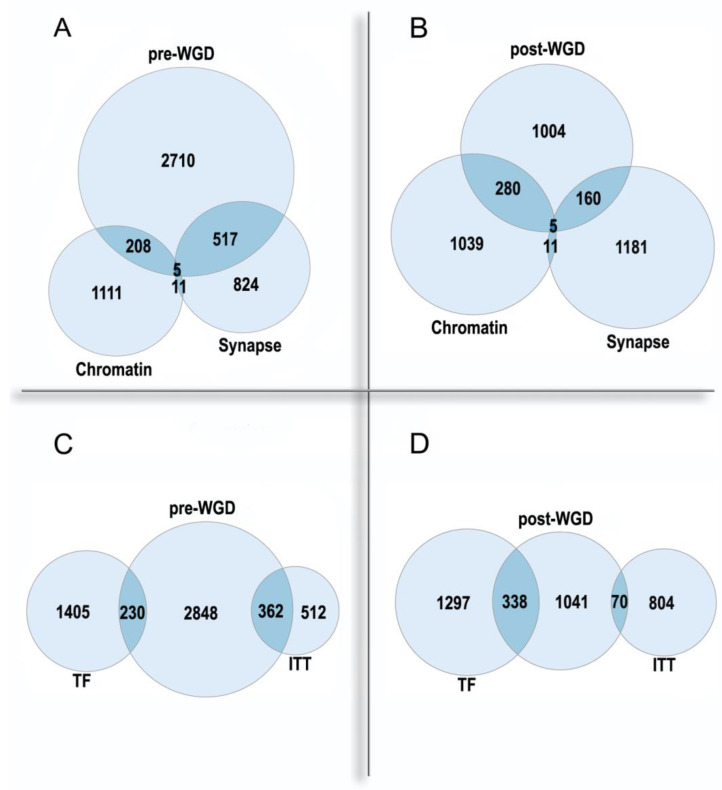
The enrichment of pre-WGD and post-WGD human ohnologs in functional gene groups. (A,B)—nuclear chromatin GO:0000790 and synapse GO:0045202. Chromatin: underrepresentation p < 0.01 in pre-WGD, enrichment p < 10−61 in post-WGD. Synapse: enrichment p < 10−71 in pre-WGD; enrichment p < 10−8 in post-WGD. (C,D)—transcription factors (TF) and ion transmembrane transporter activity GO:0015075 (ITT). TF: underrepresentation p < 10−7 in pre-WGD, enrichment p < 10−74 in post-WGD. ITT: enrichment p < 10−56 in pre-WGD, not significant p > 0.4 in post-WGD. Albeit both pre-WGD and post-WGD ohnologs are enriched in the synapse genes, there are significant differences in binomial proportions between pre-WGD and post-WGD ohnologs (p < 10−15). The pre-WGD and post-WGD ohnologs were from [33]. The transcription factors were from [34].
Figure 3
Figure 3
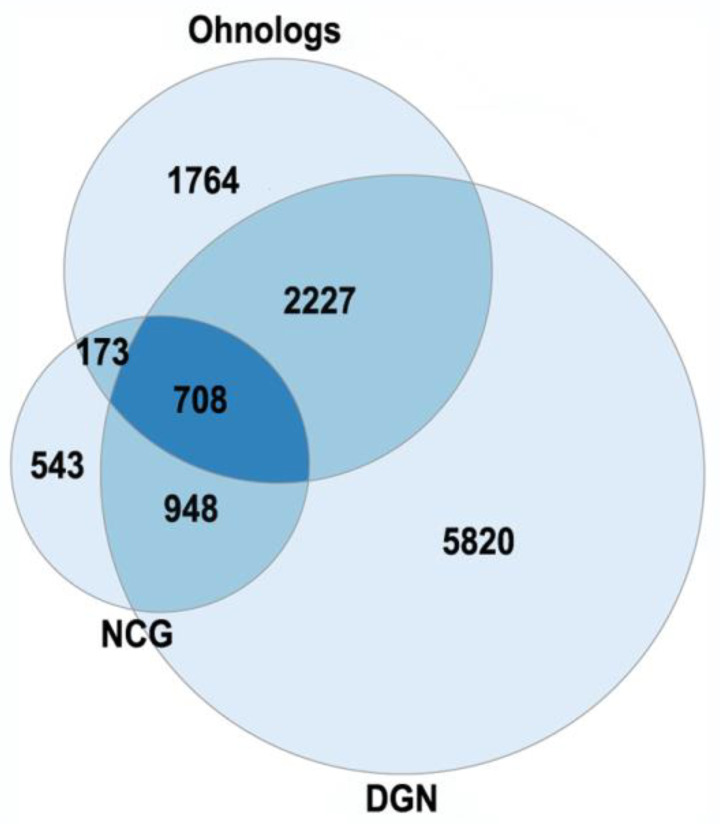
The enrichment of human ohnologs in Network of Cancer Genes (NCG) and Disease Gene Network (DGN). NCG: p < 10−46, DGN: p < 10−107. The NCG were from [54], the DGN (curated part) were from [55].
Figure 4
Figure 4
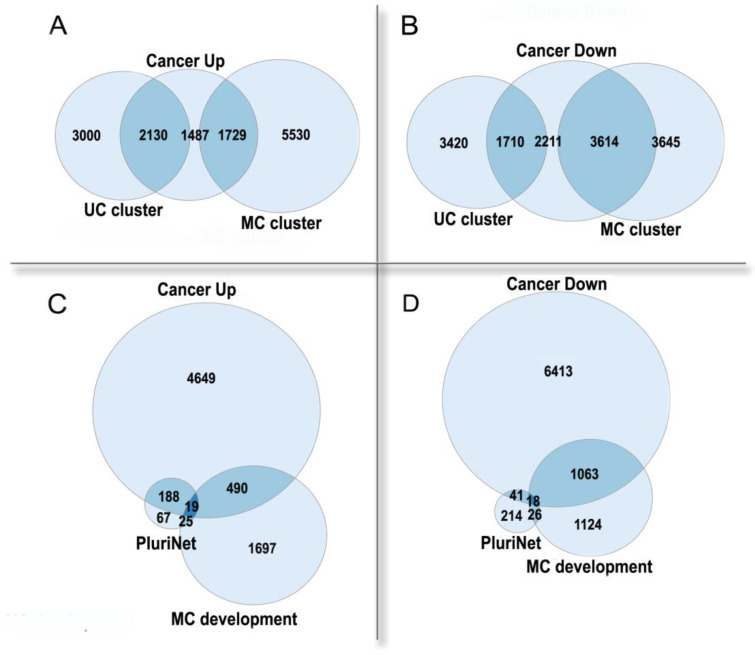
The enrichment of human genes, which are up- or down-regulated in polyploid cancer cells as compared with diploid cells of the same cancer, in functional gene groups. (A,B)—unicellular (UC) and multicellular (MC) giant clusters of interactome.UC cluster: enrichment p < 10−157 in Up, underrepresentation p < 10−15 in Down.MC cluster: underrepresentation p < 10−14 in Up, enrichment p < 10−145 in Down. (C,D)—pluripotency signature (PluriNet) and regulation of multicellular organismal development GO:2000026 (MC development). PluriNet: enrichment p < 10−51 in Up, underrepresentation p < 10−11 in Down. MC development: underrepresentation p < 10−5 in Up; enrichment p < 10−28 in Down. The up- or down-regulated genes in polyploid cancer cells were from [69], which was based on the analysis of about ten thousand cancer samples. The UC and MC cluster genes were from [12], the PluriNet genes were from MSigDB [70].
Figure 5
Figure 5
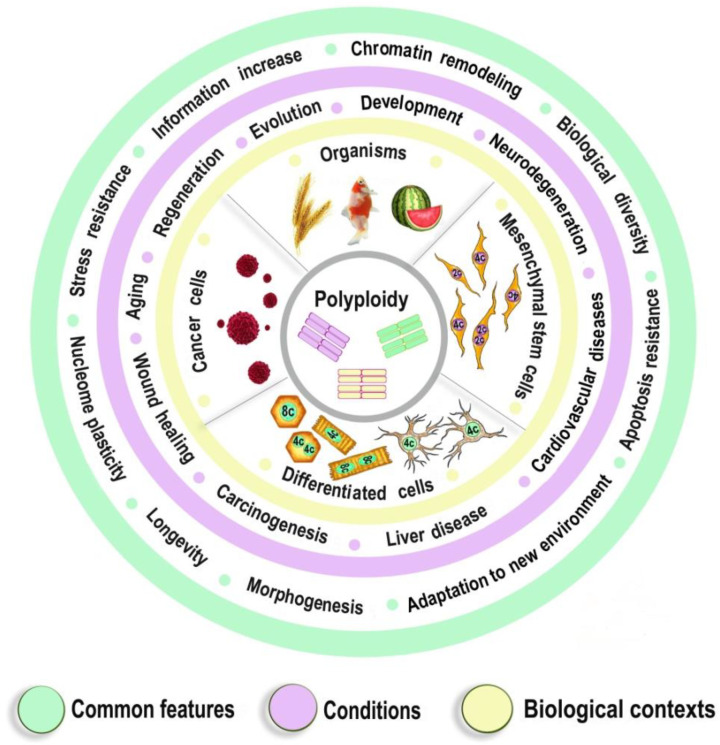
The most important Common features of polyploidy found at various physiological conditions and in different biological contexts.
Figure 6
Figure 6
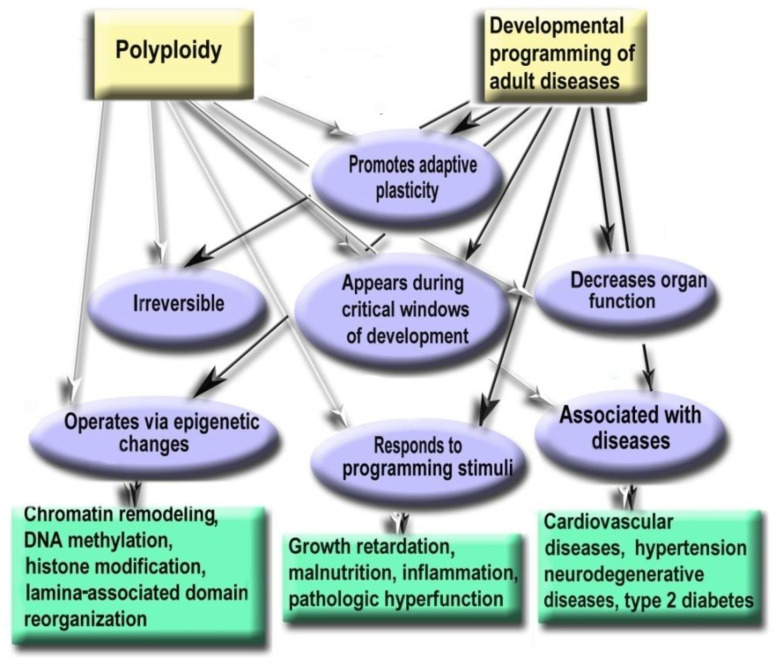
Polyploidy and developmental programming of adult diseases show similar properties.

References

    1. Gjelsvik K.J., Besen-McNally R., Losick V.P. Solving the Polyploid Mystery in Health and Disease. Trends Genet. 2019;35:6–14. doi: 10.1016/j.tig.2018.10.005. - DOI - PMC - PubMed
    1. Donne R., Saroul-Aïnama M., Cordier P., Celton-Morizur S., Desdouets C. Polyploidy in Liver Development, Homeostasis and Disease. Nat. Rev. Gastroenterol. Hepatol. 2020;17:391–405. doi: 10.1038/s41575-020-0284-x. - DOI - PubMed
    1. Fox D.T., Soltis D.E., Soltis P.S., Ashman T.-L., Van de Peer Y. Polyploidy: A Biological Force From Cells to Ecosystems. Trends Cell Biol. 2020;30:688–694. doi: 10.1016/j.tcb.2020.06.006. - DOI - PMC - PubMed
    1. Dörnen J., Sieler M., Weiler J., Keil S., Dittmar T. Cell Fusion-Mediated Tissue Regeneration as an Inducer of Polyploidy and Aneuploidy. Int. J. Mol. Sci. 2020;21:1811. doi: 10.3390/ijms21051811. - DOI - PMC - PubMed
    1. Van de Peer Y., Mizrachi E., Marchal K. The Evolutionary Significance of Polyploidy. Nat. Rev. Genet. 2017;18:411–424. doi: 10.1038/nrg.2017.26. - DOI - PubMed