Review
. 2022 Mar 25;23(7):3609.
doi: 10.3390/ijms23073609.

Mechanistic Insights into Selective Autophagy Subtypes in Alzheimer's Disease

Affiliations
Review

Mechanistic Insights into Selective Autophagy Subtypes in Alzheimer's Disease

Xinjie Guan et al. Int J Mol Sci. .

Abstract

Eukaryotic cells possess a plethora of regulatory mechanisms to maintain homeostasis and ensure proper biochemical functionality. Autophagy, a central, conserved self-consuming process of the cell, ensures the timely degradation of damaged cellular components. Several studies have demonstrated the important roles of autophagy activation in mitigating neurodegenerative diseases, especially Alzheimer's disease (AD). However, surprisingly, activation of macroautophagy has not shown clinical efficacy. Hence, alternative strategies are urgently needed for AD therapy. In recent years, selective autophagy has been reported to be involved in AD pathology, and different subtypes have been identified, such as aggrephagy, mitophagy, reticulophagy, lipophagy, pexophagy, nucleophagy, lysophagy and ribophagy. By clarifying the underlying mechanisms governing these various subtypes, we may come to understand how to control autophagy to treat AD. In this review, we summarize the latest findings concerning the role of selective autophagy in the pathogenesis of AD. The evidence overwhelmingly suggests that selective autophagy is an active mechanism in AD pathology, and that regulating selective autophagy would be an effective strategy for controlling this pathogenesis.

Keywords: Alzheimer’s disease; aggrephagy; lipophagy; lysophagy; mitophagy; nucleophagy; pexophagy; reticulophagy; ribophagy; selective autophagy.


Conflict of interest statement

The authors declare that they have no conflict of interest.

Figures
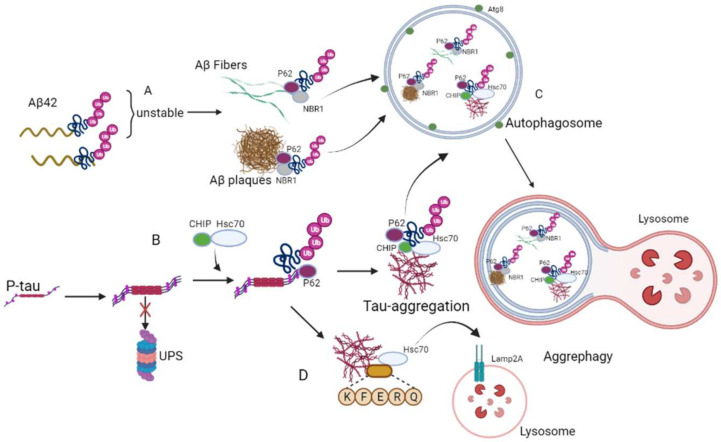
Figure 1
Figure 1
Mechanism of aggrephagy during the occurrence of AD. (A) Polyubiquitinated Aβ plaques and fibers binds to p62 and NBR1 specifically, and initiate degradation through aggrephagy. (B) Hsc70 interacts with CHIP to regulate tau ubiquitination and then is recruited by p62. (C) All these aggregate proteins are wrapped by autophagosomes for degradation. (D) KFERQ binds with tau aggregates and is transferred to the lysosome by the Lamp2A receptor for degradation.
Figure 2
Figure 2
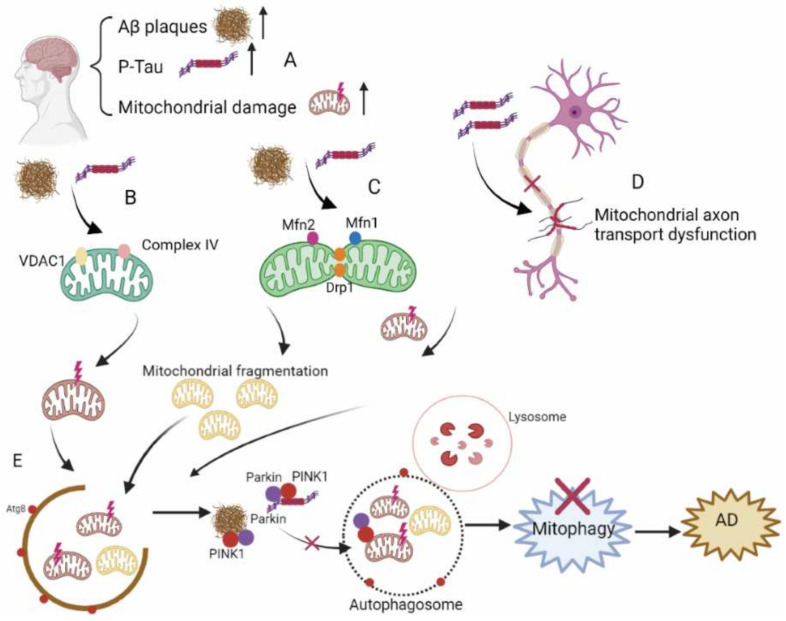
Mitophagy in the pathogenesis of AD. (A) Impairment of the mitochondria occurs in the early stages of AD, and Aβ and P-tau are increased. (B) Aβ and P-tau interact with VDAC1 and Complex IV, and interfere with mitochondrial function. (C) Aβ and P-tau induce mitochondrial fragmentation by reducing MFN1/2 and activating Drp1. (D) Hyperphosphorylation of tau blocks the binding of tau with microtubules, disrupting mitochondrial axon transport. (E) Aβ and P-tau disturb the recruitment of PINK1 and Parkin, causing mitophagy dysfunction.
Figure 3
Figure 3
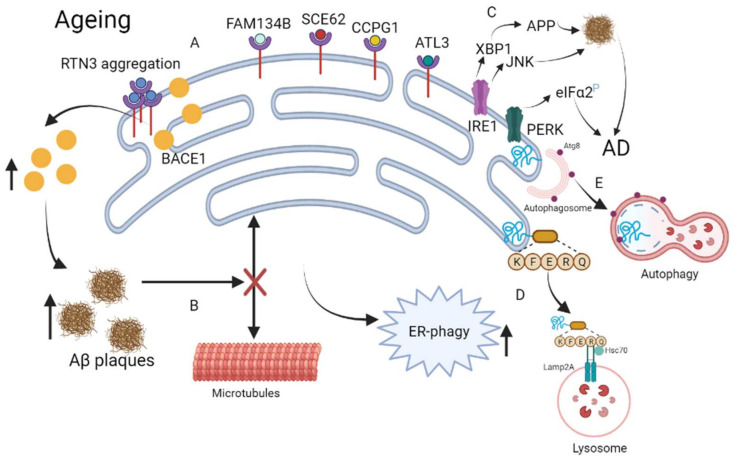
Reticulophagy in the pathogenesis of AD. (A) RTN3 aggregation counteracts the negative regulation of BACE1 activity by RTN3, causing Aβ to increase in the aging brain. (B) Deposition of Aβ inhibits the interaction of the ER and microtubules, inducing reticulophagy. (C) ER stress/AD factors increase misfolded proteins through the IRE1 and PERK pathway. (D) KFERQ binds with impaired ER for CMA degradation. (E) Autophagosomes wrap the impaired ER for degradation.

References

    1. Moreira P.I., Santos R.X., Zhu X., Lee H.G., Smith M.A., Casadesus G., Perry G. Autophagy in Alzheimer’s disease. Expert Rev. Neurother. 2010;10:1209–1218. doi: 10.1586/ern.10.84. - DOI - PubMed
    1. Querfurth H.W., LaFerla F.M. Alzheimer’s disease. N. Engl. J. Med. 2010;362:329–344. doi: 10.1056/NEJMra0909142. - DOI - PubMed
    1. Selkoe D.J., Hardy J. The amyloid hypothesis of Alzheimer’s disease at 25 years. EMBO Mol. Med. 2016;8:595–608. doi: 10.15252/emmm.201606210. - DOI - PMC - PubMed
    1. Dorszewska J., Prendecki M., Oczkowska A., Dezor M., Kozubski W. Molecular Basis of Familial and Sporadic Alzheimer’s Disease. Curr. Alzheimer Res. 2016;13:952–963. doi: 10.2174/1567205013666160314150501. - DOI - PubMed
    1. Kelley B.J., Petersen R.C. Alzheimer’s disease and mild cognitive impairment. Neurol. Clin. 2007;25:577–609. doi: 10.1016/j.ncl.2007.03.008. - DOI - PMC - PubMed