. 2022 Mar 29;23(7):3774.
doi: 10.3390/ijms23073774.

A Liquid Biopsy-Based Approach for Monitoring Treatment Response in Post-Operative Colorectal Cancer Patients

Affiliations

A Liquid Biopsy-Based Approach for Monitoring Treatment Response in Post-Operative Colorectal Cancer Patients

Barbara Kinga Barták et al. Int J Mol Sci. .

Abstract

Monitoring the therapeutic response of colorectal cancer (CRC) patients is crucial to determine treatment strategies; therefore, we constructed a liquid biopsy-based approach for tracking tumor dynamics in non-metastatic (nmCRC) and metastatic (mCRC) patients (n = 55). Serial blood collections were performed during chemotherapy for measuring the amount and the global methylation pattern of cell-free DNA (cfDNA), the promoter methylation of SFRP2 and SDC2 genes, and the plasma homocysteine level. The average cfDNA amount was higher (p < 0.05) in nmCRC patients with recurrent cancer (30.4 ± 17.6 ng) and mCRC patients with progressive disease (PD) (44.3 ± 34.5 ng) compared to individuals with remission (13.2 ± 10.0 ng) or stable disease (12.5 ± 3.4 ng). More than 10% elevation of cfDNA from first to last sample collection was detected in all recurrent cases and 92% of PD patients, while a decrease was observed in most patients with remission. Global methylation level changes indicated a decline (75.5 ± 3.4% vs. 68.2 ± 8.4%), while the promoter methylation of SFRP2 and SDC2 and homocysteine level (10.9 ± 3.4 µmol/L vs. 13.7 ± 4.3 µmol/L) presented an increase in PD patients. In contrast, we found exact opposite changes in remission cases. Our study offers a more precise blood-based approach to monitor the treatment response to different chemotherapies than the currently used markers.

Keywords: DNA methylation; cell-free DNA; colorectal cancer; homocysteine; therapeutic response.


Conflict of interest statement

The authors declare no conflict of interest.

Figures
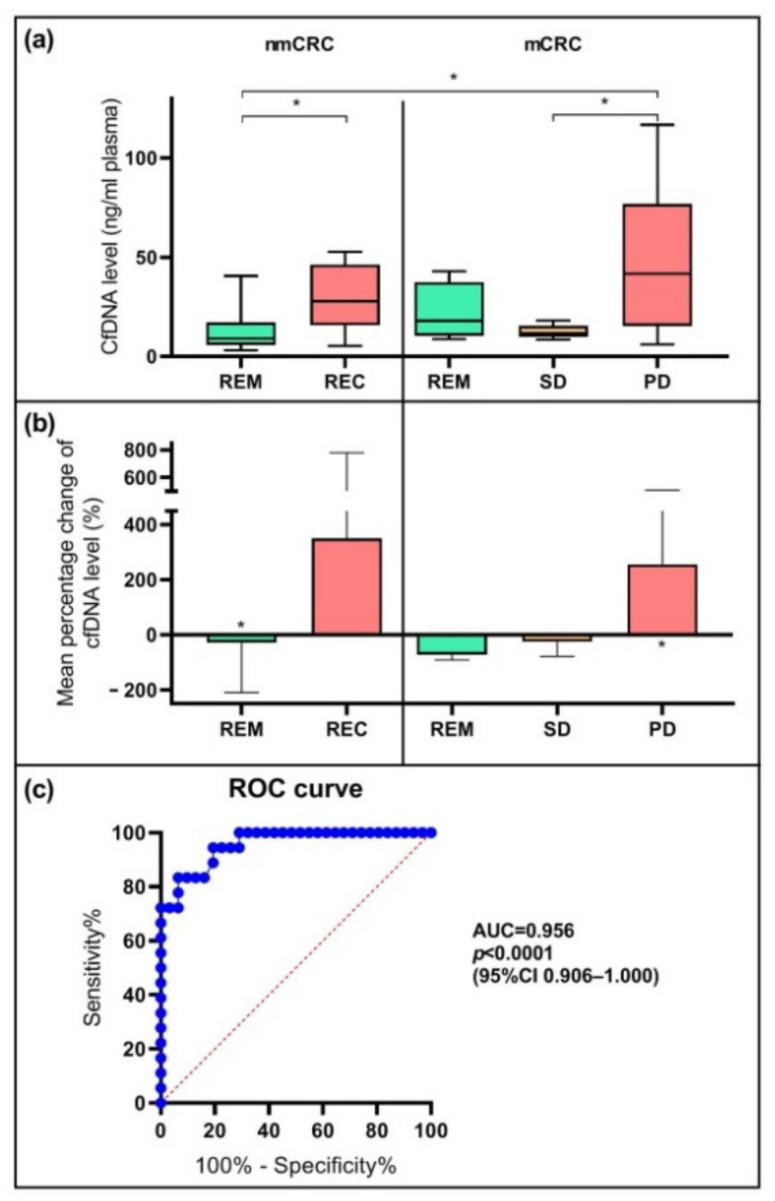
Figure 1
Figure 1
The diagnostic power of cfDNA. (a) Mean cfDNA amount (ng/mL plasma) in the plasma of CRC patient subgroups. Significantly different (* p < 0.05) cfDNA levels were noticed comparing recurrence (REC) and progressive disease (PD) vs. remission (REM) cases and progressive disease vs. stable disease (SD) among patients with metastatic CRC. (b) The mean percentage change (%) of cfDNA from first to last sample collection in the different CRC subgroups. Significant (* p < 0.05) cfDNA level elevation was observed in the case of PD between the first and last sample collection time, while an opposite trend was described in individuals with REM. (c) ROC curve analysis of cfDNA amount measured at study end indicated a sensitivity of 83% and specificity of 94% (AUC = 0.956, 95%CI 0.906–1.000, p < 0.0001) for the discrimination between individuals achieving remission and patients showing tumor progression.
Figure 2
Figure 2
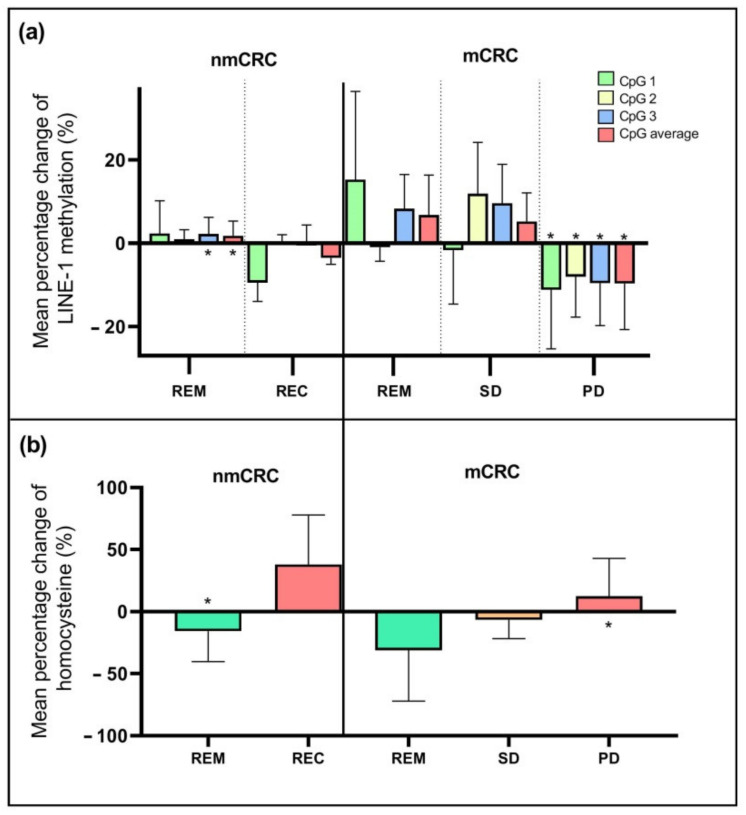
Examination of LINE-1 methylation and homocysteine level in plasma samples. (a) Mean percentage change (%) of LINE-1 methylation per CpG positions separately and their average from the first to the last sample collection in CRC patients with different treatment responses. In the case of progressive disease, the hypomethylation of both separate CpG sites and their average was observed, while in nmCRC patients with remission, increased DNA methylation was recognized (* p < 0.05). (b) Mean percentage change of homocysteine amount (%) from the beginning to the end of our study in CRC subgroups. The homocysteine level of the PD patients showed an elevation; in contrast, in the case of remission, a reduction was identified (* p < 0.05).
Figure 3
Figure 3
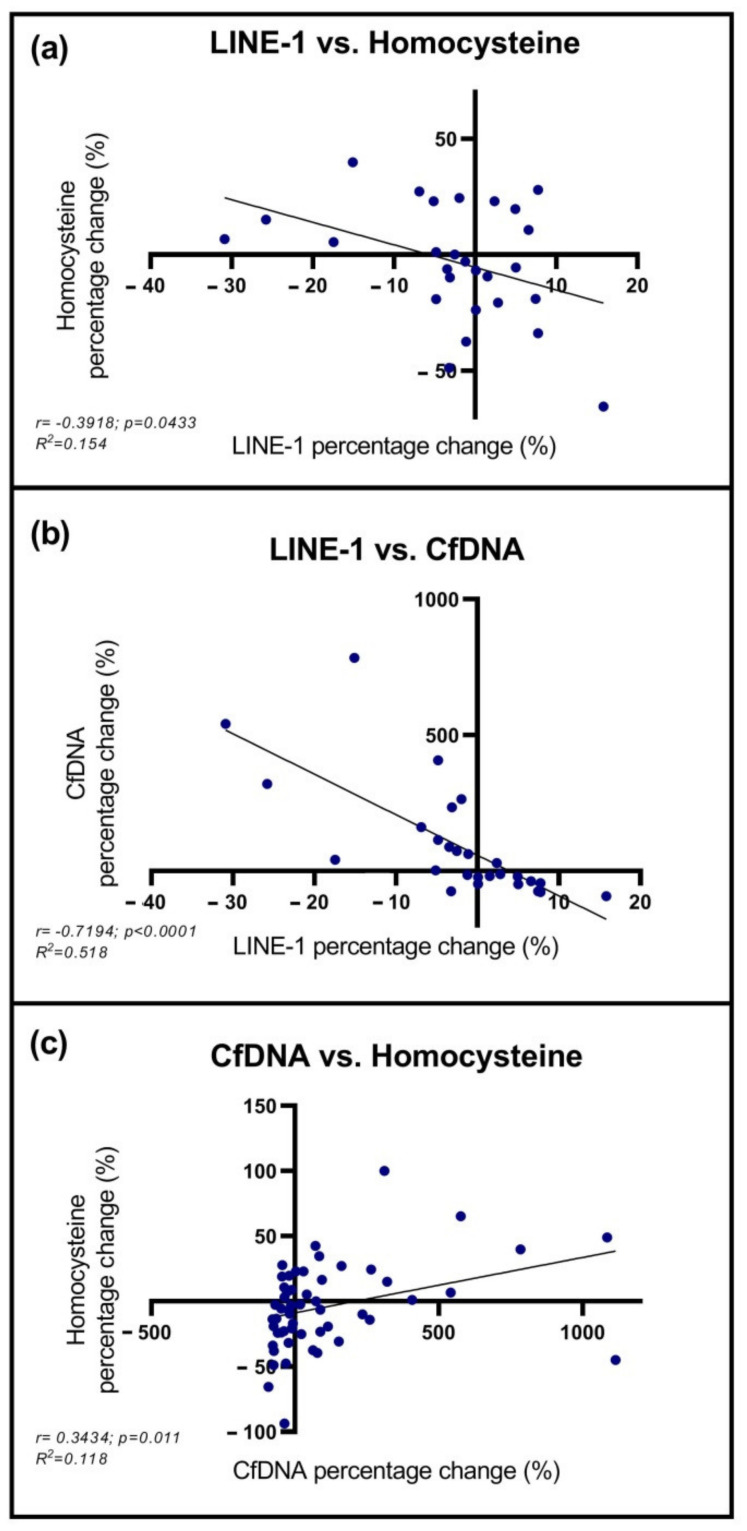
Correlation analyses of LINE-1 methylation status, homocysteine, and cfDNA levels. (a,b) A negative correlation was detected between the percentage change of mean LINE-1 methylation vs. homocysteine and cfDNA level. (c) A positive correlation was noticed comparing cfDNA and homocysteine percentage change.
Figure 4
Figure 4
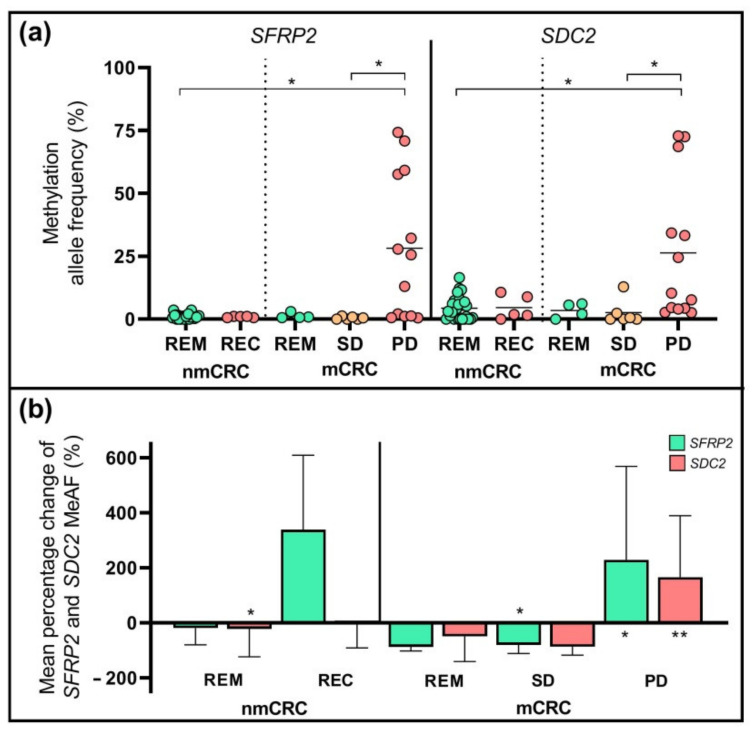
Methylation allele frequencies (MeAF) of SFRP2 and SDC2 genes. (a) The MeAF of SFRP2 and SDC2 at the time of last samples collection (* p < 0.05). (b) The mean percentage changes of MeAF between the beginning and end of the study. The SFRP2 MeAF was significantly decreased in the case of stable disease, while increased in PD. In the case of SDC2, a reduction was observed in the nmCRC REM subgroup and a rise in the PD set (* p < 0.05, ** p < 0.005).
Figure 5
Figure 5
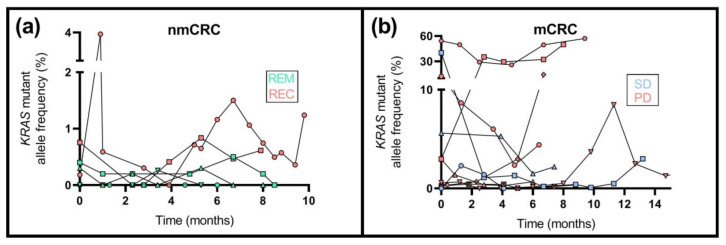
The longitudinal assessment of mutant allele frequency of the KRAS gene in non-metastatic and metastatic CRC patients. (a) In the nmCRC subgroup, the MAF was lower than 0.5% in all plasma specimens of patients with tumor remission; in contrast, a moderately higher MAF was detected in the case of recurrence. (b) In the case of metastatic CRC, all the individuals achieving remission had wild-type KRAS. Patients with progressive disease showed significantly (p < 0.05) higher average MAF than patients with stable disease.

References

    1. Sung H., Ferlay J., Siegel R.L., Laversanne M., Soerjomataram I., Jemal A., Bray F. Global Cancer Statistics 2020: GLOBOCAN Estimates of Incidence and Mortality Worldwide for 36 Cancers in 185 Countries. CA Cancer J. Clin. 2021;71:209–249. doi: 10.3322/caac.21660. - DOI - PubMed
    1. Ferlay J., Colombet M., Soerjomataram I., Dyba T., Randi G., Bettio M., Gavin A., Visser O., Bray F. Cancer incidence and mortality patterns in Europe: Estimates for 40 countries and 25 major cancers in 2018. Eur. J. Cancer. 2018;103:356–387. doi: 10.1016/j.ejca.2018.07.005. - DOI - PubMed
    1. McQuade R.M., Stojanovska V., Bornstein J.C., Nurgali K. Colorectal Cancer Chemotherapy: The Evolution of Treatment and New Approaches. Curr. Med. Chem. 2017;24:1537–1557. doi: 10.2174/0929867324666170111152436. - DOI - PubMed
    1. Kuipers E.J., Grady W.M., Lieberman D., Seufferlein T., Sung J.J., Boelens P.G., van de Velde C.J., Watanabe T. Colorectal cancer. Nat. Rev. Dis. Prim. 2015;1:15065. doi: 10.1038/nrdp.2015.65. - DOI - PMC - PubMed
    1. Xie Y.H., Chen Y.X., Fang J.Y. Comprehensive review of targeted therapy for colorectal cancer. Signal Transduct. Target. Ther. 2020;5:22. doi: 10.1038/s41392-020-0116-z. - DOI - PMC - PubMed