Review
. 2022 Apr 5;23(7):4017.
doi: 10.3390/ijms23074017.

Life Entrapped in a Network of Atavistic Attractors: How to Find a Rescue

Affiliations
Review

Life Entrapped in a Network of Atavistic Attractors: How to Find a Rescue

Andrzej Kasperski. Int J Mol Sci. .

Abstract

In view of unified cell bioenergetics, cell bioenergetic problems related to cell overenergization can cause excessive disturbances in current cell fate and, as a result, lead to a change of cell-fate. At the onset of the problem, cell overenergization of multicellular organisms (especially overenergization of mitochondria) is solved inter alia by activation and then stimulation of the reversible Crabtree effect by cells. Unfortunately, this apparently good solution can also lead to a much bigger problem when, despite the activation of the Crabtree effect, cell overenergization persists for a long time. In such a case, cancer transformation, along with the Warburg effect, may occur to further reduce or stop the charging of mitochondria by high-energy molecules. Understanding the phenomena of cancer transformation and cancer development has become a real challenge for humanity. To date, many models have been developed to understand cancer-related mechanisms. Nowadays, combining all these models into one coherent universal model of cancer transformation and development can be considered a new challenge. In this light, the aim of this article is to present such a potentially universal model supported by a proposed new model of cellular functionality evolution. The methods of fighting cancer resulting from unified cell bioenergetics and the two presented models are also considered.

Keywords: Crabtree effect; NADH molecule accumulation; Warburg effect; aneuploidy; cancer genome instability; cancer transformation; genome chaos; mtNADH molecules; unified cell bioenergetics; vertical and horizontal cancer development.


Conflict of interest statement

The author declares no conflict of interest.

Figures
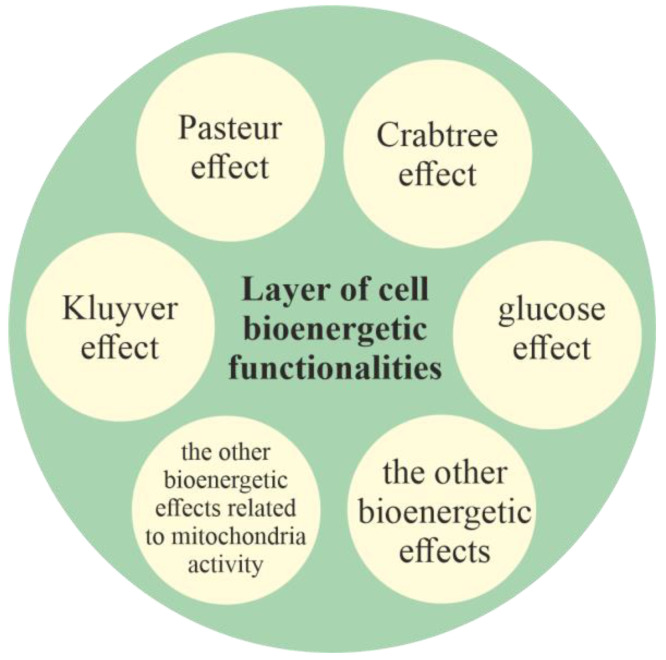
Figure 1
Figure 1
The layer of cell bioenergetic functionalities (i.e., the cell bioenergetic layer) contains fundamental functionalities that can be considered main bioenergetic drivers of cell life.
Figure 2
Figure 2
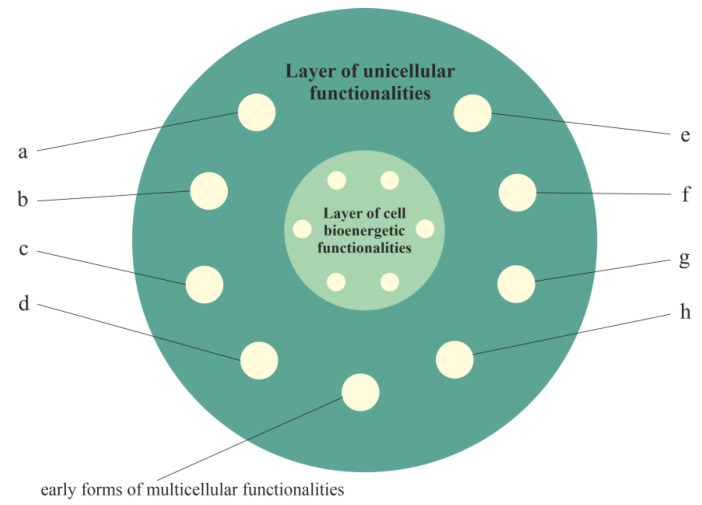
The layer of unicellular functionalities (i.e., the unicellular layer) inherits from the layer of cell bioenergetic functionalities, i.e., functionalities of the second layer can use, control (including deactivation) and extend inherited functionalities. Selected functionalities presented in this figure of the unicellular layer include (a) unregulated, rapid and aggressive angiogenesis; (b) unregulated cell proliferation; (c) a lack of a Hayflick’s limit; (d) relief from curfew and checkpoints; (e) wound healing that does not stop stem-cell-like behavior; (f) unregulated EMT migration, aggressive invasion and metastasis; (g) aerobic glycolysis; and (h) unregulated and truncated cell-differentiation cascades.
Figure 3
Figure 3
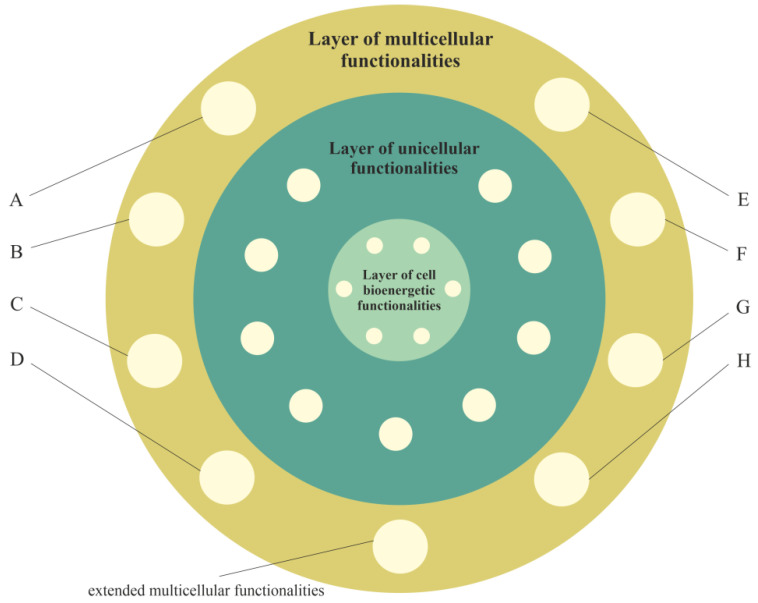
The layer of multicellular functionalities (i.e., multicellular layer) directly inherits from the layer of unicellular functionalities and indirectly from the layer of bioenergetic functionalities, i.e., functionalities of the third layer can use, control (including deactivation) and extend inherited functionalities. Selected functionalities of the multicellular layer include (A) normal well-regulated angiogenesis; (B) well-regulated cell proliferation, along with signaling, to control proliferation; (C) Hayflick’s limit and functionality of p53; (D) cell cycle checkpoints; (E) signaling bringing to an end wound healing; (F) regulated release; (G) facultative switching between oxidative phosphorylation and aerobic glycolysis; and (H) normal, well-regulated cell differentiation.
Figure 4
Figure 4
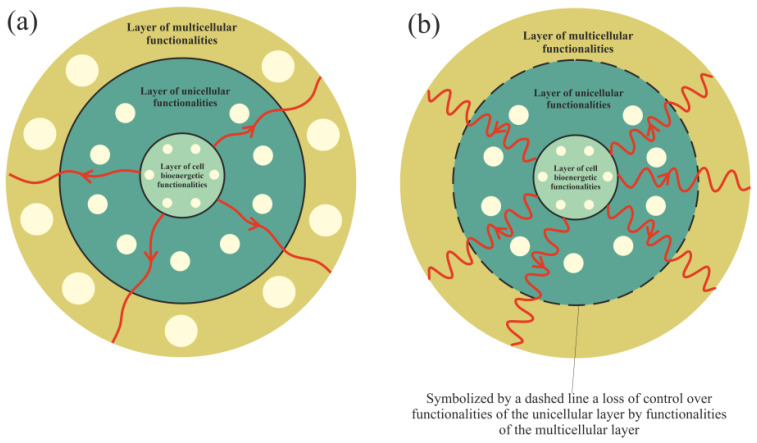
Propagation of disturbances in cell bioenergetics. (a) Small disturbances cause small disturbances in functionalities of the unicellular and multicellular layers. (b) Huge disturbances can cause a loss of functionalities of the multicellular layer (or huge disturbances in their operation), leading to a loss of control over unicellular layer functionalities.
Figure 5
Figure 5
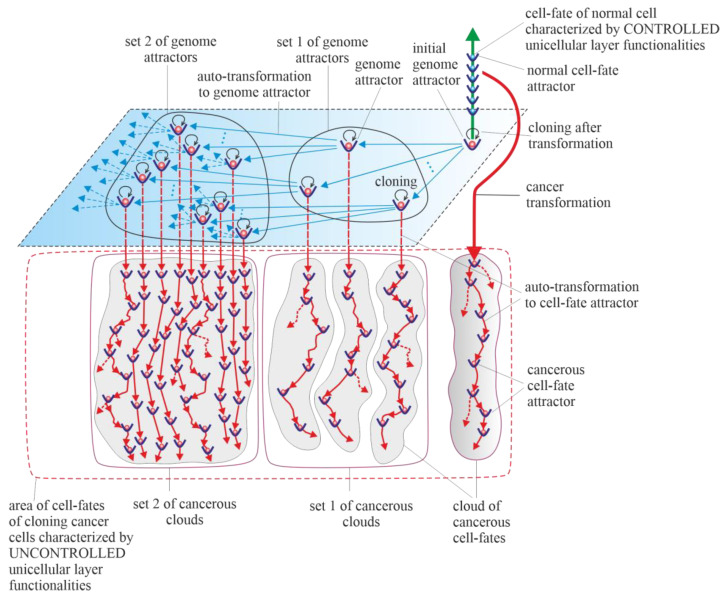
Schematic view of the universal model of cancer transformation and development presented from the perspective of the layered model of evolution of cellular functionalities (especially from the perspective of losing control over functionalities of the unicellular layer). After cancer transformation, cancer development occurs as the development of a population of individual cloning cells. Moreover, cancer development shows attractor-like behavior, i.e., vertical cancer development occurs through step-by-step changes of cell-fate attractors, and optional horizontal cancer development occurs through step-by-step changes in genome attractors.
Figure 6
Figure 6
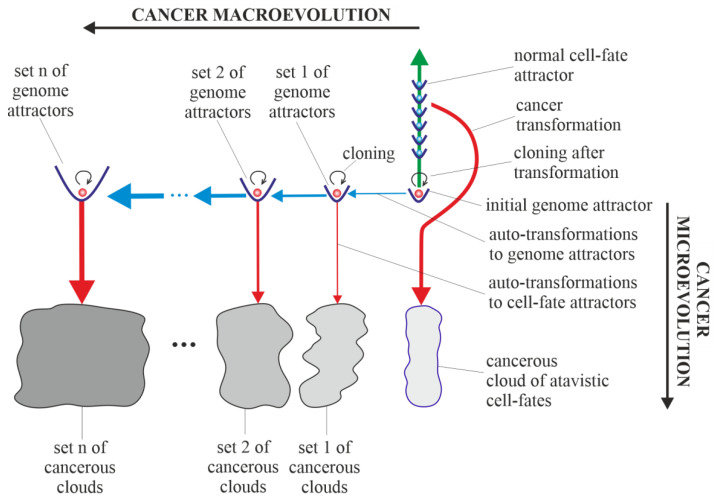
Schematic view of cancer micro- and macroevolution. Sets of cancerous clouds are generated by cells trapped in a network of genome attractors.
Figure 7
Figure 7
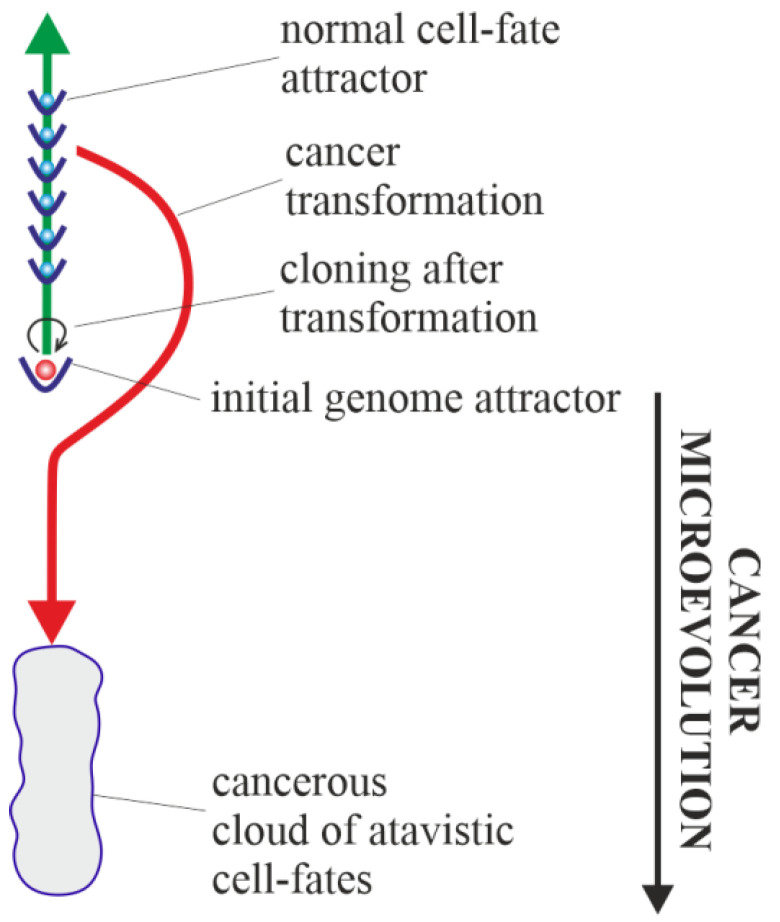
Purely vertical cancer development. After transformation, cancer development occurs only as a microevolution, i.e., only as subsequent changes in cell-fate attractors.

References

    1. Heng J., Heng H.H. Genome Chaos, Information Creation, and Cancer Emergence: Searching for New Frameworks on the 50th Anniversary of the “War on Cancer”. Genes. 2022;13:101. doi: 10.3390/genes13010101. - DOI - PMC - PubMed
    1. Erenpreisa J., Salmina K., Anatskaya O., Cragg M.S. Paradoxes of cancer: Survival at the brink. Semin. Cancer Biol. 2020. in press . - DOI - PubMed
    1. Heng H.H. Debating Cancer: The Paradox in Cancer Research. World Scientific Publishing Co.; Singapore: 2015.
    1. Ye C.J., Sharpe Z., Heng H.H. Origins and Consequences of Chromosomal Instability: From Cellular Adaptation to Genome Chaos-Mediated System Survival. Genes. 2020;11:1162. doi: 10.3390/genes11101162. - DOI - PMC - PubMed
    1. Baker S.G. The detached pericyte hypothesis: A novel explanation for many puzzling aspects of tumorigenesis. Org. J. Biol. Sci. 2018;2:25–41.