


Telework and Worker Health and Well-Being: A Review and Recommendations for Research and Practice
- PMID: 35409563
- PMCID: PMC8998114
- DOI: 10.3390/ijerph19073879
Telework and Worker Health and Well-Being: A Review and Recommendations for Research and Practice
Abstract
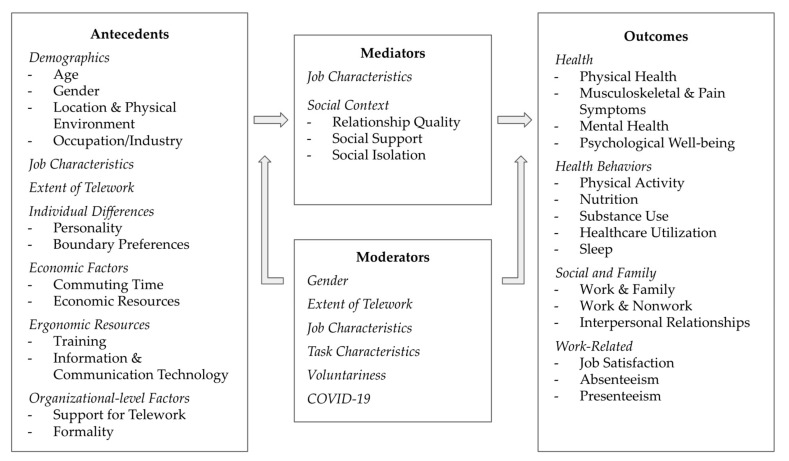
Telework (also referred to as telecommuting or remote work), is defined as working outside of the conventional office setting, such as within one's home or in a remote office location, often using a form of information communication technology to communicate with others (supervisors, coworkers, subordinates, customers, etc.) and to perform work tasks. Remote work increased over the last decade and tremendously in response to the COVID-19 pandemic. The purpose of this article is to review and critically evaluate the existing research about telework and worker health and well-being. In addition, we review and evaluate how engaging in this flexible form of work impacts worker health and well-being. Specifically, we performed a literature search on the empirical literature related to teleworking and worker health and well-being, and reviewed articles published after the year 2000 based on the extent to which they had been discussed in prior reviews. Next, we developed a conceptual framework based on our review of the empirical literature. Our model explains the process by which telework may affect worker health and well-being in reference to individual, work/life/family, organizational, and macro level factors. These components are explained in depth, followed by methodological and fundamental recommendations intended to guide future research, policies, and practices to maximize the benefits and minimize the harms associated with telework, and offer recommendations for future research.
Keywords: flexible work arrangements; remote work; telework; worker health; worker well-being.
Conflict of interest statement
The authors declare no conflict of interest. The funders had no role in the design of the study; in the collection, analyses, or interpretation of data; in the writing of the manuscript, or in the decision to publish the results.
Figures
References
-
- Bailey D.E., Kurland N.B. A review of telework research: Findings, new directions, and lessons for the study of modern work. J. Organ. Behav. 2002;23:383–400. doi: 10.1002/job.144. - DOI
-
- Global Workplace Analytics. [(accessed on 20 February 2022)]. Available online: https://globalworkplaceanalytics.com/telecommuting-statistics.
-
- Tavares A.I. Telework and health effects review. Int. J. Healthc. 2017;3:30–36. doi: 10.5430/ijh.v3n2p30. - DOI
Publication types
MeSH terms
Grants and funding
LinkOut - more resources
Full Text Sources
Medical
