


Role of the Intersections of Gender, Race and Sexual Orientation in the Association between Substance Use Behaviors and Sexually Transmitted Infections in a National Sample of Adults with Recent Criminal Legal Involvement
- PMID: 35409785
- PMCID: PMC8998534
- DOI: 10.3390/ijerph19074100
Role of the Intersections of Gender, Race and Sexual Orientation in the Association between Substance Use Behaviors and Sexually Transmitted Infections in a National Sample of Adults with Recent Criminal Legal Involvement
Abstract
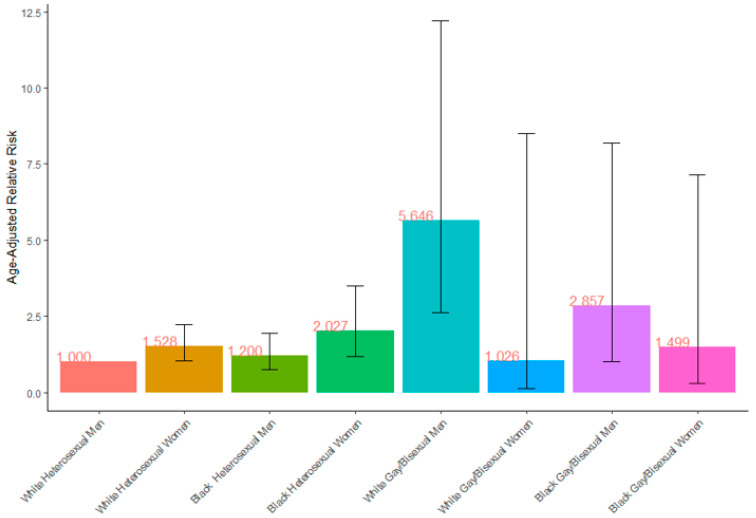
Limited research has focused on how substance use and sexual risk behaviors differ among individuals impacted by the criminal legal system based on social identities. Using the National Survey on Drug Use and Health, we estimated relative risk for reporting a sexually transmitted infection (STI) among intersectional social groups with criminal legal involvement using a modified Poisson regression. We then utilized multivariate logistic regression and marginal effects to measure associations between substance use behaviors and STIs and to estimate whether these varied among the intersectional social groups with elevated STI rates. Three groups had elevated risk of reporting an STI compared to white, heterosexual men: white, heterosexual women (1.53, 95% CI: 1.05-2.20); Black, heterosexual women (2.03, 95% CI: 1.18-3.49); and white, gay or bisexual men (5.65, 95% CI: 2.61-12.20). Considering the intersections of gender, race, and sexual orientation, elevated risks for STIs among white and Black heterosexual women were mitigated after adjusting for substance use alongside other confounders. Only those who identified as white, gay or bisexual, and male had increased STI risk after controlling for substance use. Interventions targeting Black and white heterosexual women's sexual health following incarceration should focus on substance use and interventions targeting white, gay or bisexual men should focus on healthy sexual behaviors, HIV/STI screening, and care continuum efforts.
Keywords: incarceration; intersectionality; sexually transmitted infection; substance use.
Conflict of interest statement
The authors declare no conflict of interests.
Figures
References
-
- Sawyey W., Wagner P. Mass Incarceration: The Whole Pie 2020. Prison Policy Initiative; Northampton, MA, USA: 2020.
-
- Kaeble D., Alper M. Probation and Parole in the United States, 2017–2018. U.S. Department of Justice; Washington, DC, USA: 2020.
-
- The Sentencing Project . Report of the Sentencing Project to the United Nations Human Rights Committee: Regarding Racial Disparities in the United States Criminal Justice System. The Sentencing Project; Washington, DC, USA: 2013.
-
- Grant J.M., Mottet L.A., Tanis J., Harrison J., Herman J.L., Keisling M. Injustice at Every Turn: A Report of the National Transgender Discrimination Survey. National Center for Transgender Equality and National Gay and Lesbian Task Force; Washington, DC, USA: 2011.
-
- Lane J. Women and Prison. Springer; Berlin/Heidelberg, Germany: 2020. An Overview: What We Know About Incarcerated Women and Girls; pp. 1–13.
Publication types
MeSH terms
Grants and funding
LinkOut - more resources
Full Text Sources
Medical
