Clinical Trial
. 2022 Apr 11;10(1):59.
doi: 10.1186/s40168-022-01247-6.

Gut microbiome signatures linked to HIV-1 reservoir size and viremia control

Collaborators, Affiliations
Clinical Trial

Gut microbiome signatures linked to HIV-1 reservoir size and viremia control

Alessandra Borgognone et al. Microbiome. .

Abstract

Background: The potential role of the gut microbiome as a predictor of immune-mediated HIV-1 control in the absence of antiretroviral therapy (ART) is still unknown. In the BCN02 clinical trial, which combined the MVA.HIVconsv immunogen with the latency-reversing agent romidepsin in early-ART treated HIV-1 infected individuals, 23% (3/13) of participants showed sustained low-levels of plasma viremia during 32 weeks of a monitored ART pause (MAP). Here, we present a multi-omics analysis to identify compositional and functional gut microbiome patterns associated with HIV-1 control in the BCN02 trial.

Results: Viremic controllers during the MAP (controllers) exhibited higher Bacteroidales/Clostridiales ratio and lower microbial gene richness before vaccination and throughout the study intervention when compared to non-controllers. Longitudinal assessment indicated that the gut microbiome of controllers was enriched in pro-inflammatory bacteria and depleted in butyrate-producing bacteria and methanogenic archaea. Functional profiling also showed that metabolic pathways related to fatty acid and lipid biosynthesis were significantly increased in controllers. Fecal metaproteome analyses confirmed that baseline functional differences were mainly driven by Clostridiales. Participants with high baseline Bacteroidales/Clostridiales ratio had increased pre-existing immune activation-related transcripts. The Bacteroidales/Clostridiales ratio as well as host immune-activation signatures inversely correlated with HIV-1 reservoir size.

Conclusions: The present proof-of-concept study suggests the Bacteroidales/Clostridiales ratio as a novel gut microbiome signature associated with HIV-1 reservoir size and immune-mediated viral control after ART interruption. Video abstract.

Keywords: Gut microbiome; HIV-1 post-treatment control; Microbiome-based predictive biomarker; Therapeutic HIV-1 vaccine; Viral reservoir size.


Conflict of interest statement

The authors declare that they have no competing interests.

Figures

Fig. 1
Fig. 1
Higher longitudinal Bacteroidales/Clostridiales ratio in viremic controllers. Relative abundance expressed as percentage of Bacteroidales, Clostridiales, and c their ratio in controllers (gray) and non-controllers (white) are represented by boxplots (left and right vertical panels) and line plots (middle vertical panels). In line plots, values for each subject are illustrated by white squares (non-controllers) and grey dots (viremic controllers). Boxplots show the median (horizontal black line) and interquartile range between the first and third quartiles (25th and 75th, respectively). Third vertical panels show non-controllers before ART interruption (pre-MAP, n = 7), last time point on MAP before ART resumption (last detect pVL, n = 4) and 24 weeks after ART resumption (post-MAP w4, n = 7). Abbreviations: MAP, monitored antiretroviral pause; pre-Vax, baseline (1 day before first MVA vaccination); MVA1, 1 week after first MVA vaccination; RMD, 1 week after third romidepsin infusion; MVA2, 4 weeks after second MVA vaccination. Unadjusted p values are shown. Benjamini–Hochberg multiple hypothesis correction for p values ≤ 0.05 are provided in Additional file 2: Dataset S7.
Fig. 2
Fig. 2
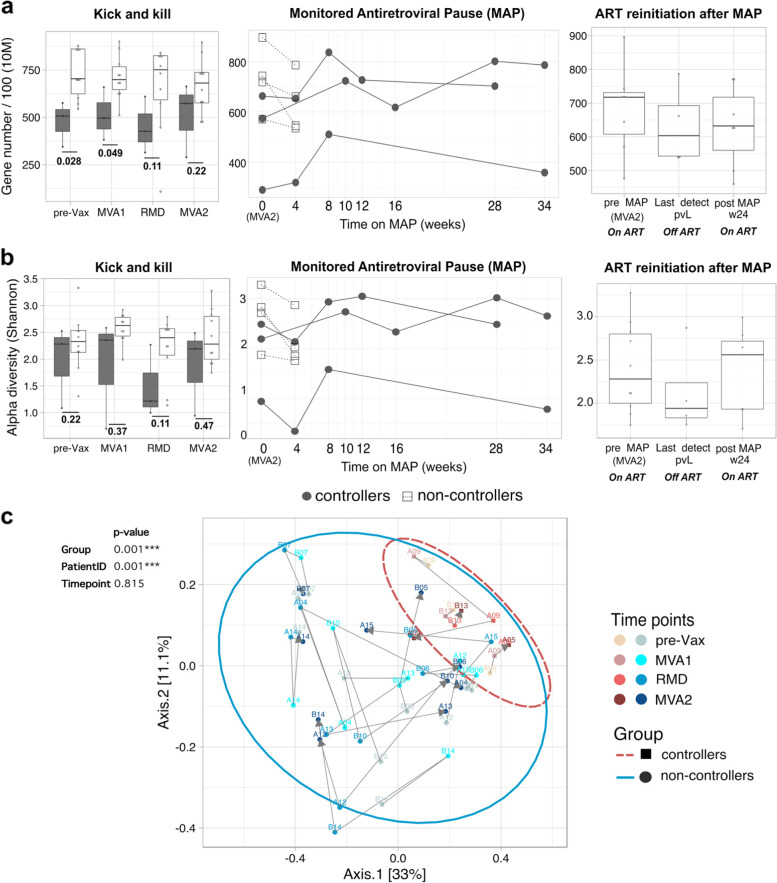
Lower microbial diversity and richness in controllers. Longitudinal a microbial gene richness at 10 million (10 M filtered reads) down-sampling size and b alpha diversity based on Shannon index in viremic controllers (gray) and non-controllers (white). c Principal coordinates analysis (PCoA) of microbial diversity based on Bray-Curtis distances at pre-vaccination and during ‘kick and kill’ intervention. Proportion of variance explained by each principal coordinate axis is reported in the corresponding axis label. Subjects per each group are represented by squares (controllers) and circles (non-controllers). Each point stands for one subject, color coded by group and time point. The increase in purple (controllers) and blue (non-controllers) colors reflects sequential time points from baseline (pre-Vax) to the second vaccine administration (MVA2). Ellipses delineate the distribution of points per each group. Gray arrows link directional changes in bacterial abundance throughout the kick and kill intervention from baseline (pre-Vax). PERMANOVA statistical analysis of samples grouped by group, PatientID (patient internal identifier), and time point is shown on the top of the panel. Abbreviations: MAP, monitored antiretroviral pause; pre-Vax, baseline (1 day before first MVA vaccination); MVA1, 1 week after first MVA vaccination; RMD, 1 week after third romidepsin infusion; MVA2, 4 weeks after second MVA vaccination. Unadjusted p values are shown. Benjamini–Hochberg multiple hypothesis correction for p values ≤ 0.05 are provided in Additional file 2: Dataset S7
Fig. 3
Fig. 3
Associations between HIV-1 reservoir size and gut microbial signatures. Spearman’s correlations between gut microbial signatures (ratio Bacteroidales/Clostridiales, gene richness, and alpha-diversity Shannon index) and longitudinal a HIV-1 DNA (HIV-1 DNA copies/106 CD4+ T cells) and b cell-associated (CA) HIV-1 RNA (HIV-1/TBP relative expression). Positive correlations are indicated in blue and negative correlations, in red. Color and size of the circles indicate the magnitude of the correlation. White asterisks indicate significant correlations (*p < 0.05; **p < 0.01; ***p < 0.001, Benjamini–Hochberg adjustment for multiple comparisons). Boxplots showing longitudinal comparison of c HIV-1 DNA and d CA HIV-1 RNA between controllers and non-controllers. Abbreviations: MAP, monitored antiretroviral pause; pre-Vax, baseline (1 day before first MVA vaccination); MVA1, 1 week after first MVA vaccination; RMD, 1 week after third romidepsin infusion; MVA2, 4 weeks after second MVA vaccination
Fig. 4
Fig. 4
Baseline metaproteomic signatures associated with HIV control after ART interruption. Comparison of Clostridiales and Bacteroidales abundances derived from gut metaproteome data in controllers and non-controllers at study entry. No differences in Clostridiales or Bacteroidales proteome at the order-level were observed. c Baseline levels of Clostridiales proteins distinguished controllers from non-controllers in a hierarchical clustering. d Functional annotation of Clostridiales bacterial proteins using KEGG gene ontology identified baseline differences in cellular metabolism pathways between groups. Abbreviations: C = controllers, NC = non-controllers, SC = spectral count. Unadjusted p values are shown. Benjamini–Hochberg multiple hypothesis correction for p values ≤ 0.05 are provided in Additional file 2: Dataset S7
Fig. 5
Fig. 5
Baseline functional enrichment in levels of immune activation and inflammatory response in viremic controllers. a Volcano plot of differentially expressed genes between controllers and non-controllers at baseline (pre-Vax) with adjusted p value < 0.1 (violet dots), adjusted p value < 0.05 (red dots) and log2 (foldchange) > 2 and adjusted p value < 0.05 (green dots). Gray-colored dots represent genes not displaying statistical significance (BH-adjusted p value > 0.1). The log2 fold change on the x-axis indicates the magnitude of change, while the −log10 (p-adjust) on the y-axis indicates the significance of each gene. b Violin plots showing relative expression levels (rlog, regularized log transformation) of differentially expressed genes with functional annotation. c Gene ontology (GO) enrichment analysis of upregulated genes in controllers. In the y-axis, only representative enriched GO terms (biological process) are reported (terms obtained after redundancy reduction by REVIGO). X-axis reports the percentage of genes in a given GO terms, expressed as ‘Gene ratio’. The color key from blue to red indicates low to high Bonferroni-adjusted log 10 p value. Dot sizes are based on the 'count' (genes) associated to each GO term. Significantly enriched GO terms, number of genes associated with each GO term and adjusted p values are provided in Additional file 3: Table S3
Fig. 6
Fig. 6
Integrative analysis of baseline gut microbial signatures, immune activation-related transcripts, bacterial proteins and HIV-1 reservoir. a Spearman’s correlations between the ratio Bacteroidales/Clostridiales and DEGs (annotated transcripts). Color and size of the circles indicate the magnitude of the correlation. White asterisks indicate significant correlations (*p < 0.05; **p < 0.01; ***p < 0.001, Benjamini–Hochberg adjustment for multiple comparisons). b Network visualizing significant Spearman’s correlations between the ratio Bacteroidales/Clostridiales and transcripts involved in the enrichment analysis described in Additional file 3: Table S4. Transcripts are represented as vertices and border width is proportional to transcript expression (log2 |cpmTMM_w0 +1|) in controllers. Edge width indicates the magnitude of correlation. c Network showing Spearman's correlation between viral reservoir (CA HIV-1 RNA and HIV-1 DNA), bacterial species within Bacteroidales and Clostrdiales, host transcripts correlated with the ratio Bacteroidales/Clostrdiales and bacterial proteins (p ≤ 0.025). Features are showed as vertices and colored by ‘omic’ dataset. Edge width indicates the magnitude of correlation coefficient. Protein-associated bacterial genera are reported in parentheses. In all panels, positive and negative correlations are indicated in blue and red, respectively. Abbreviations: DEGs, differentially expressed genes between controllers and non-controllers; R, Ruminococcus; Ps, Pseudoflavonifactor and pre-Vax, baseline timepoint (1 day before first MVA vaccination)

References

    1. Volberding PA, Deeks SG. Antiretroviral therapy and management of HIV infection. Lancet. 2010;376(9734):49–62. doi: 10.1016/S0140-6736(10)60676-9. - DOI - PubMed
    1. Finzi D, Hermankova M, Pierson T, Carruth LM, Buck C, Chaisson RE, et al. Identification of a reservoir for HIV-1 in patients on highly active antiretroviral therapy. Science (80-) 1997;278:1295–1300. doi: 10.1126/science.278.5341.1295. - DOI - PubMed
    1. Siliciano JD, Kajdas J, Finzi D, Quinn TC, Chadwick K, Margolick JB, et al. Long-term follow-up studies confirm the stability of the latent reservoir for HIV-1 in resting CD4+ T cells. Nat Med. 2003;9:727–728. doi: 10.1038/nm880. - DOI - PubMed
    1. Chun TW, Davey RT, Engel D, Lane HC, Fauci AS. AIDS: Re-emergence of HIV after stopping therapy. Nature. 1999;401:874–875. doi: 10.1038/44755. - DOI - PubMed
    1. Namazi G, Fajnzylber JM, Aga E, Bosch RJ, Acosta EP, Sharaf R, et al. The control of HIV after antiretroviral medication pause (CHAMP) study: posttreatment controllers identified from 14 clinical studies. J Infect Dis. 2018;218:1954–1963. doi: 10.1093/infdis/jiy479. - DOI - PMC - PubMed

Publication types