Review
. 2023;21(2):380-391.
doi: 10.2174/1570159X20666220411091332.

The Lymphatic System In The Brain Clearance Mechanisms - New Therapeutic Perspectives For Alzheimer's Disease

Affiliations
Review

The Lymphatic System In The Brain Clearance Mechanisms - New Therapeutic Perspectives For Alzheimer's Disease

Angelika Chachaj et al. Curr Neuropharmacol. 2023.

Abstract

Alzheimer's disease (AD) is the most common cause of dementia worldwide. Pathological deposits of neurotoxic proteins within the brain, such as amyloid-ß and hyperphosphorylated tau tangles, are the prominent features in AD. According to recent studies, the newly discovered brain lymphatic system was demonstrated to be crucial in the clearance of metabolic macromolecules from the brain. Meningeal lymphatic vessels located in the dura mater drain the fluid, macromolecules, and immune cells from cerebrospinal fluid (CSF) and transport them, as lymph, to the deep cervical lymph nodes. The lymphatic system provides the perivascular exchange of CSF with interstitial fluid (ISF) and ensures the homeostasis of neuronal interstitial space. In this review, we aim to summarize recent findings on the role of the lymphatic system in AD pathophysiology and discuss possible therapeutic perspectives, targeting the lymphatic clearance mechanisms within the brain.

Keywords: Dementia; amyloid-β (Aβ); cerebrospinal fluid (CSF); glymphatic system; interstitial fluid (ISF); meningeal lymphatic vessels (MLVs); perivascular space.


Conflict of interest statement

The authors declare no conflict of interest, financial or otherwise.

Figures
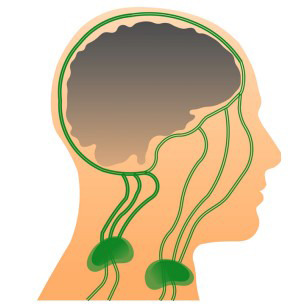
Fig. (1)
Fig. (1)
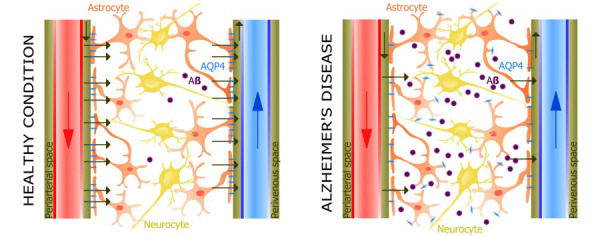
Scheme of the meningeal lymphatic system in humans. Meningeal lymphatic vessels (MLVs) are situated within the dura mater and drain the cerebrospinal fluid (CSF) from the adjacent subarachnoid space, and the interstitial fluid (ISF) coming from the glymphatic system. This mixture (CSF-ISF) fluid is further transported by MLVs into deep cervical lymph nodes (dcLNs) via foramina at the base of the skull. Some lymph is also transported through the lymph vessels passing the cribriform plate with the olfactory nerves into superficial cervical lymph nodes (dcLNs). Figure adapted and modified from Tamura, R. Neurosurg Rev 2020, 43, 1055-1064.
Fig. (2)
Fig. (2)
Schematic pictures of glymphatic system in healthy condition and in Alzheimer's disease. Interstitial flow of cerebrospinal fluid (CSF) - interstitial fluid (ISF) between “influx” (para-arterial spaces) and “efflux” (perivenous or perineuronal spaces) sites was demonstrated to be mediated by aquaporin 4 (AQP4) water channels situated on astrocytic endfeet. The continuous movement of fluid throughout the brain interstitium provides the clearance of waste from the brain. Impaired glymphatic function contribute to deposition of toxins, including Aβ accumulation. Figure adapted and modified from Mader, S. Cells, 2019, 8, 90.

References

    1. Patterson C. World Alzheimer Report 2018. The state of the art of dementia research: New frontiers. Alzheimer’s Disease International. London: ADI; 2018.
    1. Blennow K., de Leon M.J., Zetterberg H. Alzheimer’s disease. Lancet. 2006;368(9533):387–403. doi: 10.1016/S0140-6736(06)69113-7. - DOI - PubMed
    1. Wang M., Ding F., Deng S., Guo X., Wang W., Iliff J.J., Nedergaard M. Focal solute trapping and global glymphatic pathway impairment in a murine model of multiple microinfarcts. J. Neurosci. 2017;37(11):2870–2877. doi: 10.1523/JNEUROSCI.2112-16.2017. - DOI - PMC - PubMed
    1. Földi M. The brain and the lymphatic system revisited. Lymphology. 1999;32(2):40–44. - PubMed

    1. Baluk P., Fuxe J., Hashizume H., Romano T., Lashnits E., Butz S., Vestweber D., Corada M., Molendini C., Dejana E., McDonald D.M. Functionally specialized junctions between endothelial cells of lymphatic vessels. J. Exp. Med. 2007;204(10):2349–2362. doi: 10.1084/jem.20062596. - DOI - PMC - PubMed

MeSH terms