


Phase I/II study of streptozocin monotherapy in Japanese patients with unresectable or metastatic gastroenteropancreatic neuroendocrine tumors
- PMID: 35411926
- PMCID: PMC9264336
- DOI: 10.1093/jjco/hyac048
Phase I/II study of streptozocin monotherapy in Japanese patients with unresectable or metastatic gastroenteropancreatic neuroendocrine tumors
Erratum in
-
Correction.Jpn J Clin Oncol. 2022 Nov 3;52(11):1358. doi: 10.1093/jjco/hyac156. Jpn J Clin Oncol. 2022. PMID: 36124846 Free PMC article. No abstract available.
Abstract
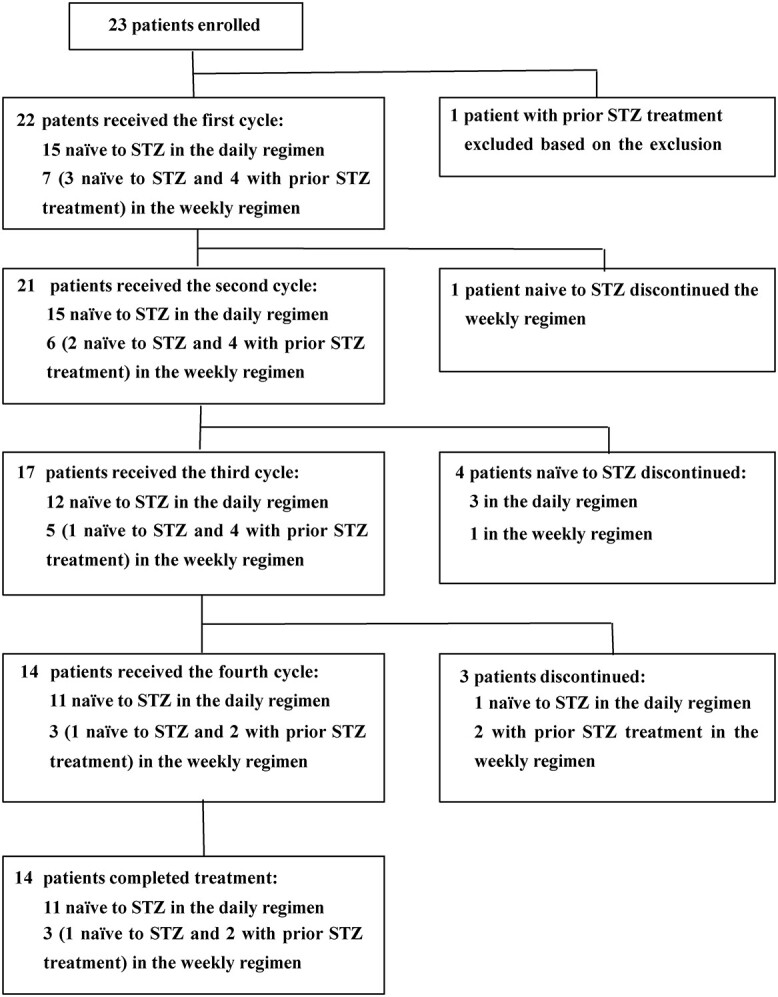
Background: This phase I/II study was conducted to evaluate the efficacy, safety and pharmacokinetics of streptozocin (STZ) in Japanese patients with unresectable or metastatic gastroenteropancreatic neuroendocrine tumors.
Methods: Twenty-two patients received up to 4 cycles of intravenous STZ at either 500 mg/m2 once daily for 5 consecutive days every 6 weeks (daily regimen) or at 1000-1500 mg/m2 once weekly for 6 weeks (weekly regimen). Tumor response was evaluated using the modified RECIST criteria ver. 1.1, and adverse events were assessed by grade according to the National Cancer Institute CTCAE (ver. 4.0).
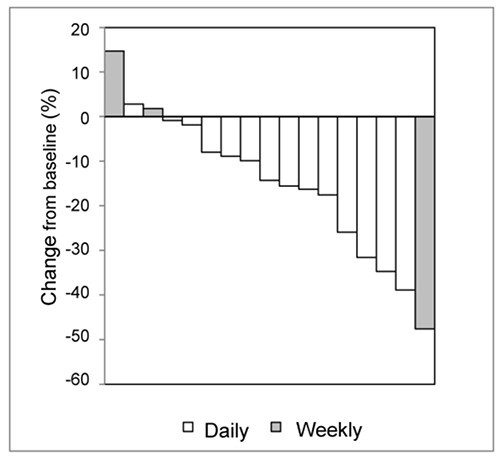
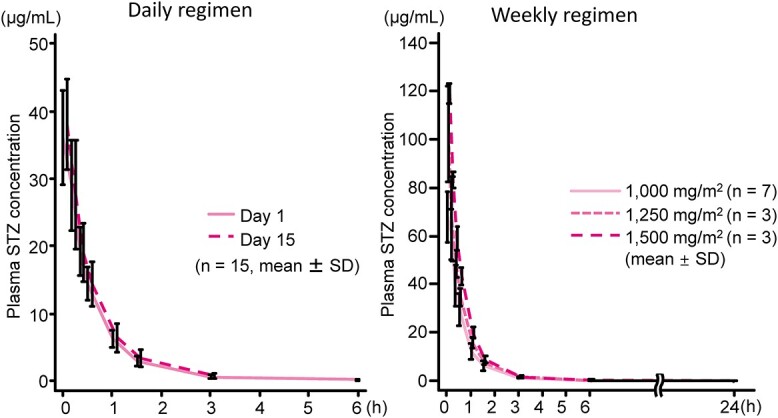
Results: Fourteen (63.6%) patients completed the study protocol. No patients had complete response; partial response in 2 (9.1%), stable disease in 17 (77.3%), non-complete response/non-progressive disease in 2 (9.1%) and only 1 (4.5%) had non-evaluable disease. Excluding the latter, the response rate in the daily and weekly regimens was 6.7% (1/15) and 16.7% (1/6), respectively, with an overall response rate of 9.5% (2/21). However, the best overall response in each patient showed that the disease control rate was 100%.Adverse events occurred in all 22 patients, including 17 grade 3 adverse events in 11 patients; however, no grade 4 or 5 adverse events were reported. Prophylactic hydration and antiemetic treatment reduced the severity and incidence of nephrotoxicity, nausea and vomiting. Plasma STZ concentrations decreased rapidly after termination of infusion, with a half-life of 32-40 min. Neither repeated administration nor dose increases affected pharmacokinetic parameters.
Conclusions: STZ may be a useful option for Japanese patients with unresectable or metastatic gastroenteropancreatic neuroendocrine tumors.
Keywords: disease control; neuroendocrine tumor; streptozocin; tumor shrinkage.
© The Author(s) 2022. Published by Oxford University Press.
Figures
References
-
- Ito T, Igarashi H, Nakamura K, et al. Epidemiological trends of pancreatic and gastrointestinal neuroendocrine tumors in Japan: a nationwide survey analysis. J Gastroenterol 2015;50:58–64. - PubMed
-
- Yao JC, Hassan M, Phan A, et al. One hundred years after “carcinoid”: epidemiology of and prognostic factors for neuroendocrine Tumors in 35,825 cases in the United States. J Clin Oncol 2008;26:3063–72. - PubMed
-
- Raymond E, Dahan L, Raoul J-L, et al. Sunitinib malate for the treatment of pancreatic neuroendocrine Tumors. New Engl J Med 2011;364:501–13. - PubMed
