


Generation of two iPSC lines from hypertrophic cardiomyopathy patients carrying MYBPC3 and PRKAG2 variants
- PMID: 35413566
- PMCID: PMC9708393
- DOI: 10.1016/j.scr.2022.102774
Generation of two iPSC lines from hypertrophic cardiomyopathy patients carrying MYBPC3 and PRKAG2 variants
Abstract
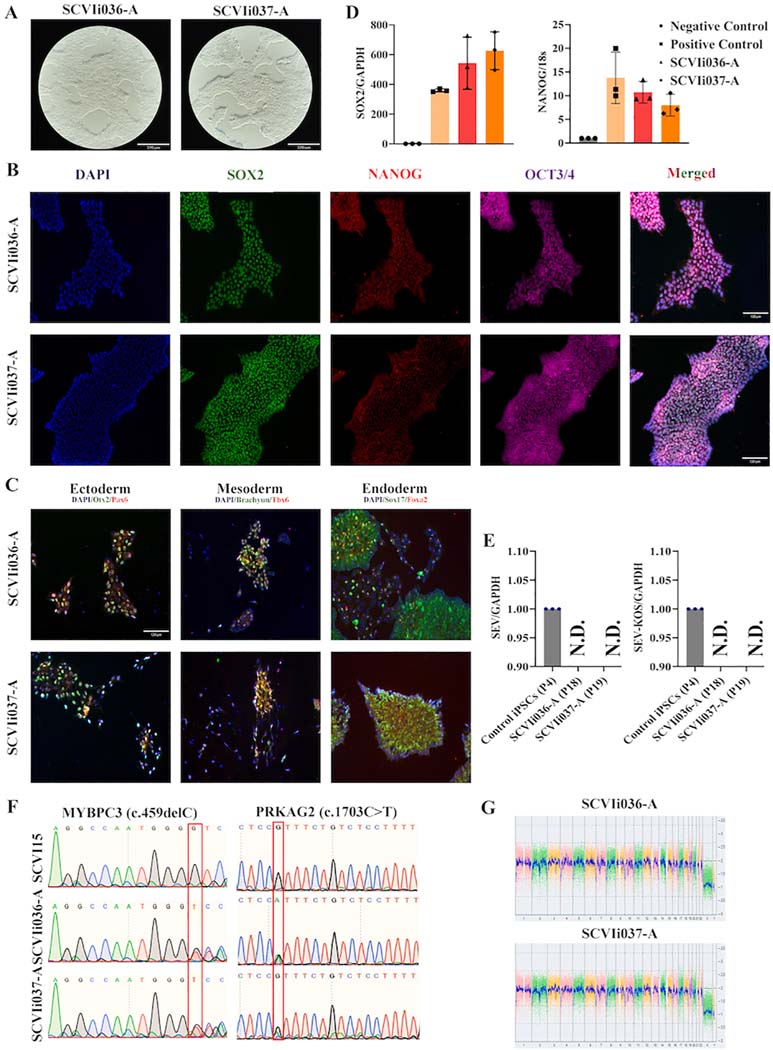
Hypertrophic cardiomyopathy (HCM) is an inherited cardiac disorder characterized by a thick left ventricular wall and an increased risk of arrhythmias, heart failure, and sudden cardiac death. The MYBPC3 and PRAKG2 are known causal genes for HCM. Here we generated two human-induced pluripotent stem cell lines from two HCM patients carrying two heterozygous mutations in MYBPC3 (c.459delC) and PRKAG2 (c.1703C > T). Both iPSC lines expressed pluripotent markers, had a normal karyotype, and were able to differentiate into three germ layers, making them potentially valuable tools for modeling HCM in vitro and investigating the pathological mechanisms related to these two variants.
Keywords: Hypertrophic cardiomyopathy; Induced pluripotent stem cells; MYBPC3; and PRKAG2.
Copyright © 2022 The Authors. Published by Elsevier B.V. All rights reserved.
Figures
References
-
- Lan F, Lee AS, Liang P, Sanchez-Freire V, Nguyen PK, Wang L, Han L, Yen M, Wang Y, Sun N, Abilez OJ, Hu S, Ebert AD, Navarrete EG, Simmons CS, Wheeler M, Pruitt B, Lewis R, Yamaguchi Y, Ashley EA, Bers DM, Robbins RC, Longaker MT, Wu JC, 2013. Abnormal calcium handling properties underlie familial hypertrophic cardiomyopathy pathology in patient-specific induced pluripotent stem cells. Cell Stem Cell 12, 101–113. - PMC - PubMed
-
- Seeger T, Shrestha R, Lam CK, Chen C, McKeithan WL, Lau E, Wnorowski A, McMullen G, Greenhaw M, Lee J, Oikonomopoulos A, Lee S, Yang H, Mercola M, Wheeler M, Ashley EA, Yang F, Karakikes I, Wu JC, 2019. A premature termination codon mutation in MYBPC3 causes hypertrophic cardiomyopathy via chronic activation of nonsense-mediated decay. Circulation 139, 799–811. - PMC - PubMed
-
- Belbachir N, Lai C, Rhee JW, Zhuge Y, Perez MV, Sallam K, Wu JC, 2021. Generation of two induced pluripotent stem cell lines from Brugada syndrome affected patients carrying SCN5A mutations. Stem Cell Res. 57, 102605. - PubMed
Publication types
MeSH terms
Substances
Grants and funding
LinkOut - more resources
Full Text Sources
Research Materials
