


The Use of Artificial Intelligence-Based Conversational Agents (Chatbots) for Weight Loss: Scoping Review and Practical Recommendations
- PMID: 35416791
- PMCID: PMC9047740
- DOI: 10.2196/32578
The Use of Artificial Intelligence-Based Conversational Agents (Chatbots) for Weight Loss: Scoping Review and Practical Recommendations
Abstract
Background: Overweight and obesity have now reached a state of a pandemic despite the clinical and commercial programs available. Artificial intelligence (AI) chatbots have a strong potential in optimizing such programs for weight loss.
Objective: This study aimed to review AI chatbot use cases for weight loss and to identify the essential components for prolonging user engagement.
Methods: A scoping review was conducted using the 5-stage framework by Arksey and O'Malley. Articles were searched across nine electronic databases (ACM Digital Library, CINAHL, Cochrane Central, Embase, IEEE Xplore, PsycINFO, PubMed, Scopus, and Web of Science) until July 9, 2021. Gray literature, reference lists, and Google Scholar were also searched.
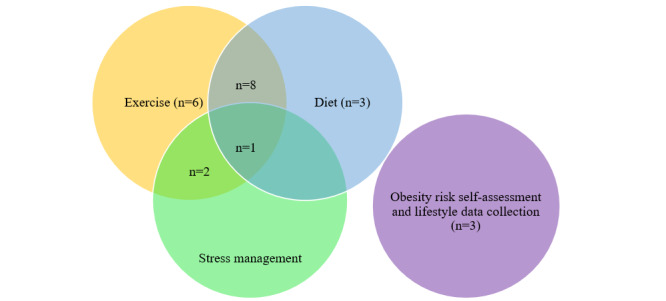
Results: A total of 23 studies with 2231 participants were included and evaluated in this review. Most studies (8/23, 35%) focused on using AI chatbots to promote both a healthy diet and exercise, 13% (3/23) of the studies used AI chatbots solely for lifestyle data collection and obesity risk assessment whereas only 4% (1/23) of the studies focused on promoting a combination of a healthy diet, exercise, and stress management. In total, 48% (11/23) of the studies used only text-based AI chatbots, 52% (12/23) operationalized AI chatbots through smartphones, and 39% (9/23) integrated data collected through fitness wearables or Internet of Things appliances. The core functions of AI chatbots were to provide personalized recommendations (20/23, 87%), motivational messages (18/23, 78%), gamification (6/23, 26%), and emotional support (6/23, 26%). Study participants who experienced speech- and augmented reality-based chatbot interactions in addition to text-based chatbot interactions reported higher user engagement because of the convenience of hands-free interactions. Enabling conversations through multiple platforms (eg, SMS text messaging, Slack, Telegram, Signal, WhatsApp, or Facebook Messenger) and devices (eg, laptops, Google Home, and Amazon Alexa) was reported to increase user engagement. The human semblance of chatbots through verbal and nonverbal cues improved user engagement through interactivity and empathy. Other techniques used in text-based chatbots included personally and culturally appropriate colloquial tones and content; emojis that emulate human emotional expressions; positively framed words; citations of credible information sources; personification; validation; and the provision of real-time, fast, and reliable recommendations. Prevailing issues included privacy; accountability; user burden; and interoperability with other databases, third-party applications, social media platforms, devices, and appliances.
Conclusions: AI chatbots should be designed to be human-like, personalized, contextualized, immersive, and enjoyable to enhance user experience, engagement, behavior change, and weight loss. These require the integration of health metrics (eg, based on self-reports and wearable trackers), personality and preferences (eg, based on goal achievements), circumstantial behaviors (eg, trigger-based overconsumption), and emotional states (eg, chatbot conversations and wearable stress detectors) to deliver personalized and effective recommendations for weight loss.
Keywords: artificial intelligence; behavior change; chatbot; conversational agent; machine learning; mobile phone; natural language processing; obesity; overweight; sentiment analysis; weight loss.
©Han Shi Jocelyn Chew. Originally published in JMIR Medical Informatics (https://medinform.jmir.org), 13.04.2022.
Conflict of interest statement
Conflicts of Interest: None declared.
Figures
References
-
- Obesity and overweight. World Health Organization. 2021. [2022-04-04]. https://www.who.int/news-room/fact-sheets/detail/obesity-and-overweight .
-
- Norris T, Cole TJ, Bann D, Hamer M, Hardy R, Li L, Ong KK, Ploubidis GB, Viner R, Johnson W. Duration of obesity exposure between ages 10 and 40 years and its relationship with cardiometabolic disease risk factors: a cohort study. PLoS Med. 2020 Dec;17(12):e1003387. doi: 10.1371/journal.pmed.1003387. https://dx.plos.org/10.1371/journal.pmed.1003387 PMEDICINE-D-20-00944 - DOI - DOI - PMC - PubMed
Publication types
LinkOut - more resources
Full Text Sources
