


Thermophotovoltaic efficiency of 40
- PMID: 35418635
- PMCID: PMC9007744
- DOI: 10.1038/s41586-022-04473-y
Thermophotovoltaic efficiency of 40
Abstract
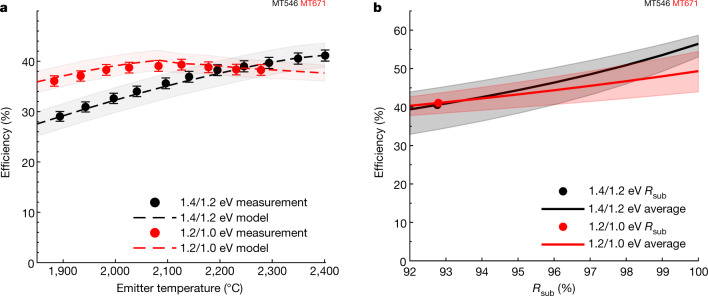
Thermophotovoltaics (TPVs) convert predominantly infrared wavelength light to electricity via the photovoltaic effect, and can enable approaches to energy storage1,2 and conversion3-9 that use higher temperature heat sources than the turbines that are ubiquitous in electricity production today. Since the first demonstration of 29% efficient TPVs (Fig. 1a) using an integrated back surface reflector and a tungsten emitter at 2,000 °C (ref. 10), TPV fabrication and performance have improved11,12. However, despite predictions that TPV efficiencies can exceed 50% (refs. 11,13,14), the demonstrated efficiencies are still only as high as 32%, albeit at much lower temperatures below 1,300 °C (refs. 13-15). Here we report the fabrication and measurement of TPV cells with efficiencies of more than 40% and experimentally demonstrate the efficiency of high-bandgap tandem TPV cells. The TPV cells are two-junction devices comprising III-V materials with bandgaps between 1.0 and 1.4 eV that are optimized for emitter temperatures of 1,900-2,400 °C. The cells exploit the concept of band-edge spectral filtering to obtain high efficiency, using highly reflective back surface reflectors to reject unusable sub-bandgap radiation back to the emitter. A 1.4/1.2 eV device reached a maximum efficiency of (41.1 ± 1)% operating at a power density of 2.39 W cm-2 and an emitter temperature of 2,400 °C. A 1.2/1.0 eV device reached a maximum efficiency of (39.3 ± 1)% operating at a power density of 1.8 W cm-2 and an emitter temperature of 2,127 °C. These cells can be integrated into a TPV system for thermal energy grid storage to enable dispatchable renewable energy. This creates a pathway for thermal energy grid storage to reach sufficiently high efficiency and sufficiently low cost to enable decarbonization of the electricity grid.
© 2022. The Author(s).
Conflict of interest statement
M.A.S. and E.J.T. worked on a similar project with Antora Energy.
Figures




References
-
- Amy C, Seyf HR, Steiner MA, Friedman DJ, Henry A. Thermal energy grid storage using multi-junction photovoltaics. Energy Environ. Sci. 2019;12:334–343. doi: 10.1039/C8EE02341G. - DOI
-
- Datas A, Ramos A, Martí A, del Cañizo C, Luque A. Ultra high temperature latent heat energy storage and thermophotovoltaic energy conversion. Energy. 2016;107:542–549. doi: 10.1016/j.energy.2016.04.048. - DOI
-
- Fraas, L. M. et al. TPV generators using the radiant tube burner configuration. In 17th European PV Solar Energy Conference Vol. 26(EUPVSEC, 2001).
-
- Fraas, L. M., Avery, J. E. & Han Xiang, H. Thermophotovoltaics: Heat and electric power from low bandgap solar cells around gas fired radiant tube burners. In Conference Record of the Twenty-Ninth IEEE Photovoltaic Specialists Conference 1553–1556 (IEEE, 2002).
-
- Yang WM, Chua KJ, Pan JF, Jiang DY, An H. Development of micro-thermophotovoltaic power generator with heat recuperation. Energy Convers. Manage. 2014;78:81–87. doi: 10.1016/j.enconman.2013.10.040. - DOI
Publication types
MeSH terms
LinkOut - more resources
Full Text Sources
Other Literature Sources
