. 2022 Jul;42(5):923-934.
doi: 10.1007/s10875-022-01231-7. Epub 2022 Apr 14.

SARS-CoV-2 Vaccine Responses in Individuals with Antibody Deficiency: Findings from the COV-AD Study

Collaborators, Affiliations

SARS-CoV-2 Vaccine Responses in Individuals with Antibody Deficiency: Findings from the COV-AD Study

Adrian M Shields et al. J Clin Immunol. 2022 Jul.

Abstract

Background: Vaccination prevents severe morbidity and mortality from COVID-19 in the general population. The immunogenicity and efficacy of SARS-CoV-2 vaccines in patients with antibody deficiency is poorly understood.

Objectives: COVID-19 in patients with antibody deficiency (COV-AD) is a multi-site UK study that aims to determine the immune response to SARS-CoV-2 infection and vaccination in patients with primary or secondary antibody deficiency, a population that suffers from severe and recurrent infection and does not respond well to vaccination.

Methods: Individuals on immunoglobulin replacement therapy or with an IgG less than 4 g/L receiving antibiotic prophylaxis were recruited from April 2021. Serological and cellular responses were determined using ELISA, live-virus neutralisation and interferon gamma release assays. SARS-CoV-2 infection and clearance were determined by PCR from serial nasopharyngeal swabs.

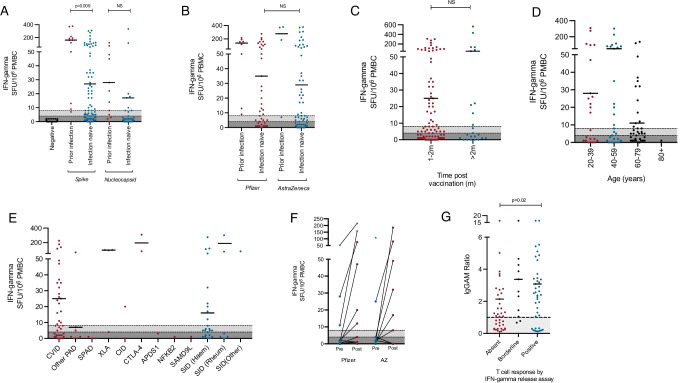
Results: A total of 5.6% (n = 320) of the cohort reported prior SARS-CoV-2 infection, but only 0.3% remained PCR positive on study entry. Seropositivity, following two doses of SARS-CoV-2 vaccination, was 54.8% (n = 168) compared with 100% of healthy controls (n = 205). The magnitude of the antibody response and its neutralising capacity were both significantly reduced compared to controls. Participants vaccinated with the Pfizer/BioNTech vaccine were more likely to be seropositive (65.7% vs. 48.0%, p = 0.03) and have higher antibody levels compared with the AstraZeneca vaccine (IgGAM ratio 3.73 vs. 2.39, p = 0.0003). T cell responses post vaccination was demonstrable in 46.2% of participants and were associated with better antibody responses but there was no difference between the two vaccines. Eleven vaccine-breakthrough infections have occurred to date, 10 of them in recipients of the AstraZeneca vaccine.

Conclusion: SARS-CoV-2 vaccines demonstrate reduced immunogenicity in patients with antibody deficiency with evidence of vaccine breakthrough infection.

Keywords: COVID-19; CVID; Inborn errors of immunity; Primary immunodeficiency; SARS-CoV-2; Secondary immunodeficiency; Vaccination.


Conflict of interest statement

The authors declare no competing interests.

Figures
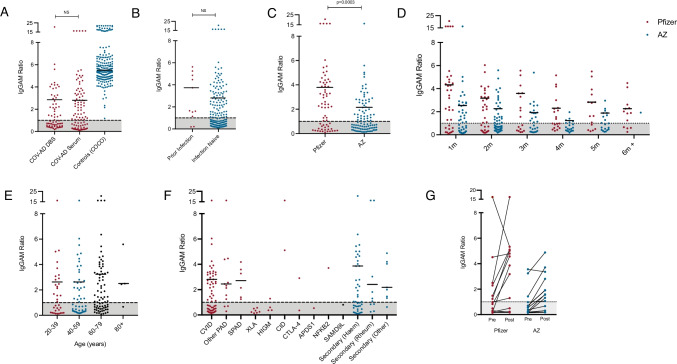
Fig. 1
Fig. 1
Serological responses to SARS-CoV-2 vaccination in individuals with antibody deficiency. Comparison of serological responses to SARS-CoV-2 vaccination in COV-AD participants. A COV-AD participants sampled 1–2 m post second vaccine dose via dried blood spot (DBS) or serum and in comparison to healthy controls (COCO). B Comparison of individuals with prior PCR proven infection and those who were infection naive sampled 1–2 m post second vaccine dose. C Comparison of recipients of the AstraZeneca ChAdOx1 nCoV-19 and the Pfizer BioNTech 162b2 vaccines sampled 1–2 m post second vaccine dose. D Comparison of serological responses over time from vaccination. E Comparison of serological responses across age groups in individuals sampled 1–2 m post second vaccine dose. F Comparison of serological responses by underlying immunodeficiency in participants samples 1–2 m post second vaccine dose. G Dynamic serological response before and after second vaccine dose. Results are presented as the IgGAM ratio with the grey shaded area representing the results below the cut-off for positivity. Horizontal bars represent the median of seropositive results
Fig. 2
Fig. 2
Cellular responses to SARS-CoV-2 vaccination in individuals with antibody deficiency. Comparison of cellular responses following SARS-CoV-2 vaccination in COV-AD participants using an IFN-gamma release assay. A Comparison of T cell responses to spike and nucleocapsid peptide pools in individuals with prior PCR proven SARS-CoV-2 infection and those who were infection naive, in participants sampled 1–2 m post second vaccine dose. B Comparison of cellular responses to spike peptide pools between the Pfizer and AstraZeneca vaccines in participants sampled 1–2 m post second vaccine dose. C Comparison of the cellular responses to spike peptide pools over time. D Comparison of the cellular responses to spike peptide pools by age in participants sampled 1–2 m post second vaccine dose. E Comparison of the cellular responses to spike peptide pools by underlying immunodeficiency in participants sampled 1–2 m post second vaccine dose. F Dynamic changes in cellular response to spike peptide pools before and after the second vaccine dose. G Relationship between the T cell response to spike peptide pools and the magnitude of the anti-spike antibody response in participants sampled 1–2 m post second vaccine dose. Results are presented as the number of IFN-gamma producing spots per 106 cells. Dark grey shaded areas represent no response, light grey shaded areas represent borderline response, as per the manufacturers’ instructions
Fig. 3
Fig. 3
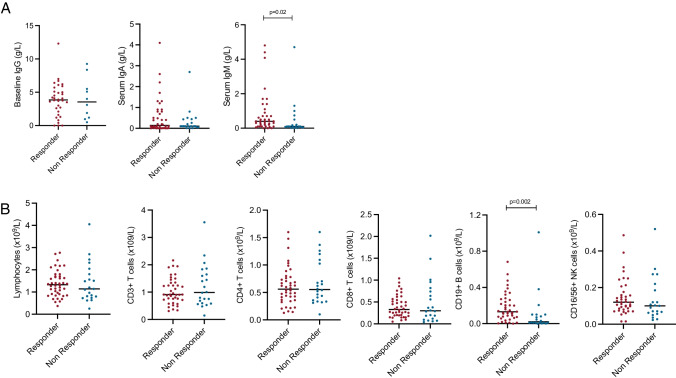
Correlates of seropositivity following SARS-CoV-2 vaccination in individuals with antibody deficiency. Comparison of pre-vaccination immunological parameters between seropositive and seronegative participants sampled 1–2 months following their second vaccine dose: A Pre-treatment serum IgG concentration and current serum IgA and IgM concentration. B Total lymphocyte count and lymphocyte subset enumeration
Fig. 4
Fig. 4
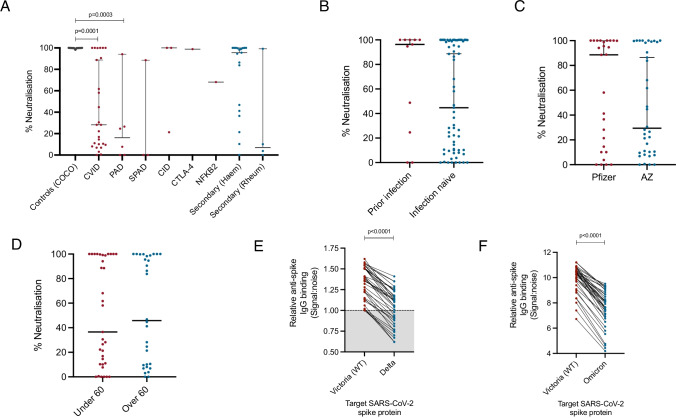
Functional immunity following SARS-CoV-2 vaccination in individuals with antibody deficiency. Serum neutralisation capacity was assessed using live virus neutralisation in seropositive individuals sampled 1–2 months post second vaccine dose. A Serum neutralising antibody capacity of seropositive individuals by underlying immunodeficiency. B Comparison of serum neutralising antibody capacity between individuals with prior PCR proven SARS-CoV-2 infection and those who were infection naive. C Comparison of serum neutralising antibody capacity between recipients of the Pfizer and AstraZeneca vaccinations. D Comparison of serum neutralising antibody capacity by age of participants. E Comparison of binding of vaccine-induced IgG antibodies from participants sampled 1–2 months post vaccination to the wild-type (Victoria) SARS-CoV-2 spike protein and the Delta variant of concern within an ELISA detection system. F Comparison of binding of vaccine-induced IgG antibodies from participants sampled 1–2 months post vaccination to the wild-type (Victoria) SARS-CoV-2 spike protein and the Omicron variant of concern within an ELISA detection system

References

    1. Weinreich DM, et al. REGEN-COV antibody combination and outcomes in outpatients with Covid-19. N Engl J Med. 2021. - PMC - PubMed
    1. Hanrath AT, Payne BAI, Duncan CJA, Prior SARS-CoV-2 infection is associated with protection against symptomatic reinfection. J Infect. 2020. - PMC - PubMed
    1. Lumley SF, et al. Antibody status and incidence of SARS-CoV-2 infection in health care workers. N Engl J Med. 2020. - PMC - PubMed
    1. Shields AM, et al. COVID-19: seroprevalence and vaccine responses in UK dental care professionals. J Dent Res. 2021;100(11):1220–1227. doi: 10.1177/00220345211020270. - DOI - PMC - PubMed
    1. Buckland MS, et al. Treatment of COVID-19 with remdesivir in the absence of humoral immunity: a case report. Nat Commun. 2020;11(1):6385. doi: 10.1038/s41467-020-19761-2. - DOI - PMC - PubMed

Publication types