. 2022 Apr 15;13(1):42.
doi: 10.1186/s40104-022-00689-0.

Heat shock protein family D member 1 in boar spermatozoa is strongly related to the litter size of inseminated sows

Affiliations

Heat shock protein family D member 1 in boar spermatozoa is strongly related to the litter size of inseminated sows

Won-Ki Pang et al. J Anim Sci Biotechnol. .

Abstract

Background: Sperm quality evaluation is the logical first step in increasing field fertility. Spermatozoa contain cytoplasmic organelles and biomolecules known as sperm-intrinsic factors, which play key roles in sperm maturation, sperm-oocyte fusion, and embryo development. In particular, sperm membrane proteins [e.g., arginine vasopressin receptor 2, beta-actin, prohibitin, and heat shock protein family D member 1 (HSPD1)] and RNA could be used as functional indicators of male fertility. We sought to clarify the effects of differential mRNA expression of selected genes on several fertilisation parameters, including sperm motility, motion kinematics, capacitation, and litter size, in a porcine model.

Results: Our results demonstrated that HSPD1 expression was significantly correlated with male fertility, as measured by the litter size of inseminated sows. The expression of HSPD1 mRNA was linked to sperm motility and other motion kinematic characteristics. Furthermore, HSPD1 had a 66.7% overall accuracy in detecting male fertility, and the high-litter size group which was selected with the HSPD1 marker had a 1.34 greater litter size than the low-litter size group.

Conclusions: Our findings indicate that HSPD1 might be a helpful biomarker for superior boar selection for artificial insemination, which could boost field fertility.

Keywords: Fertilisation; HSPD1; Male fertility; Sperm RNA; Sperm motility.


Conflict of interest statement

The authors declare that they have no competing interests.

Figures
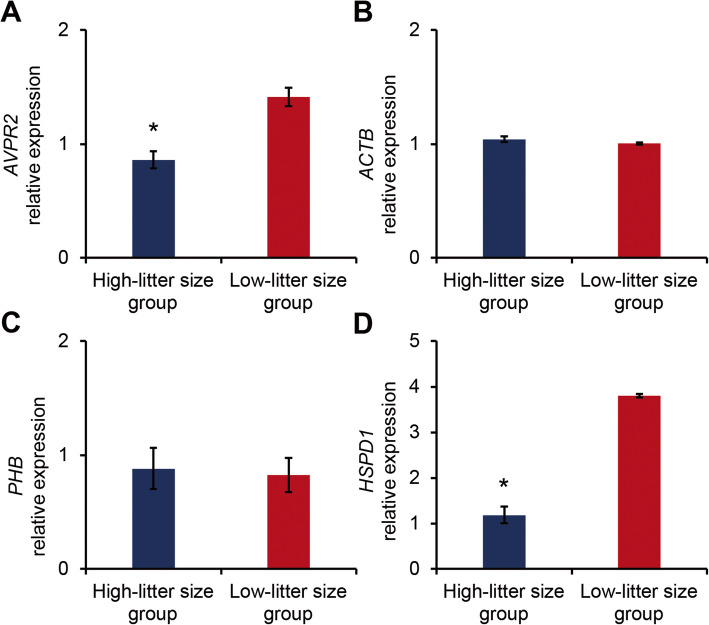
Fig. 1
Fig. 1
Beta-actin (ACTB), prohibitin (PHB), heat shock protein family D member 1 (HSPD1), and arginine vasopressin receptor 2 (AVPR2) mRNA expression in high- and low-litter size boar spermatozoa. Differences in marker candidate gene expression in the high-litter size (n = 3) and low-litter size (n = 3) spermatozoa groups based on the average litter sizes. A AVPR2 mRNA expression in boar spermatozoa with high- and low-litter sizes. B ACTB mRNA expression in boar spermatozoa with high- and low-litter sizes. C PHB mRNA expression in boar spermatozoa with high- and low-litter sizes. D HSPD1 mRNA expression in boar spermatozoa with high- and low-litter sizes. Relative expression was normalised to GAPDH expression. The data are expressed as the mean ± standard error of the mean (SEM); *P < 0.05
Fig. 2
Fig. 2
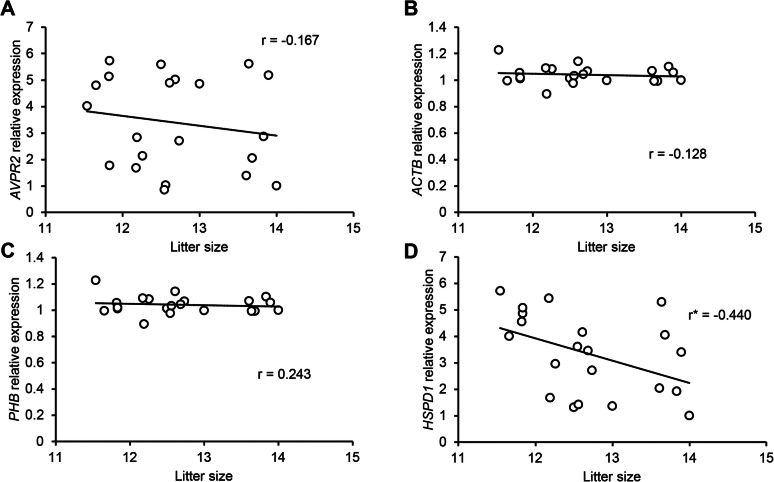
Correlation analysis between gene expression and pre-fertilisation parameters. A Linear regression of AVPR2 mRNA expression and litter size. B Linear regression of ACTB mRNA expression and litter size. C Linear regression of PHB mRNA expression and litter size. D Linear regression of HSPD1 mRNA expression and litter size. r, Pearson correlation coefficient; *P < 0.05, calculated via the linear regression test
Fig. 3
Fig. 3
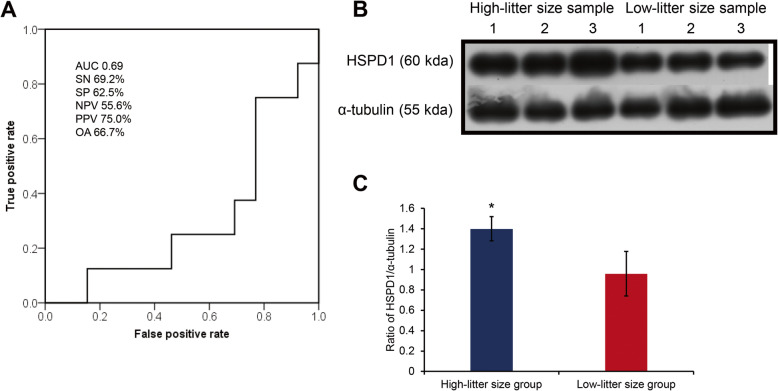
Quality assessment of HSPD1 mRNA marker and protein expression. A Receiver operating characteristic (ROC) curve of HSPD1 mRNA expression versus litter size. All the predictive parameters were calculated based on the average litter size (12.68) of samples. AUC, Area under the curve. Sensitivity (SN) is the percentage of boars showing true-positive results when tested with mRNA expression. Specificity (SP) is the percentage of boars showing true-negative results. The positive predictive value (PPV) is the percentage of boars that tested positive and also exhibited a true-positive litter size. The negative predictive value (NPV) is the percentage of boars that tested negative or simultaneously had a true-negative litter size. OA, Overall accuracy. B Western blotting image of HSPD1 and α-tubulin proteins. C Relative expression of HSPD1 in high- and low-litter size groups. The data are expressed as the mean ± SEM; *P < 0.05
Fig. 4
Fig. 4
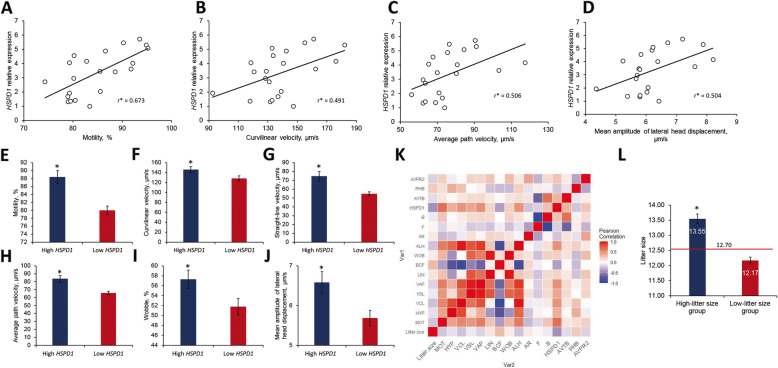
Fertility parameters linked to gene expression dysregulation. A Linear regression of HSPD1 expression and motility (%). B Linear regression of HSPD1 expression and curvilinear velocity (μm/s). C Linear regression of HSPD1 expression and average path velocity (μm/s). D Linear regression of HSPD1 expression and mean amplitude of lateral head displacement (μm/s). E Difference of motility in high- and low-HSPD1 expression groups. F Difference of curvilinear velocity (μm/s) in high- and low-HSPD1 expression groups. G Difference of straight-line velocity (μm/s) in high- and low-HSPD1 expression groups. H Difference of average path velocity (μm/s) in high- and low-HSPD1 expression groups. I Difference of wobble (%) in high- and low-HSPD1 expression groups. J Difference of mean amplitude of lateral head displacement (μm/s) in high- and low-HSPD1 expression groups. The average values of each fertility parameter were compared based on the cut-off values of HSPD1 expression (3.1798) from the ROC curves. K Correlation heatmap of all parameters. L Average litter size of high- and low-litter size groups separated by HSPD1 mRNA expression. The data are expressed as the mean ± SEM; *P < 0.05

References

    1. Vishwanath R. Artificial insemination: the state of the art. Theriogenology. 2003;59(2):571–584. doi: 10.1016/S0093-691X(02)01241-4. - DOI - PubMed
    1. Kwon WS, Rahman MS, Lee JS, Yoon SJ, Park YJ, Pang MG. Discovery of predictive biomarkers for litter size in boar spermatozoa. Mol Cell Proteomics. 2015;14(5):1230–1240. doi: 10.1074/mcp.M114.045369. - DOI - PMC - PubMed
    1. Van Blerkom J, Davis P, Merriam J, Sinclair J. Nuclear and cytoplasmic dynamics of sperm penetration, pronuclear formation and microtubule organization during fertilization and early preimplantation development in the human. Hum Reprod Update. 1995;1(5):429–461. doi: 10.1093/humupd/1.5.429. - DOI - PubMed
    1. Sutovsky P, Schatten G. Paternal contributions to the mammalian zygote: fertilization after sperm-egg fusion. Int Rev Cytol. 2000;195:1–65. - PubMed
    1. Sutovsky P. Review: sperm-oocyte interactions and their implications for bull fertility, with emphasis on the ubiquitin-proteasome system. Animal. 2018;12(s1):s121–s132. doi: 10.1017/S1751731118000253. - DOI - PMC - PubMed