Review
. 2021 Feb 10;11(12):6477-6503.
doi: 10.1039/d0ra09807h. eCollection 2021 Feb 4.

Tin-selenide as a futuristic material: properties and applications

Affiliations
Review

Tin-selenide as a futuristic material: properties and applications

Manoj Kumar et al. RSC Adv. .

Abstract

SnSe/SnSe2 is a promising versatile material with applications in various fields like solar cells, photodetectors, memory devices, lithium and sodium-ion batteries, gas sensing, photocatalysis, supercapacitors, topological insulators, resistive switching devices due to its optimal band gap. In this review, all possible applications of SnSe/SnSe2 have been summarized. Some of the basic properties, as well as synthesis techniques have also been outlined. This review will help the researcher to understand the properties and possible applications of tin selenide-based materials. Thus, this will help in advancing the field of tin selenide-based materials for next generation technology.


Conflict of interest statement

Authors declare no conflict of interest exists.

Figures

Fig. 1
Fig. 1. (a) Salient feature of tin selenide materials. (b) Crystal structure of SnSe, (c) SnSe having Pnma to Cmcm phase transition. This figure has been adapted/reproduced from ref. with permission from Elsevier, copyright 2018". (d) Crystal structure of SnSe2. This figure has been adapted/reproduced from ref. with permission from ACS, copyright 2016". (e) Equilibrium phase diagram of Sn–Se system. This figure has been adapted/reproduced from ref. with permission from Wiley, copyright 2020".
Fig. 2
Fig. 2. (a) Bridgeman–Stockbarger technique to grow a single crystal. (b) Schematic illustration for the synthesis of SnSe QDs by cathodic exfoliation. This figure has been adapted/reproduced from ref. with permission from RSC, copyright 2019" (c) schematic synthesis process for the SnSe nanosheets by the liquid-phase exfoliation method includes two main steps: Li± hydrothermal intercalation and sonication-assisted exfoliation. This figure has been adapted/reproduced from ref. with permission from Wiley, copyright 2020". SEM images showing the evolution of the SnSex nanostructures concerning the growth temperature, (d) large flakes with diameters of several microns grown at 450 °C, with a thickness of ∼60 nm shown in the inset, (e) high yield of nanowire growth at 500 °C. This figure has been adapted/reproduced from ref. with permission from Wiley, copyright 2020".
Fig. 3
Fig. 3. TEM image (a) and (b) SnSe2 nanoplates and high resolution TEM (HRTEM) images (c) side, and (d) top views. This figure has been adapted/reproduced from ref. with permission from RSC, copyright 2011".
Fig. 4
Fig. 4. (a) Schematic show of the SnSe2 structure and the quantum dot (QD) fabrication process, and (b) TEM image of SnSe2 QDs with a centrifugal speed of 6000 rpm. These figures has been adapted/reproduced from ref. with permission from MDPI, copyright 2019". (c) Low-magnification TEM image of a SnSe2 flake, (d) corresponding HRTEM image of the flake, (e) electron diffraction pattern from the same flake, (f) schematic diagram of the chemical vapor deposition method, and (g) a typical atomic force microscope (AFM) image at the flake edge, and the height profile showing a thickness of ∼1.5 nm. These figures has been adapted/reproduced from ref. with permission from Wiley, copyright 2015".
Fig. 5
Fig. 5. Various applications are based on SnSe materials. Solar cell, this figure has been adapted/reproduced from ref. with permission from ACS, copyright 2010". Battery electrode, this figure has been adapted/reproduced from ref. with permission from Elsevier, copyright 2020". Gas sensor, this figure has been adapted/reproduced from ref. with permission from ACS, copyright 2019". Photocatalysis, this figure has been adapted/reproduced from ref. with permission from Scielo, copyright 2017". Thermoelectric, this figure has been adapted/reproduced from ref. with permission from Elsevier, copyright 2018". Supercapacitor, this figure has been adapted/reproduced from ref. with permission from ACS, copyright 2014". Memory devices, this figure has been adapted/reproduced from ref. with permission from AIP, copyright 2014". And photodetector, this figure has been adapted/reproduced from ref. with permission from Elsevier, copyright 2020".
Fig. 6
Fig. 6. (a) HRTEM image of a single nanocrystal. (b) Selected area electron diffraction (SAED) pattern of SnSe. (c) Low-resolution TEM image of SnSe nanocrystals. (d) The device structure of SnSe solar cells. These figures has been adapted/reproduced from ref. with permission from ACS, copyright 2010".
Fig. 7
Fig. 7. The ZT of SnSe for Pnma (a), Cmcm (b) phases and comparison between experimental data and calculated data (c). These figures has been adapted/reproduced with permission from Elsevier, copyright 2018".
Fig. 8
Fig. 8. (a) Total thermal conductivity of polycrystalline SnSe–PbSe (5 mol %) doped with 1 mol% Na for pristine, Reduced (R), and Ball milled then Reduced (BR) samples taken parallel to the press direction of SPS, and total thermal conductivity compared with undoped SnSe and Na doped SnSe, and (b) ZT of polycrystalline SnSe–PbSe (5 mol %) doped with 1 mol% Na for pristine, Reduced (R), and Ball milled then Reduced (BR), and ZT compared with the undoped SnSe and Na doped SnSe.. These figures has been adapted/reproduced from ref. with permission from Elsevier, copyright 2019".
Fig. 9
Fig. 9. Variation of ZT with the doping element given in bracket, where blank () shows the undoped SnSe.
Fig. 10
Fig. 10. (a) Figure of merit (ZT) of SnCuxSe2 (x = 0, 0.01, 0.02, 0.05) as a function of temperature. This figure has been adapted/reproduced from ref. with permission from ACS, copyright 2020". (b) Variation of ZT with different doping elements, irrespective of operating temperature, where blank () represents undoped SnSe2, and Pred. 1 and Pred. 2 mean theoretical predicted values, respectively.
Fig. 11
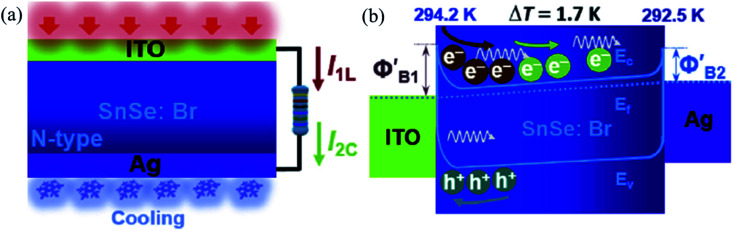
Fig. 11. Schematic working state (a) and energy band diagram (b) of the device under the combined action of light illumination and cooling (I1L = photovoltaic current, I2C = thermocurrent). Reprinted with permission from. These figures has been adapted/reproduced from ref. with permission from Elsevier, copyright 2019".
Fig. 12
Fig. 12. (a) Schematic of selenization of DC sputtered Sn film and (b) thickness-dependent SnSe2 thin films' responsivity. These figures has been adapted/reproduced from ref. with permission from Nature, copyright 2017". (c) Responsivity and photocurrent with power density at different bias voltage and, (d) response and recovery time at 400 mV bias, these figures has been adapted/reproduced from ref. with permission from Elsevier, copyright 2020".
Fig. 13
Fig. 13. The most stable sites of optimized configurations of the adsorbate molecules: (a) CO, (b) CO2, (c) CH2O, (d) O2, (e) NO2, and (f) SO2 adsorbed on a β-SnSe monolayer. Most stable sites are exhibited. These figures has been adapted/reproduced with permission from MDPI, copyright 2019".
Fig. 14
Fig. 14. (a) Low magnification TEM images, (b) schematic structure of the device, (c) transient response of the sensor SnO2/SnSe to CO (100–1000 ppm) at 260 μC. These figures has been adapted/reproduced from ref. with permission from Nature, copyright 2013". (d) SEM image of a semi hexagonal nanosheet of SnSe2, (e) optical image of a 6 nm thick SnSe2 gas sensor device, (f) dynamic sensing responses of the 6 nm thick SnSe2 resistor device measured with 405 nm laser illumination. These figures has been adapted/reproduced from ref. with permission from ACS, copyright 2019".
Fig. 15
Fig. 15. Indicative representation of photodegradation of RhB dye in the presence of UV light. In a typical experiment, the various dyes' degradation rate is checked using eqn (3). These figures has been adapted/reproduced from ref. with permission from Scielo, copyright 2017".
Fig. 16
Fig. 16. (a) The temperature dependence of resistance for the SLL SS/S and GST thin films at a constant heating rate of 10 °C min−1, and (b) reversible reflectivity evolution of SLL [SS(10)/S(2)] thin film induced by two consecutive picosecond laser pulses with different fluencies: (i) crystallization process and (ii) amorphization process. These figures has been adapted/reproduced from ref. with permission from AIP, copyright 2016".

References

    1. Lokhande A. C. Qattan I. A. Lokhande C. D. Patole S. P. J. Mater. Chem. A. 2020;8:918–977. doi: 10.1039/C9TA10667G. - DOI
    1. Lokhande A. C. Babar P. T. Karade V. C. Gang M. G. Lokhande V. C. Lokhande C. D. Kim J. H. J. Mater. Chem. A. 2019;7:17118–17182. doi: 10.1039/C9TA00867E. - DOI
    1. Ali I. Suhail M. Alothman Z. A. Alwarthan A. RSC Adv. 2018;8:30125–30147. doi: 10.1039/C8RA06517A. - DOI - PMC - PubMed
    1. Wang J. Chen R. Xiang L. Komarneni S. Ceram. Int. 2018;44:7357–7377. doi: 10.1016/j.ceramint.2018.02.013. - DOI
    1. Chung K. M. Wamwangi D. Woda M. Wuttig M. Bensch W. J. Appl. Phys. 2008;103:083523. doi: 10.1063/1.2894903. - DOI