Review
. 2021 Jan 11;11(4):2253-2291.
doi: 10.1039/d0ra08041a. eCollection 2021 Jan 6.

Organic dots (O-dots) for theranostic applications: preparation and surface engineering

Affiliations
Review

Organic dots (O-dots) for theranostic applications: preparation and surface engineering

Amin Shiralizadeh Dezfuli et al. RSC Adv. .

Abstract

Organic dots is a term used to represent materials including graphene quantum dots and carbon quantum dots because they rely on the presence of other atoms (O, H, and N) for their photoluminescence or fluorescence properties. They generally have a small size (as low as 2.5 nm), and show good photostability under prolonged irradiation. The excitation and emission wavelengths of O-dots can be tailored according to their synthetic procedure, where although their quantum yield is quite low compared with organic dyes, this is partly compensated by their large absorption coefficients. A wide range of strategies have been used to modify the surface of O-dots for passivation, improving their solubility and biocompatibility, and allowing the attachment of targeting moieties and therapeutic cargos. Hybrid nanostructures based on O-dots have been used for theranostic applications, particularly for cancer imaging and therapy. This review covers the synthesis, physics, chemistry, and characterization of O-dots. Their applications cover the prevention of protein fibril formation, and both controlled and targeted drug and gene delivery. Multifunctional therapeutic and imaging platforms have been reported, which combine four or more separate modalities, frequently including photothermal or photodynamic therapy and imaging and drug release.


Conflict of interest statement

There are no conflicts to declare.

Figures

Fig. 1
Fig. 1. Four aspects of theranostic agents: (1) cargo delivery (e.g. cells, proteins, nucleic acids, nanotherapeutics and drugs), (2) imaging via different imaging modalities (OI: optical imaging, US: ultrasound imaging, PET: positron emission tomography, SPECT: single-photon emission computed tomography, MRI: magnetic resonance imaging, and CT: computed tomography), (3) stimuli responsiveness to either external or internal or both stimuli and (4) independent therapeutic functions.
Fig. 2
Fig. 2. (a) Formation of type I and type II carbon dots starting from citric acid as the carbon precursor. The intermediate “primary fluorophores” is a nominal unit. (b and c) Schematic illustration of the luminescence of O-dots upon excitation, which is related to their size. (d) Typical absorption spectra of O-dots.
Fig. 3
Fig. 3. Schematic illustration of the structure of this review.
Fig. 4
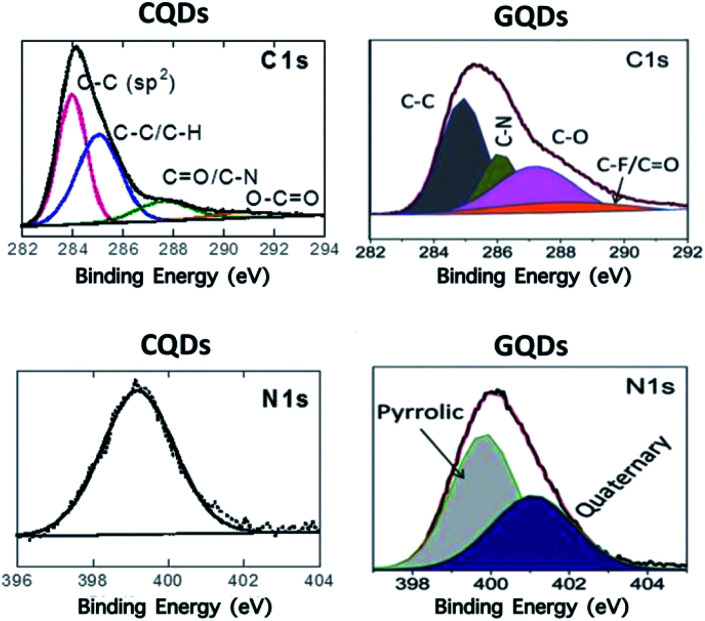
Fig. 4. Characteristics of organic dots. XPS bonds of CQDs (hydrothermal synthesis using 4-aminophenylboronic acid) (reproduced from ref. with permission from the American Chemical Society, Copyright 2016).
Fig. 5
Fig. 5. Properties of organic dots. Both GQDs and CQDs possess various optical properties including high UV and NIR absorption, photosensitizing nature and high photo-stability.
Fig. 6
Fig. 6. Toxicity of O-dots. The parameters involved in the toxicity of O-dots are demonstrated above. These parameters define the mechanism of impact and together cause damage and alterations in biological systems. Some of these effects lead to cell death, while others may cause malfunctioning.
Fig. 7
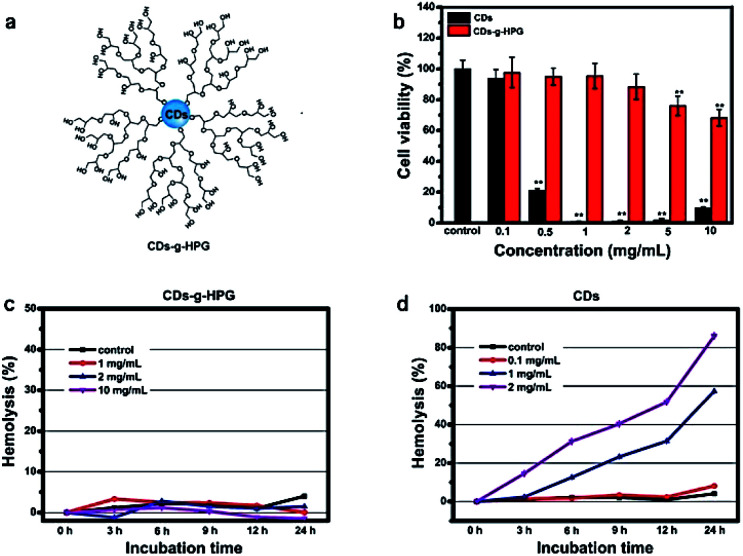
Fig. 7. (a) Structure of carbon quantum dots coated with HPG. (b) Cell viability of A549 cells after incubation with CDs or CDs-g-HPG at different concentrations for 24 h (c) and (d) lysis rate of RBCs incubated with CD-g-HPG and CD respectively (figure reproduced from S. Li, Z. Guo, R. Feng, Y. Zhang, W. Xue and Z. Liu, RSC Adv., 2017, 7, 4975, Published by The Royal Society of Chemistry).
Fig. 8
Fig. 8. Cytotoxicity assays of GQDs. (a) Cell viability results via WST-1 assay under 24 h of exposure with GQDs at different concentrations. (b) Rate of apoptosis in the cells treated with GQDs, obtained from flow cytometry with annexin-V-FITC/PI staining. (c) Quadrant analysis of the flow (figure has been reproduced from ref. with permission from Elsevier, Copyright 2019).
Fig. 9
Fig. 9. Toxicity assays of graphene quantum dots. (a) WST-1 assay, (b) cell apoptosis and necrosis results, (c) LDH assay, (d) ROS generation assay, (e) weight of surviving mice with no difference compared with the control group, (f) effect of PEG-GQD and PEG-GO injection seven times into the mice and their living status, which is lower in GO. (g) Weight indexes of the main organs collected on day 40 from the mice injected with PEG-GO and PEG-GQDs, which indicates abnormality in the PEG-GO group. All these assays together demonstrate the low toxicity of GQDs (Figure has been reproduced from ref. with permission from Elsevier, Copyright 2014).
Fig. 10
Fig. 10. Synthetic approaches for O-dots. (a) Top-down methods including laser ablation, hydrothermal, arc discharge and electrochemical methods with mentioned resources. (b) Bottom-top methods including ultrasonic, microwave pyrolysis and hydrothermal methods with the mentioned carbon precursors.
Fig. 11
Fig. 11. Major top-down synthetic methods. (a) Electrochemical oxidation is performed in electrolytic cells, which can be divided into two types. (1) One electrode is made of carbon, while the other one is platinum. The carbon electrode in this electrolytic cell acts as a carbon precursor. (2) In the second type of cell, both electrodes are made of platinum, and the carbon precursors are dispersed in the medium. (b) Laser ablation method. Laser irradiation is used as a source of energy to break down graphite into carbon atoms and form GQDs or CQDs in the medium. (c) Arc discharge between two electrodes in a gas-filled tube cut out of carbon atoms from powdered carbon. Carbon atoms drift into the cathode forming carbon structures.
Fig. 12
Fig. 12. Electrochemical preparation of GQD from MWCNT. Electrochemical oxidation of MWCNTs and subsequent electrochemical reduction leads to break down of sheets and electrostatic repulsion, respectively.
Fig. 13
Fig. 13. GQD functionalization and modification with other elements. Functional groups and heteroatoms add different properties to GQDs (i.e. increase in solubility, better photoluminescence and catalytic properties).
Fig. 14
Fig. 14. Interaction of O-dots with biological components. (a) O-dots prevent protein fibrillation by preventing the interaction of protein subunits with each other. (b) O-dots cause disruption in cellular membrane integrity, enter cells via endocytosis and cause chemical variations in membranes, leading to cell lysis and changes in photoluminescence. (c) O-dots attach to nucleic acids via electrostatic interaction and make conformational changes in them.
Fig. 15
Fig. 15. Interaction of O-dots with body fluids and the brain blood barrier. (a) O-dots can interact with body fluid components, specifically proteins. (b) O-dots can pass through the BBB via passive and active transport.
Fig. 16
Fig. 16. Schematic of the biomedical applications of organic dots.
Fig. 17
Fig. 17. Gene therapy based on graphene quantum dots. Several parameters should be considered in gene delivery and gene therapy. (a) Number of layers and surface modification of GQDs play a key role in the loading capacity of the particles. (b) Size, electrical charge, hydrophobicity and surface chemistry of GQDs are important parameters in their structural stability and longer circulation. (c) Electrical charge, condensation, nature and amount of cargo, synthetic method and modifications would change the size of the particles, which leads to altered performance. (d) Nucleic acid loading and changes in size determine the net charge of the particles. (e) Different properties of the GQD complex determine the route of its entrance into cells.
Fig. 18
Fig. 18. Schematic illustration of phototherapy methods based on organic dots. O-dots can act as photosensitizers or they can be coated or filled with other photosensitizers. Excitation of O-dots and their subsequent loss of energy to lower energy states lead to the generation of ROS.
Fig. 19
Fig. 19. (a) Confocal laser-scanning microscopy (CLSM) images of HeLa cells incubated with N–O-CDs (100 μg mL−1) excited by 405 nm. (b). In vivo fluorescence imaging of the tumor site from a mouse intratumor injected with N–O-CDs at 0 h, 5 min, 1 h, and 3 h post-treatment. The color bars represent the fluorescence intensity. Red circles indicate the position of the implanted tumor. (c) Synthetic procedure of N–O-CQDs (this figure has been reproduced from ref. with permission from Elsevier, Copyright 2018).
Fig. 20
Fig. 20. (a and d) Schematic illustration of the ZIF-8/GQD nanoparticles with encapsulation of Dox molecules and synergistic Dox delivery and photo thermal therapy. (b and d) Dox-CuS@GQDs nanoparticles and their therapeutic function. (c and d) Schematic illustration of drug loading and release from mesoporous silica nanoparticles capped with GQDs and their function.
Fig. 21
Fig. 21. Schematic illustration of combined therapy. Combined therapeutic systems possess 2 or 3 of these properties.

References

    1. Rivas A. L. Hoogesteijn A. L. Antoniades A. Tomazou M. Buranda T. Perkins D. J. Fair J. M. Durvasula R. Fasina F. O. Tegos G. P. Van Regenmortel M. H. V. Front. Immunol. 2019 doi: 10.3389/fimmu.2019.01258. - DOI - PMC - PubMed
    1. Visvader J. Lindeman G. J. Cell Stem Cell. 2012 doi: 10.1016/j.stem.2012.05.007. - DOI - PubMed
    1. Zugazagoitia J. Guedes C. Ponce S. Ferrer I. Molina-Pinelo S. Paz-Ares L. Clin. Ther. 2016;38:1551–1566. doi: 10.1016/j.clinthera.2016.03.026. - DOI - PubMed
    1. W. H. Organization, Guide to Cancer Early Diagnosis, 2017
    1. Bhatkoti P. Paul M. IEEE Xplore. 2016 doi: 10.1109/IVCNZ.2016.7804459. - DOI