Review
. 2022 Apr 16;19(1):97.
doi: 10.1186/s12974-022-02454-6.

The macrophage: a key player in the pathophysiology of peripheral neuropathies

Affiliations
Review

The macrophage: a key player in the pathophysiology of peripheral neuropathies

Zeina Msheik et al. J Neuroinflammation. .

Abstract

Macrophages are present in all mammalian tissues and coexist with various cell types in order to respond to different environmental cues. However, the role of these cells has been underestimated in the context of peripheral nerve damage. More importantly, macrophages display divergent characteristics, associated with their origin, and in response to the modulatory effects of their microenvironment. Interestingly, the advent of new techniques such as fate mapping and single-cell transcriptomics and their synergistic use has helped characterize in detail the origin and fate of tissue-resident macrophages in the peripheral nervous system (PNS). Furthermore, these techniques have allowed a better understanding of their functions from simple homeostatic supervisors to chief regulators in peripheral neuropathies. In this review, we summarize the latest knowledge about macrophage ontogeny, function and tissue identity, with a particular focus on PNS-associated cells, as well as their interaction with reactive oxygen species under physiological and pathological conditions. We then revisit the process of Wallerian degeneration, describing the events accompanying axon degeneration, Schwann cell activation and most importantly, macrophage recruitment to the site of injury. Finally, we review these processes in light of internal and external insults to peripheral nerves leading to peripheral neuropathies, the involvement of macrophages and the potential benefit of the targeting of specific macrophages for the alleviation of functional defects in the PNS.

Keywords: Macrophage polarization; Nerve-resident macrophages; Neuroinflammation; Oxidative stress; Peripheral neuropathy; Wallerian degeneration.


Conflict of interest statement

The authors declare that they have no competing interests.

Figures
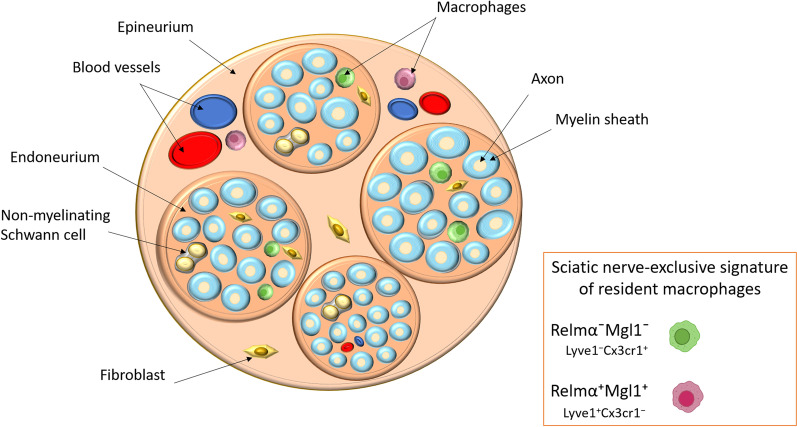
Fig. 1
Fig. 1
Schematic cross section of the sciatic nerve. RelmαMgl1 is an exclusive “fingerprint” of resident macrophages in the sciatic nerve in normal physiological state. Using confocal microscopy, RelmαMgl1 Lyve1Cx3cr1+ macrophages are located inside the endoneurium and are more abundant than Relmα+Mgl1+Lyve1+Cx3cr1 macrophages found in the epineurium connective tissue. The epineurial Relmα+Mgl1+ sciatic nerve macrophages were often found to be associated with blood vessels, a characteristic not observed in endoneurial RelmαMgl1 macrophages [34]. The scale is arbitrary for visual clarity reasons
Fig. 2
Fig. 2
A schematic representation of the key players along the Wallerian degeneration pathway. Nmnat2 activity can be disrupted by intrinsic causes (Nmnat2 gene mutation, Nmnat2 inhibition, or axonal failure) or by extrinsic insults due to axonal injury. Nmnat2 is the normal axonal synthetic enzyme for NAD+ (nicotinamide adenine dinucleotide). When Nmnat2 activity is stopped, SARM1 is activated and through dimerization of its Toll/interleukin-1 receptor (TIR) domain, triggers a rapid breakdown of NAD+ into ADPR (adenosine diphosphate ribose), cADPR (cyclic adenosine diphosphate ribose), and nicotinamide (NAM). Exactly how SARM1 is activated is still debated. One explanation is that the accumulation of Nmnat2 substrate, nicotinamide mononucleotide (NMN), can activate SARM1 [85]. NAD+ depletion (through both blockade of Nmnat2 and activation of SARM1) and ADPR /cADPR accumulation (products of SARM1) are suggested to cause energetic and cytoskeletal perturbations, respectively, thereby mediating axon degeneration distal to the injury site. This is followed by SC activation and macrophage recruitment
Fig. 3
Fig. 3
Schematic summary of the inflammatory process taking place in the peripheral axon. Monocyte recruitment and ROS production are common pathological mechanisms in many peripheral neuropathies of various causes. Several mechanisms take place simultaneously. Activated Schwann cells (SC) transdifferentiate to clear debris and recruit blood monocytes through the secretion of monocyte chemoattractant protein 1 (MCP-1/CCL2). In addition, repair SC and local fibroblasts express and secrete colony stimulating factor 1 (CSF1) to mobilize resident macrophages. Damage associated molecular patterns (DAMPs) also polarize macrophages. The on-site macrophages present a spectrum of phenotypes between M1-like macrophages and M2-like macrophages. Resolution of neuroinflammation (in a critical time-window) through intrinsic regulation or management of the external insult (e.g. correcting hyperglycaemia or withdrawing neurotoxins), likely results in reversible damage that only mildly affects nerve functionality. However, unresolved inflammation can cause tissue remodelling and fibrosis, severely affecting nerve function. AGE: advanced glycation end-products. ER: endoplasmic reticulum. UPR: unfolded protein response

References

    1. Guilliams M, Thierry GR, Bonnardel J, Bajenoff M. Establishment and Maintenance of the Macrophage Niche. Immunity. 2020;52:434–451. doi: 10.1016/j.immuni.2020.02.015. - DOI - PubMed
    1. Heumann R, Korsching S, Bandtlow C, Thoenen H. Changes of nerve growth factor synthesis in nonneuronal cells in response to sciatic nerve transection. J Cell Biol. 1987;104:1623–1631. doi: 10.1083/jcb.104.6.1623. - DOI - PMC - PubMed
    1. La Fleur M, Underwood JL, Rappolee DA, Werb Z. Basement membrane and repair of injury to peripheral nerve: defining a potential role for macrophages, matrix metalloproteinases, and tissue inhibitor of metalloproteinases-1. J Exp Med. 1996;184:2311–2326. doi: 10.1084/jem.184.6.2311. - DOI - PMC - PubMed
    1. Perrin FE, Lacroix S, Avilés-Trigueros M, David S. Involvement of monocyte chemoattractant protein-1, macrophage inflammatory protein-1alpha and interleukin-1beta in Wallerian degeneration. Brain J Neurol. 2005;128:854–866. doi: 10.1093/brain/awh407. - DOI - PubMed
    1. Shamash S, Reichert F, Rotshenker S. The cytokine network of Wallerian degeneration: tumor necrosis factor-alpha, interleukin-1alpha, and interleukin-1beta. J Neurosci Off J Soc Neurosci. 2002;22:3052–3060. doi: 10.1523/JNEUROSCI.22-08-03052.2002. - DOI - PMC - PubMed
