


Preliminary evidence of key factors in successful flipping: predicting positive student experiences in flipped classrooms
- PMID: 35431321
- PMCID: PMC8990668
- DOI: 10.1007/s10734-022-00848-2
Preliminary evidence of key factors in successful flipping: predicting positive student experiences in flipped classrooms
Abstract
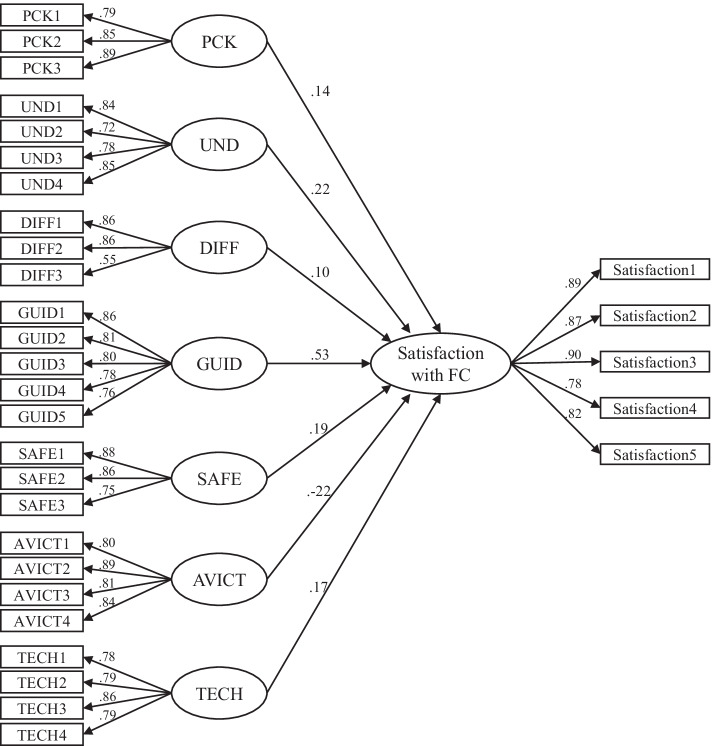
Flipped classrooms have become widely adopted in educational settings (e.g., in higher education) worldwide. However, there is a need for more precise understanding of the ingredients for student satisfaction in a flipped setting. The aim of this paper was to investigate university students' experiences of the factors that create a successful flipped course. Ten measures were used to investigate the hypothesized factors affecting satisfaction, which were chosen based on the results from previous flipped classroom studies and higher educational research. These measures were grouped into three dimensions: (1) pedagogical (five measures), (2) social (three measures), and (3) technological (two measures). Exploratory factor analysis was run to analyze the adequacy of the instruments. Results revealed that the factor structure was as expected and that the instruments measuring all ten factors of teaching and learning in a flipped classroom were adequate. Furthermore, confirmatory factor analysis was used to formally operationalize the hypothesized latent constructs, and to build a structural equation model for predicting the student satisfaction of a flipped classroom. In the end, seven factors were found to predict student satisfaction with flipped courses. The highest predictor was guidance from the dimension of pedagogy, and the second-best predictor was experienced teaching for understanding. The results, limitations, and conclusion are discussed in terms of key issues and the development of a flipped classroom pedagogical design for higher education.
Keywords: Flipped classroom; Higher education; Learning experience; Quantitative research methods.
© The Author(s) 2022.
Conflict of interest statement
Conflicts of interestThe authors declare that they have no conflict of interest.
Figures
References
-
- Abeysekera L, Dawson P. Motivation and cognitive load in the flipped classroom: Definition, rationale and a call for research. Higher Education Research & Development. 2015;34(1):1–14. doi: 10.1080/07294360.2014.934336. - DOI
-
- Akçayır G, Akçayır M. The flipped classroom: A review of its advantages and challenges. Computers & Education. 2018;126:334–345. doi: 10.1016/j.compedu.2018.07.021. - DOI
-
- Alexander, B., Ashford-Rowe, K., Barajas-Murph, N., Dobbin, G., Knott, J., McCormack, M., Pomerantz, J., Seilhamer, R., & Weber, N. (2019). EDUCAUSE horizon report 2019 higher education edition (pp. 3–41). EDUCAUSE.
-
- Awidi IT, Paynter M. The impact of a flipped classroom approach on student learning experience. Computers & Education. 2019;128:269–283. doi: 10.1016/j.compedu.2018.09.013. - DOI
-
- Baert, H., De Rick, K., & Van Valckenborgh, K. (2006). Towards the conceptualisation of learning climate. Adult Education: New Routes in a New Landscape, 87–111.
LinkOut - more resources
Full Text Sources