. 2022 Mar 31:13:843106.
doi: 10.3389/fimmu.2022.843106. eCollection 2022.

Visual Analysis of Colorectal Cancer Immunotherapy: A Bibliometric Analysis From 2012 to 2021

Affiliations

Visual Analysis of Colorectal Cancer Immunotherapy: A Bibliometric Analysis From 2012 to 2021

Long Ma et al. Front Immunol. .

Abstract

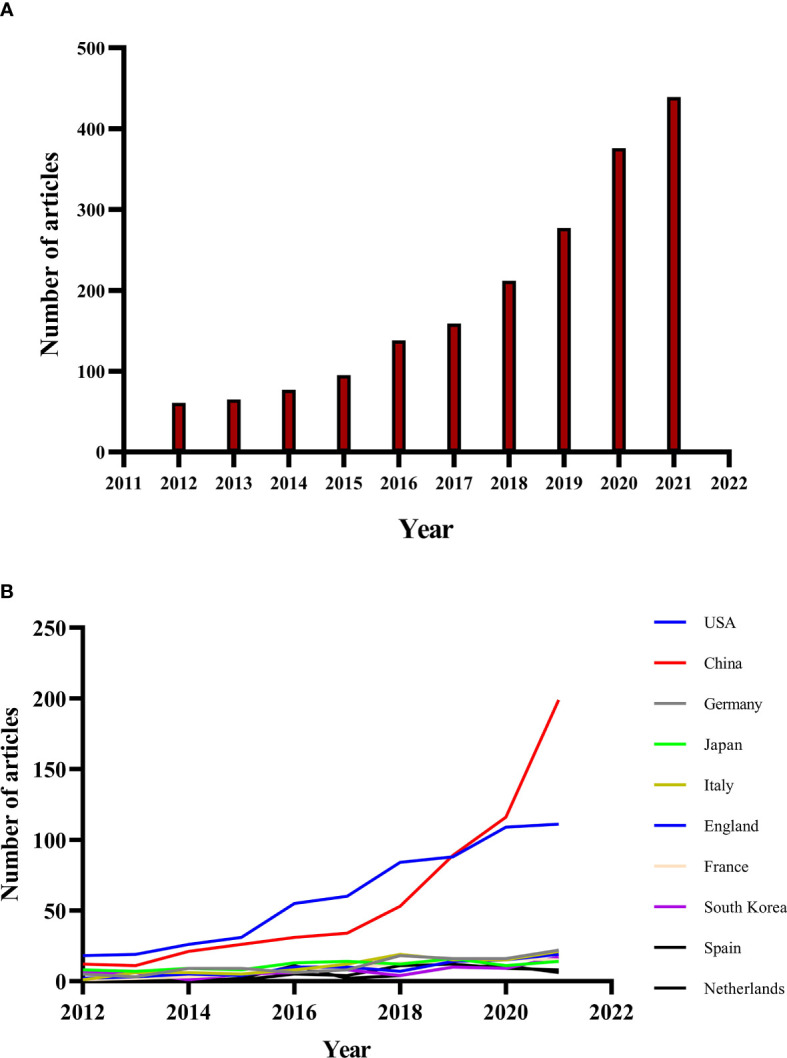
An increasing number of studies have shown that immunotherapy serves a significant role in treating colorectal cancer (CRC) and has become a hotspot. However, few studies used the bibliometric method to analyze this field comprehensively. This study collected 1,899 records of CRC immunotherapy from 2012 to October 31, 2021, and used CiteSpace to analyze regions, institutions, journals, authors, and keywords to predict the latest trends in CRC immunotherapy research. The United States and China, contributing more than 60% of publications, were the main drivers in this field. Sun Yat-sen University was the most active institution, while the National Cancer Institute had the highest frequency of citations. Most publications were published in the Journal for Immunotherapy of Cancer. Adam E Snook was the most prolific writer, while Dung T. Le was the most commonly co-cited author. "T cell", "MMI" and "PD-1blocked" were the most widely studied aspects of CRC immunotherapy. "Immune checkpoint inhibitor", "combination therapy", "drug therapy" and "liver metastases" were current research hotspots. "Tumor microenvironment", "neutrophils", "tumor-associated macrophages", and "suppressor cell" have emerged as research hotspots in recent years. "Gut microbiota", "nanoparticle" and "tumor mutational burden" as recently emerged frontiers of research that should be closely monitored.

Keywords: CiteSpace; bibliometric; colorectal cancer; gut microbiota; immune checkpoint; immunotherapy.


Conflict of interest statement

The authors declare that the research was conducted in the absence of any commercial or financial relationships that could be construed as a potential conflict of interest.

Figures

Figure 1
Figure 1
Flowchart depicting the article selection process.
Figure 2
Figure 2
(A) Annual publications of immunotherapy in colorectal cancer from 2012 to 2021. (B) The country’s annual trend publications related to colorectal cancer immunotherapy from 2012 to 2021.
Figure 3
Figure 3
A visual map for CiteSpace network of countries/regions and institutions associated with colorectal cancer immunotherapy. (A) Country/regional collaboration analysis; (B) Institutional collaboration analysis. The nodes represent countries/regions or institutions, and the lines connect them. Nodes represent countries/regions or institutions. The number of publications grows proportionally to the size of the nodes. The lines between the nodes represent the cooperation relationship, and the thickness of the connecting lines represents the strength of their cooperation, the closer the cooperation, the thicker the connecting lines. the nodes with the outermost purple circles have higher centrality. From 2012 to 2021, the color changes from brown to green.
Figure 4
Figure 4
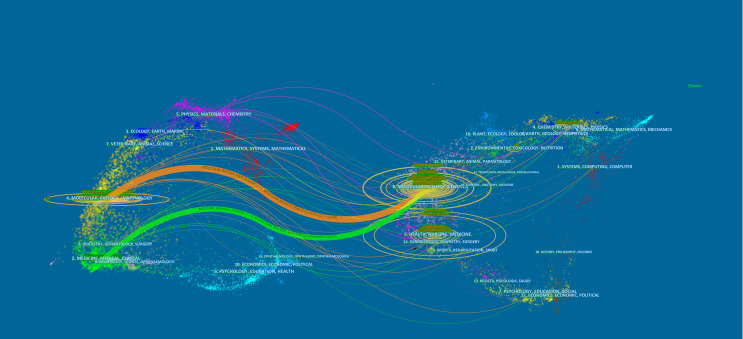
The dual-map overlay of journals related to colorectal cancer immunotherapy. Notes: On the left were the citing journals, on the right were the cited journals, and the colored path represented the citation relationship.
Figure 5
Figure 5
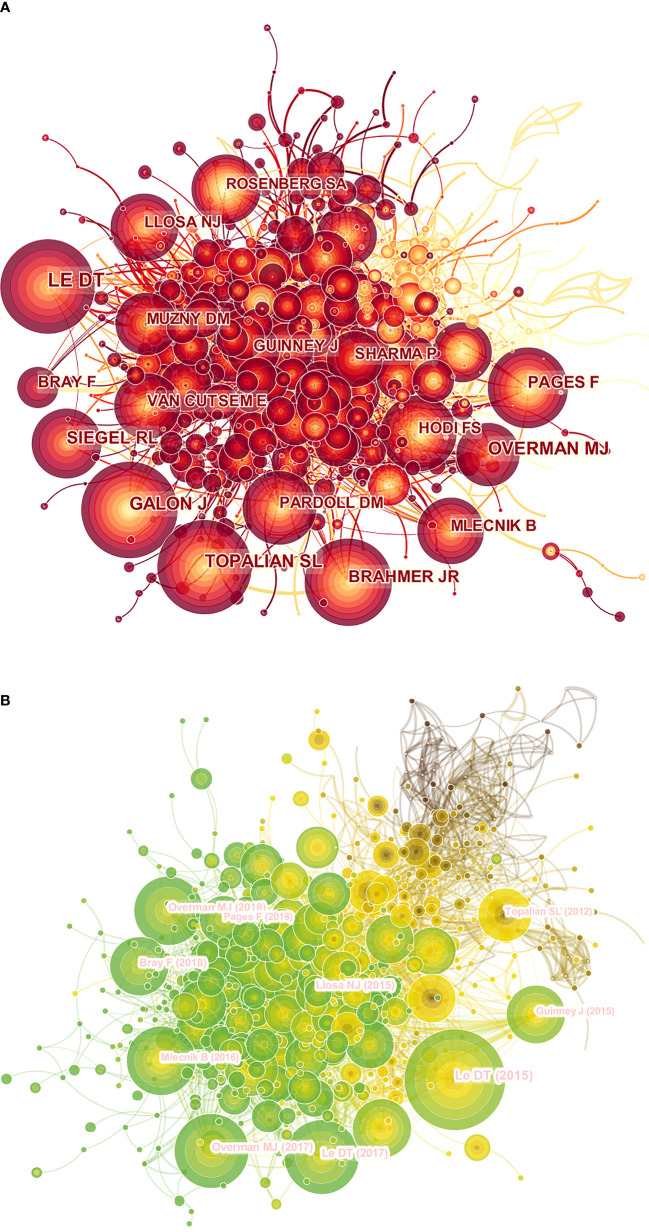
A CiteSpace network visualization of co-cited authors and references regarding colorectal cancer immunotherapy. (A) Network visualization diagram of the co-cited authors of the Publications. (B) Network visualization diagram of cited references. Co-cited authors or cited references are indicated by the node. The co-citation relationship is indicated by the line connecting the nodes. The node area grows as the number of co-citations increases. The colors represent different years, in A, the color changes from yellow to red from 2012 to 2021, and in B, the color changes from brown to green from 2012 to 2021.
Figure 6
Figure 6
A timeline view for co-cited references associated with colorectal cancer immunotherapy. The node’s position on the horizontal axis represents the time when the reference first appeared, and the node’s size is positively correlated with the number of citations of the reference. The lines between the nodes represent co-cited relationships. The redder the color means closer to 2021, and the more yellow the color means closer to 2012.The clusters with redder colors and larger nodes included more publications, demonstrating that the issue of this cluster was a hot topic in the field.
Figure 7
Figure 7
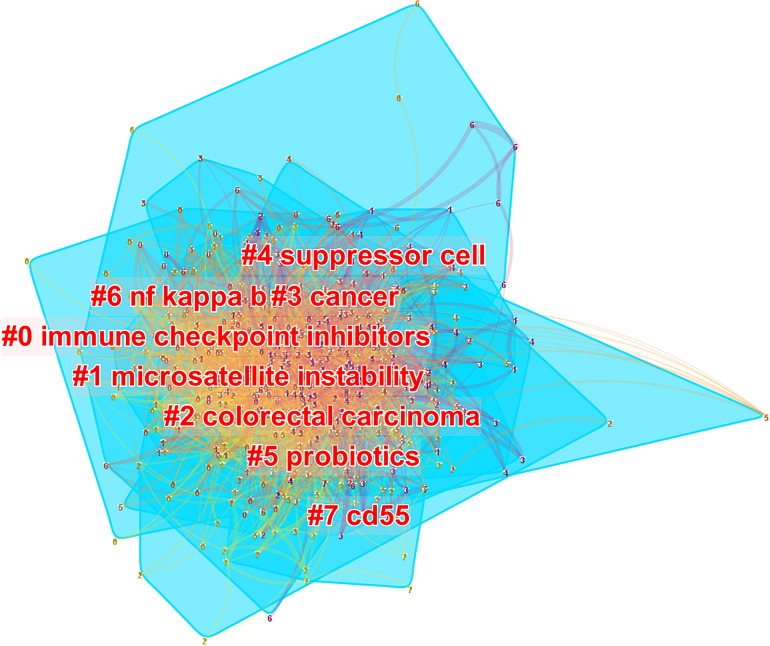
The cluster of keywords related to colorectal cancer immunotherapy. The different colors represented different clusters. Each point represents a keyword, and the number on the node represents the cluster to which the keyword belongs. The lines between the points represent two keywords with co-occurrence relationship. The color of the line segment represents the year, from 2012 to 2021, the color changes from purple to yellow. The blue blocks represent the extent of each cluster in the network space.
Figure 8
Figure 8
Time zone view of keywords for colorectal cancer immunotherapy. In 2012-2016, keywords with co-occurrence rate ≥80 were shown; from 2013-2021, we manually added annual top5 keywords and their co-occurrence frequency. The position of the cross on the horizontal axis represents the year in which the keyword first appeared. The size of the cross reflects the frequency of co-occurrence, and the larger the cross represents the higher frequency of co-occurrence. The lines between the crosses represent the co-occurrence of two keywords. The lines are colored to indicate the different years. From 2012 to 2021, the color changes from yellow to red.
Figure 9
Figure 9
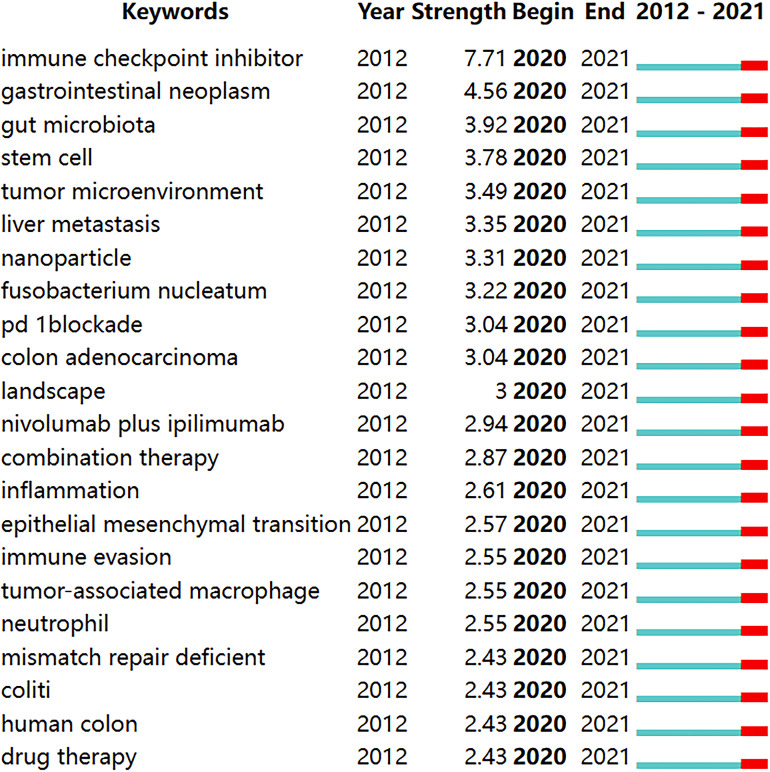
Keywords with burst periods from 2020 onward among the top 103 burst keywords in articles related to colorectal cancer immunotherapy. A blue line indicates the timeline, and the intervals in which bursts were found are indicated by red sections on the blue timeline, indicating the start year, the end year, and the burst duration.

References

    1. Sung H, Ferlay J, Siegel RL, Laversanne M, Soerjomataram I, Jemal A, et al. Global Cancer Statistics 2020: GLOBOCAN Estimates of Incidence and Mortality Worldwide for 36 Cancers in 185 Countries. CA Cancer J Clin (2021) 71(3):209–49. doi: 10.3322/caac.21660 - DOI - PubMed
    1. Ganesh K, Stadler ZK, Cercek A, Mendelsohn RB, Shia J, Segal NH, et al. Immunotherapy in Colorectal Cancer: Rationale, Challenges and Potential. Nat Rev Gastroenterol Hepatol (2019) 16(6):361–75. doi: 10.1038/s41575-019-0126-x - DOI - PMC - PubMed
    1. Sveen A, Kopetz S, Lothe RA. Biomarker-Guided Therapy for Colorectal Cancer: Strength in Complexity. Nat Rev Clin Oncol (2020) 17(1):11–32. doi: 10.1038/s41571-019-0241-1 - DOI - PMC - PubMed
    1. Giordano G, Remo A, Porras A, Pancione M. Immune Resistance and EGFR Antagonists in Colorectal Cancer. Cancers (Basel). (2019) 11(8):1089. doi: 10.3390/cancers11081089 - DOI - PMC - PubMed
    1. Hinshaw DC, Shevde LA. The Tumor Microenvironment Innately Modulates Cancer Progression. Cancer Res (2019) 79(18):4557–66. doi: 10.1158/0008-5472.CAN-18-3962 - DOI - PMC - PubMed

Publication types

Substances