


Hidden risks associated with conventional short intermittent hemodialysis: A call for action to mitigate cardiovascular risk and morbidity
- PMID: 35433339
- PMCID: PMC8968472
- DOI: 10.5527/wjn.v11.i2.39
Hidden risks associated with conventional short intermittent hemodialysis: A call for action to mitigate cardiovascular risk and morbidity
Abstract
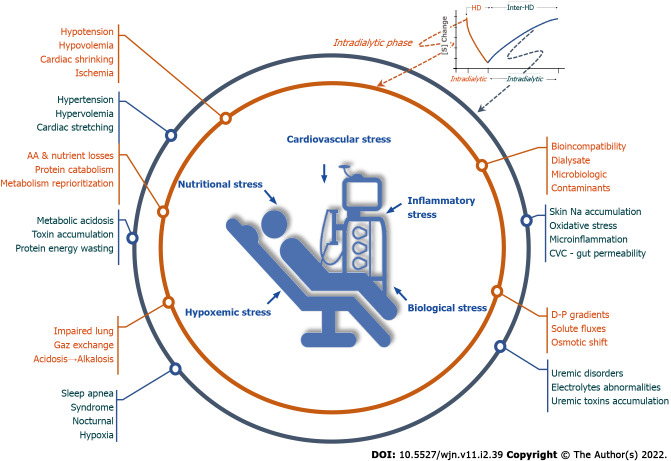
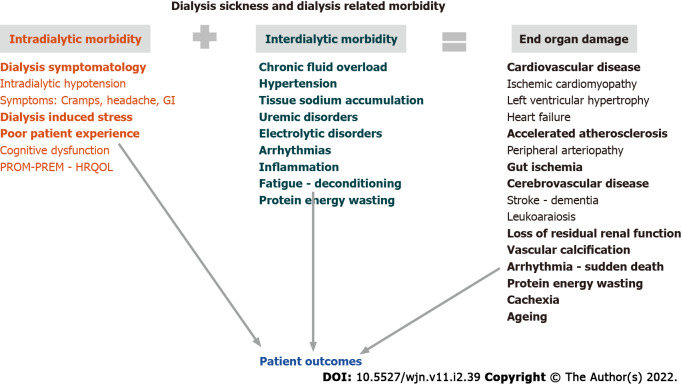
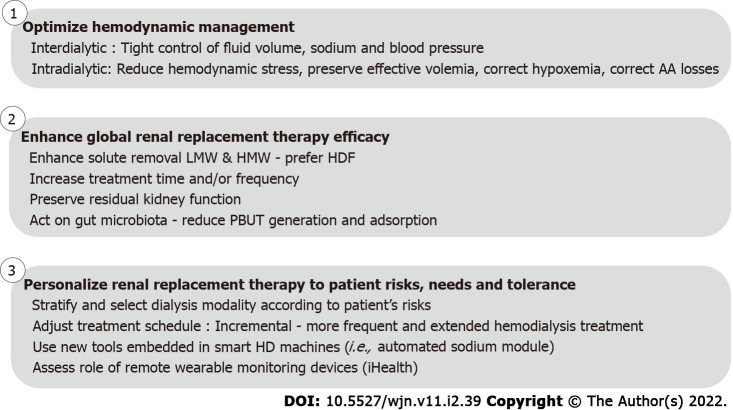
The development of maintenance hemodialysis (HD) for end stage kidney disease patients is a success story that continues to save many lives. Nevertheless, intermittent renal replacement therapy is also a source of recurrent stress for patients. Conventional thrice weekly short HD is an imperfect treatment that only partially corrects uremic abnormalities, increases cardiovascular risk, and exacerbates disease burden. Altering cycles of fluid loading associated with cardiac stretching (interdialytic phase) and then fluid unloading (intradialytic phase) likely contribute to cardiac and vascular damage. This unphysiologic treatment profile combined with cyclic disturbances including osmotic and electrolytic shifts may contribute to morbidity in dialysis patients and augment the health burden of treatment. As such, HD patients are exposed to multiple stressors including cardiocirculatory, inflammatory, biologic, hypoxemic, and nutritional. This cascade of events can be termed the dialysis stress storm and sickness syndrome. Mitigating cardiovascular risk and morbidity associated with conventional intermittent HD appears to be a priority for improving patient experience and reducing disease burden. In this in-depth review, we summarize the hidden effects of intermittent HD therapy, and call for action to improve delivered HD and develop treatment schedules that are better tolerated and associated with fewer adverse effects.
Keywords: Biologic storm; Cardiovascular mortality; Circulatory stress; Dialysis sickness; Dialytic morbidity; End stage kidney disease; Personalized medicine.
©The Author(s) 2022. Published by Baishideng Publishing Group Inc. All rights reserved.
Conflict of interest statement
Conflict-of-interest statement: Canaud B is acting as scientist consultant for FMC. No conflict of interest exists for other authors.
Figures
References
-
- Liyanage T, Ninomiya T, Jha V, Neal B, Patrice HM, Okpechi I, Zhao MH, Lv J, Garg AX, Knight J, Rodgers A, Gallagher M, Kotwal S, Cass A, Perkovic V. Worldwide access to treatment for end-stage kidney disease: a systematic review. Lancet. 2015;385:1975–1982. - PubMed
Publication types
LinkOut - more resources
Full Text Sources
Research Materials
Miscellaneous
