


The Influence of Degrees of Severity of Temporomandibular Dysfunction on Report of Vestibular Symptoms - A Cross-Sectional Study
- PMID: 35437122
- PMCID: PMC9848288
- DOI: 10.1080/10669817.2022.2064084
The Influence of Degrees of Severity of Temporomandibular Dysfunction on Report of Vestibular Symptoms - A Cross-Sectional Study
Abstract
Introduction: Due to the anatomical proximity and functional connection, vestibular symptoms (VS) are common in temporomandibular disorders (TMD). However, it is not known whether the degree of severity of TMD affect the report of associated vestibular symptoms.
Objective: To evaluate associations of demographic, clinical and functional factors, as well as report of VS, with the severity of TMD.
Method: Cross-sectional study carried out at a higher education institution in Salvador, Bahia, Brazil. After approval by the Ethics Committee of Hospital Santo Antônio (CAAE 81517317.2.0000.0047), the collection team applied the Dizziness Handicap Inventory (DHI), the Fonseca Anamnestic Questionnaire (QAF) and the Research Diagnostic Criteria for Temporomandibular Disorders axis II questions (RDC/TMD) in employees, teachers and students. Statistical tests of association with the Chi-square, t test for independent samples and ANOVA (alpha 5% and 80% power) were performed.
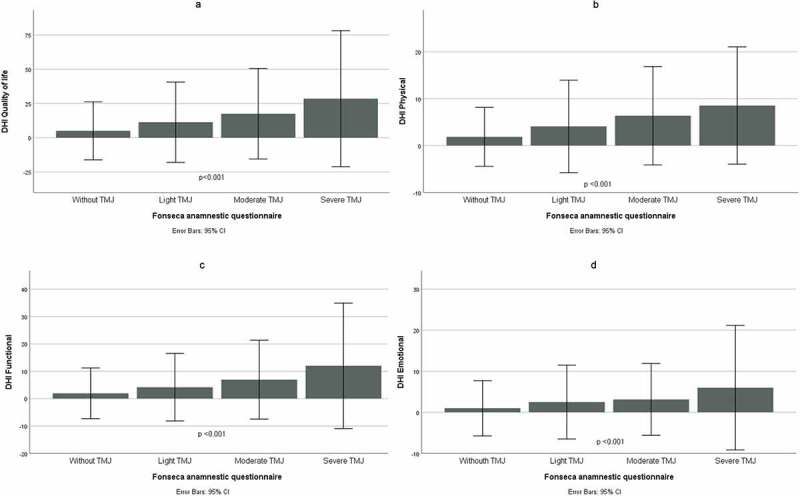
Results: The sample of 623 participants identified 333 (63.7%) people with TMD and 418 (79.9%) with VS. Females were associated with both temporomandibular dysfunction and vestibular symptoms. The degree of severity of the TMD showed a strong correlation with VS (p < 0.001).
Conclusion: In the studied sample, it was observed that the greater the degree of severity of the TMD, the greater the VS, which confirms the need to evaluate both systems in symptomatic patients for each of the clinical conditions.
Keywords: Vestibulopathies; dizziness; prevalence; temporomandibular disorders.
Conflict of interest statement
No potential conflict of interest was reported by the author(s).
Figures
References
-
- Okeson JP. Management of temporomandibular disorders and occlusion. 7th ed. United States: Elsevier - Health Sciences Division; 2012. p. 504. St Louis.
-
- Taucci RA, Bianchini EMG. Verificação da interferência das disfunções temporomandibulares na articulação da fala: queixas e caracterização dos movimentos mandibulares. Rev da Soc Bras Fonoaudiol. 2007;12(4):274–280.
-
- National Academies of Sciences . Engineering and M. temporomandibular disorders: priorities for research and care. Washington (DC): The National Academies Press; 2020. - PubMed
-
- Donnarumma MDC, Muzilli CA, Ferreira C, et al. Disfunções temporomandibulares: sinais, sintomas e abordagem multidisciplinar. Rev CEFAC. 2010;12(5):788–794.
MeSH terms
LinkOut - more resources
Full Text Sources
Medical
