Multicenter Study
. 2022 Aug;304(2):406-416.
doi: 10.1148/radiol.212137. Epub 2022 Apr 19.

MRI Radiogenomics of Pediatric Medulloblastoma: A Multicenter Study

Affiliations
Multicenter Study

MRI Radiogenomics of Pediatric Medulloblastoma: A Multicenter Study

Michael Zhang et al. Radiology. 2022 Aug.

Abstract

Background Radiogenomics of pediatric medulloblastoma (MB) offers an opportunity for MB risk stratification, which may aid therapeutic decision making, family counseling, and selection of patient groups suitable for targeted genetic analysis. Purpose To develop machine learning strategies that identify the four clinically significant MB molecular subgroups. Materials and Methods In this retrospective study, consecutive pediatric patients with newly diagnosed MB at MRI at 12 international pediatric sites between July 1997 and May 2020 were identified. There were 1800 features extracted from T2- and contrast-enhanced T1-weighted preoperative MRI scans. A two-stage sequential classifier was designed-one that first identifies non-wingless (WNT) and non-sonic hedgehog (SHH) MB and then differentiates therapeutically relevant WNT from SHH. Further, a classifier that distinguishes high-risk group 3 from group 4 MB was developed. An independent, binary subgroup analysis was conducted to uncover radiomics features unique to infantile versus childhood SHH subgroups. The best-performing models from six candidate classifiers were selected, and performance was measured on holdout test sets. CIs were obtained by bootstrapping the test sets for 2000 random samples. Model accuracy score was compared with the no-information rate using the Wald test. Results The study cohort comprised 263 patients (mean age ± SD at diagnosis, 87 months ± 60; 166 boys). A two-stage classifier outperformed a single-stage multiclass classifier. The combined, sequential classifier achieved a microaveraged F1 score of 88% and a binary F1 score of 95% specifically for WNT. A group 3 versus group 4 classifier achieved an area under the receiver operating characteristic curve of 98%. Of the Image Biomarker Standardization Initiative features, texture and first-order intensity features were most contributory across the molecular subgroups. Conclusion An MRI-based machine learning decision path allowed identification of the four clinically relevant molecular pediatric medulloblastoma subgroups. © RSNA, 2022 Online supplemental material is available for this article. See also the editorial by Chaudhary and Bapuraj in this issue.


Conflict of interest statement

Disclosures of conflicts of interest: M.Z. No relevant relationships. S.W.W. No relevant relationships. J.N.W. No relevant relationships. M.W.W. No relevant relationships. S.T. No relevant relationships. M.H. No relevant relationships. L.T. No relevant relationships. Q.Z. No relevant relationships. S.S.A. No relevant relationships. K.S. No relevant relationships. S. Lummus No relevant relationships. H.L. No relevant relationships. A.E. No relevant relationships. A.R. No relevant relationships. J.N. No relevant relationships. S.H. No relevant relationships. M.M. No relevant relationships. S. Laughlin No relevant relationships. S. Perreault No relevant relationships. K.R.M.B. No relevant relationships. R.M.L. No relevant relationships. Y.J.C. Hyundai Hope on Wheels research grant from the Ericksen Family Endowed Professorship. B.E.W. Deputy editor of Radiology; spouse owns stock in Siemens; spouse is employee of Siemens Healthineers. C.Y.H. No relevant relationships. K.M. European Course in Paediatric Neuroradiology lecture honorarium; Guerbet lecturer honorarium; Siemens lecturer honorarium; payment for expert medicolegal reports in the United Kingdom. H.V. Payment for deposition testimony from Miller Weisbrod; participant on a DataSafety Monitoring Board or Advisory Board for Stanford Neuropathy. S.H.C. No relevant relationships. T.S.J. Payment to institution from Cancer Research UK, The Brain Tumour Charity, Children with Cancer UK, NIHR, Great Ormond Street Hospital Children’s Charity, Olivia Hodson Cancer Fund; royalties for book publishing from Elsevier; honoraria for editing from Wiley; payment for lecture to an educational event organized by Bayer; payment via Neuropath Ltd, a company owned and operated by the author and their wife, for expert witness work in the courts in the UK and Ireland for expert neuropathology work, mostly in the case of unexpected child deaths for the HM courts; Editor in Chief for Neuropathology and Applied Neurobiology (paid a share of the profits of the journal); Lead for the Childhood Solid Tumour Domain of the Genomics England Clinical Interpretation Partnership; shareholder in Repath and Neuropath. K.A. No relevant relationships. P.G.F. NIH/NCI for co-investigator in Pediatric Brain Tumor Consortium; NIN/NHGRI for co-principal investigator in Undiagnosed Diseases Network; payment for role as Associate Editor for The Journal of Pediatrics by Elsevier Publishing; personal stock holdings in Johnson & Johnson. M.T. No relevant relationships. T.P. NIH funded Pediatric Brain Tumor Consortium Neuroimaging Center grant; payments from Springer Publishing; President of the American Society of Neuroradiology. N.A.V. No relevant relationships. G.A.G. Participant on a DataSafety Monitoring Board or Advisory Board for Stanford University. S. Pfister Grants from EU (IMI-2, ERC), BMBF, Brain Tumor Charity, DFG, Deutsche Kinderkrebsstiftung, Deutsche Krebshilfe; three patents in DNA methylation–based tumor classification; leadership or fiduciary role in SAB Princess Maxima Center, SAB INCA, and SAB BioSkryb. E.T. Grants or contracts from FDA, Cure Starts Now, American Brain Tumor Foundation, NIH; consulting fees for being a scientific advisor for Oncoheroes Biosciences; support for attending meetings and/or travel for Cure Starts Now; provisional patent on a drill for craniosynostosis surgery; participant on a DataSafety Monitoring Board or Advisory Board for University of Alabama for a Phase I clinical trial of malignant pediatric brain tumors. A.J. No relevant relationships. V.R. No relevant relationships. K.W.Y. Participant on a DataSafety Monitoring Board or Advisory Board for Stanford University.

Figures

None
Graphical abstract
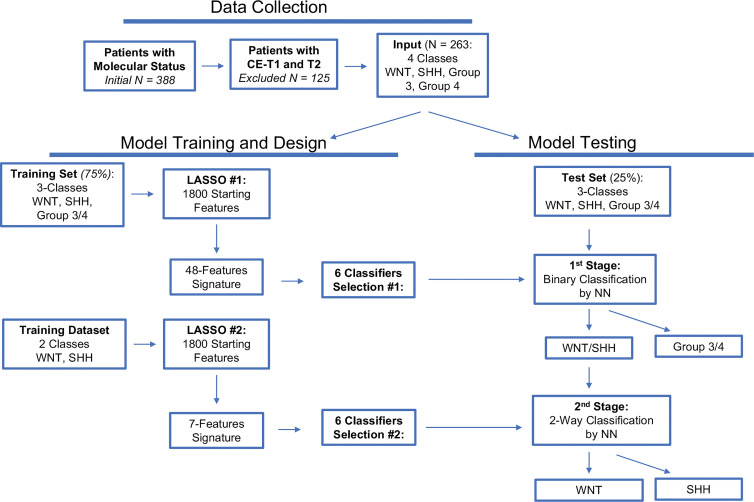
Flowchart shows workflow for training and testing of a two-stage
classifier. Each stage consists of a binary classifier optimized for its own
respective reduced-feature set obtained by sparse regression analyses. The
first stage passes the subgroup composed of wingless (WNT) and sonic
hedgehog (SHH) to the second stage for further separation. CE = contrast
enhanced, LASSO = least absolute shrinkage and selection operator, NN =
neural network.
Figure 1:
Flowchart shows workflow for training and testing of a two-stage classifier. Each stage consists of a binary classifier optimized for its own respective reduced-feature set obtained by sparse regression analyses. The first stage passes the subgroup composed of wingless (WNT) and sonic hedgehog (SHH) to the second stage for further separation. CE = contrast enhanced, LASSO = least absolute shrinkage and selection operator, NN = neural network.
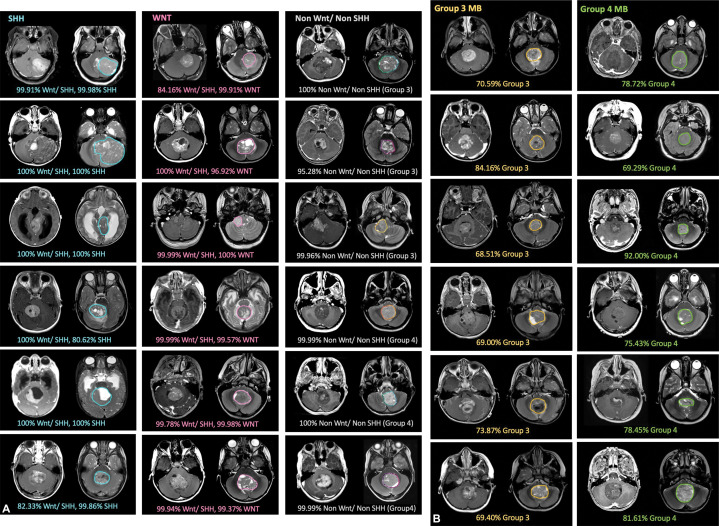
Examples of probability output on contrast-enhanced T1-weighted (left)
and T2-weighted (right) MRI scans from the medulloblastoma (MB) test subset
that did not participate in the model development. (A) Results of a staged
primary classifier model are shown with probability outputs of non-wingless
(WNT) and non–sonic hedgehog (SHH) and subsequent outputs of WNT and
SHH generated from WNT and SHH. (B) Examples of tumors from an independent
binary classifier model that differentiates between group 3 and group 4 are
shown.
Figure 2:
Examples of probability output on contrast-enhanced T1-weighted (left) and T2-weighted (right) MRI scans from the medulloblastoma (MB) test subset that did not participate in the model development. (A) Results of a staged primary classifier model are shown with probability outputs of non-wingless (WNT) and non–sonic hedgehog (SHH) and subsequent outputs of WNT and SHH generated from WNT and SHH. (B) Examples of tumors from an independent binary classifier model that differentiates between group 3 and group 4 are shown.
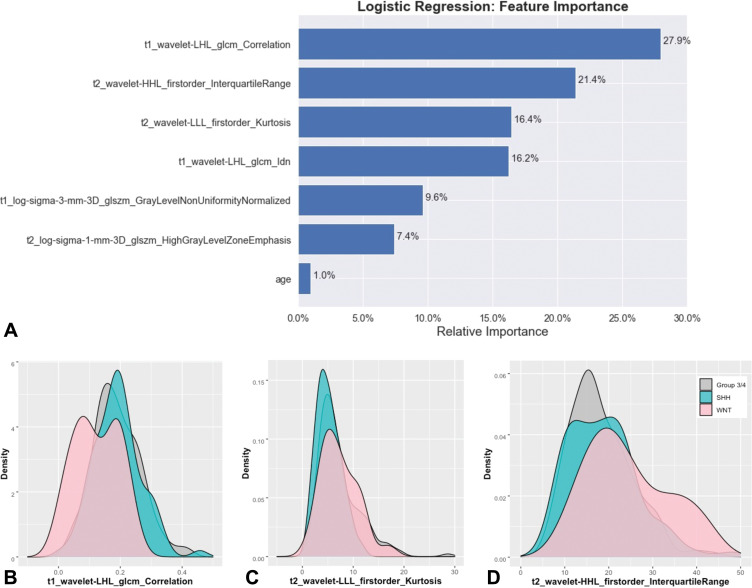
(A) Bar plot shows the relative influence as calculated with logistic
regression of the seven reduced features for the second stage, a binary
classifier trained to distinguish wingless (WNT) from sonic hedgehog (SHH)
medulloblastoma. (B–D) Density plots of the top three Image Biomarker
Standardization Initiative features, including (B) T1-Correlation, (C)
T2-Kurtosis, and (D) T2-Interquartile Range.
Figure 3:
(A) Bar plot shows the relative influence as calculated with logistic regression of the seven reduced features for the second stage, a binary classifier trained to distinguish wingless (WNT) from sonic hedgehog (SHH) medulloblastoma. (B–D) Density plots of the top three Image Biomarker Standardization Initiative features, including (B) T1-Correlation, (C) T2-Kurtosis, and (D) T2-Interquartile Range.
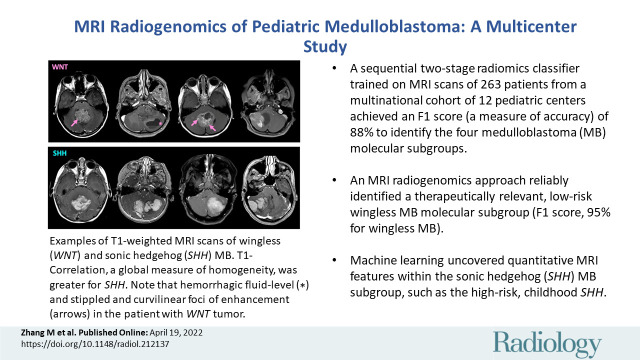
Examples of axial contrast-enhanced T1 MRI scans of wingless (WNT) and
sonic hedgehog (SHH) medulloblastoma. T1-Correlation, a global measure of
homogeneity, was greater for SHH on contrast-enhanced T1-weighted MRI scans.
At a macroscopic level, SHH tumors appear to have more homogeneous
distribution of high signal intensity across pixels on T1-weighted MRI scans
compared with more heterogeneous enhancement of WNT tumors, which might
relate to higher vascular fragility and associated hemorrhagic components.
Note that hemorrhagic fluid-level (*) and stippled and curvilinear
foci of enhancement (arrows) are seen in the patient with WNT
tumor.
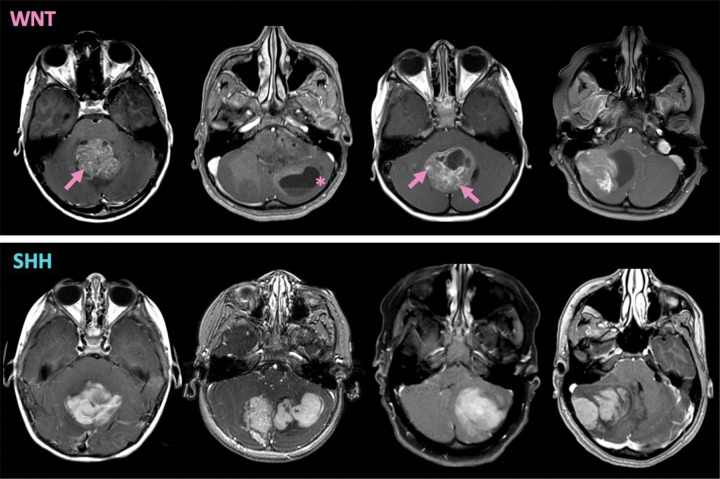
Figure 4:
Examples of axial contrast-enhanced T1 MRI scans of wingless (WNT) and sonic hedgehog (SHH) medulloblastoma. T1-Correlation, a global measure of homogeneity, was greater for SHH on contrast-enhanced T1-weighted MRI scans. At a macroscopic level, SHH tumors appear to have more homogeneous distribution of high signal intensity across pixels on T1-weighted MRI scans compared with more heterogeneous enhancement of WNT tumors, which might relate to higher vascular fragility and associated hemorrhagic components. Note that hemorrhagic fluid-level (*) and stippled and curvilinear foci of enhancement (arrows) are seen in the patient with WNT tumor.
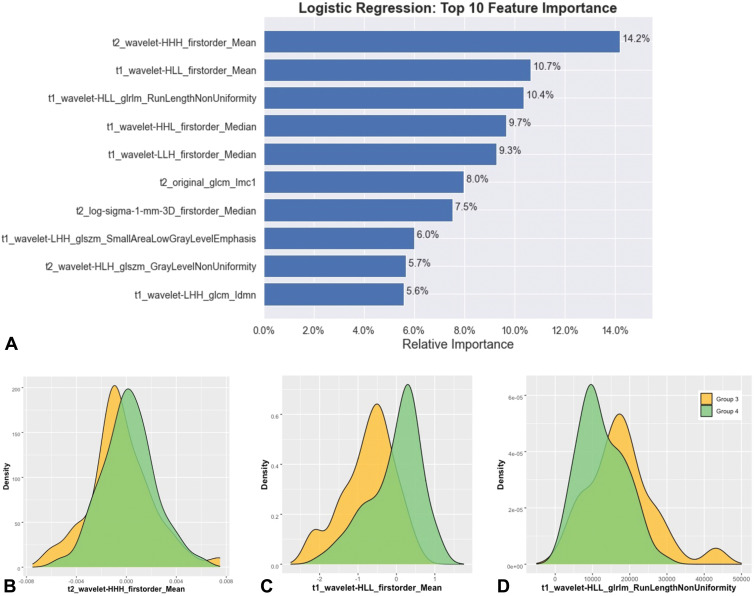
(A) Bar plot shows the relative influence as calculated by logistic
regression of the top 10 reduced features for the follow-up binary
classifier trained to distinguish group 3 from group 4. (B–D) Density
plots of the top three Image Biomarker Standardization Initiative features,
including (B) T2-Mean, (C) T1-Mean, and (D) T1-Run Length
Nonuniformity.
Figure 5:
(A) Bar plot shows the relative influence as calculated by logistic regression of the top 10 reduced features for the follow-up binary classifier trained to distinguish group 3 from group 4. (B–D) Density plots of the top three Image Biomarker Standardization Initiative features, including (B) T2-Mean, (C) T1-Mean, and (D) T1-Run Length Nonuniformity.
Contrast-enhanced (CE) T1-weighted, arterial spin labeling (ASL), and
T2*-weighted MRI features of medulloblastoma and corresponding
vascular immunohistochemistry. The ETS-related gene (ERG) antibody (pink)
stains are for nuclei of endothelial cells, which line the interior surface
of blood vessels and are a marker of vascular density. The Claudin-5 (Cldn5)
antibody (brown) stains are for endothelial tight junction protein and mark
blood-brain barrier integrity. (A) Images in a patient with group 3 right
cerebellopontine mass. On T2*-weighted image, the mass shows
heterogeneous enhancement with irregular T2* foci of blood products
or deoxyhemoglobin of tumor vascularity (red arrows). Corresponding ASL
image shows high perfusion (white arrow). Diffuse loss of Claudin-5
expression (lack of brown staining) along endothelial cells (pink ERG
staining) suggests blood-brain barrier breakdown. (B) Images in a different
patient with group 3 tumor show faint foci (red arrows) on
T2*-weighted image, intermediate perfusion, and heterogeneous
distribution of Claudin-5 expression, depending on the tumor specimen
location (blue and green boxes). (C) Images in patient with group 4 tumor
show mild, patchy enhancement and intermediate perfusion. No discrete blood
products are present on T2*-weighted MRI scan. Diffuse Claudin-5
expression is seen associated with abundant endothelial cells (pink staining
behind the brown staining) within the tumor, suggesting high vascular
density associated with preserved blood-brain barrier integrity.
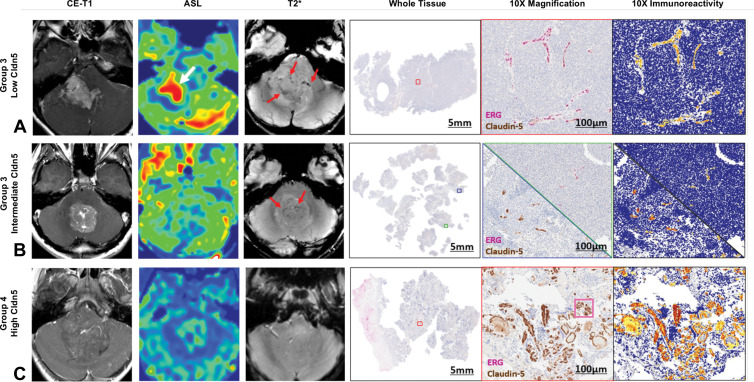
Figure 6:
Contrast-enhanced (CE) T1-weighted, arterial spin labeling (ASL), and T2*-weighted MRI features of medulloblastoma and corresponding vascular immunohistochemistry. The ETS-related gene (ERG) antibody (pink) stains are for nuclei of endothelial cells, which line the interior surface of blood vessels and are a marker of vascular density. The Claudin-5 (Cldn5) antibody (brown) stains are for endothelial tight junction protein and mark blood-brain barrier integrity. (A) Images in a patient with group 3 right cerebellopontine mass. On T2*-weighted image, the mass shows heterogeneous enhancement with irregular T2* foci of blood products or deoxyhemoglobin of tumor vascularity (red arrows). Corresponding ASL image shows high perfusion (white arrow). Diffuse loss of Claudin-5 expression (lack of brown staining) along endothelial cells (pink ERG staining) suggests blood-brain barrier breakdown. (B) Images in a different patient with group 3 tumor show faint foci (red arrows) on T2*-weighted image, intermediate perfusion, and heterogeneous distribution of Claudin-5 expression, depending on the tumor specimen location (blue and green boxes). (C) Images in patient with group 4 tumor show mild, patchy enhancement and intermediate perfusion. No discrete blood products are present on T2*-weighted MRI scan. Diffuse Claudin-5 expression is seen associated with abundant endothelial cells (pink staining behind the brown staining) within the tumor, suggesting high vascular density associated with preserved blood-brain barrier integrity.

Comment in

References

    1. Attallah O . MB-AI-His: Histopathological Diagnosis of Pediatric Medulloblastoma and its Subtypes via AI . Diagnostics (Basel) 2021. ; 11 ( 2 ): 359 . - PMC - PubMed
    1. Chen X , Fan Z , Li KKW , et al. . Molecular subgrouping of medulloblastoma based on few-shot learning of multitasking using conventional MR images: a retrospective multicenter study . Neurooncol Adv 2020. ; 2 ( 1 ): vdaa079 . - PMC - PubMed
    1. Das D , Mahanta LB , Ahmed S , Baishya BK . Classification of childhood medulloblastoma into WHO-defined multiple subtypes based on textural analysis . J Microsc 2020. ; 279 ( 1 ): 26 – 38 . - PubMed
    1. Iv M , Zhou M , Shpanskaya K , et al. . MR Imaging-Based Radiomic Signatures of Distinct Molecular Subgroups of Medulloblastoma . AJNR Am J Neuroradiol 2019. ; 40 ( 1 ): 154 – 161 . - PMC - PubMed
    1. Yan J , Liu L , Wang W , et al. . Radiomic Features From Multi-Parameter MRI Combined With Clinical Parameters Predict Molecular Subgroups in Patients With Medulloblastoma . Front Oncol 2020. ; 10 : 558162 . - PMC - PubMed

Publication types

Substances

LinkOut - more resources