


Neurocomputations of strategic behavior: From iterated to novel interactions
- PMID: 35441465
- PMCID: PMC9542218
- DOI: 10.1002/wcs.1598
Neurocomputations of strategic behavior: From iterated to novel interactions
Abstract
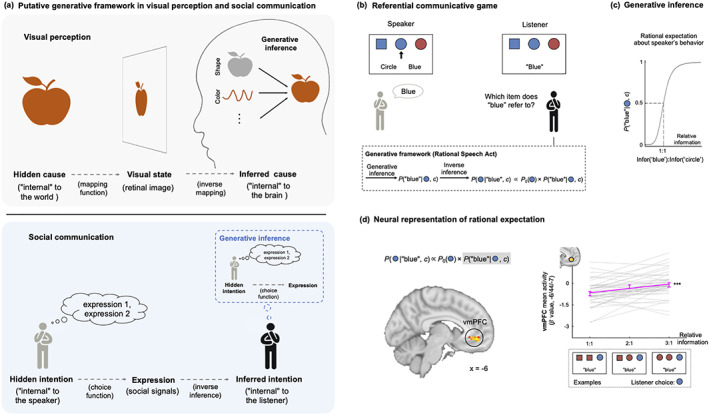
Strategic interactions, where an individual's payoff depends on the decisions of multiple intelligent agents, are ubiquitous among social animals. They span a variety of important social behaviors such as competition, cooperation, coordination, and communication, and often involve complex, intertwining cognitive operations ranging from basic reward processing to higher-order mentalization. Here, we review the progress and challenges in probing the neural and cognitive mechanisms of strategic behavior of interacting individuals, drawing an analogy to recent developments in studies of reward-seeking behavior, in particular, how research focuses in the field of strategic behavior have been expanded from adaptive behavior based on trial-and-error to flexible decisions based on limited prior experience. We highlight two important research questions in the field of strategic behavior: (i) How does the brain exploit past experience for learning to behave strategically? and (ii) How does the brain decide what to do in novel strategic situations in the absence of direct experience? For the former, we discuss the utility of learning models that have effectively connected various types of neural data with strategic learning behavior and helped elucidate the interplay among multiple learning processes. For the latter, we review the recent evidence and propose a neural generative mechanism by which the brain makes novel strategic choices through simulating others' goal-directed actions according to rational or bounded-rational principles obtained through indirect social knowledge. This article is categorized under: Economics > Interactive Decision-Making Psychology > Reasoning and Decision Making Neuroscience > Cognition.
Keywords: decision neuroscience; game theory; social cognition; strategic behavior.
© 2022 The Authors. WIREs Cognitive Science published by Wiley Periodicals LLC.
Conflict of interest statement
The authors have declared no conflicts of interest for this article.
Figures

References
-
- Baker, C. L. , Jara‐Ettinger, J. , Saxe, R. , & Tenenbaum, J. B. (2017). Rational quantitative attribution of beliefs, desires and percepts in human mentalizing. Nature Human Behaviour, 1, 1–10. 10.1038/s41562-017-0064 - DOI
Publication types
MeSH terms
Grants and funding
LinkOut - more resources
Full Text Sources
Miscellaneous
