. 2022 Apr 20;17(4):e0267151.
doi: 10.1371/journal.pone.0267151. eCollection 2022.

Language barriers in global bird conservation

Affiliations

Language barriers in global bird conservation

Pablo Jose Negret et al. PLoS One. .

Abstract

Multiple languages being spoken within a species' distribution can impede communication among conservation stakeholders, the compilation of scientific information, and the development of effective conservation actions. Here, we investigate the number of official languages spoken within the distributions of 10,863 bird species to identify which species might be particularly affected by consequences of language barriers. We show that 1587 species have 10 languages or more spoken within their distributions. Threatened and migratory species have significantly more languages spoken within their distributions, when controlling for range size. Particularly high numbers of species with many languages within their distribution are found in Eastern Europe, Russia and central and western Asia. Global conservation efforts would benefit from implementing guidelines to overcome language barriers, especially in regions with high species and language diversity.


Conflict of interest statement

The authors have declared that no competing interests exist.

Figures
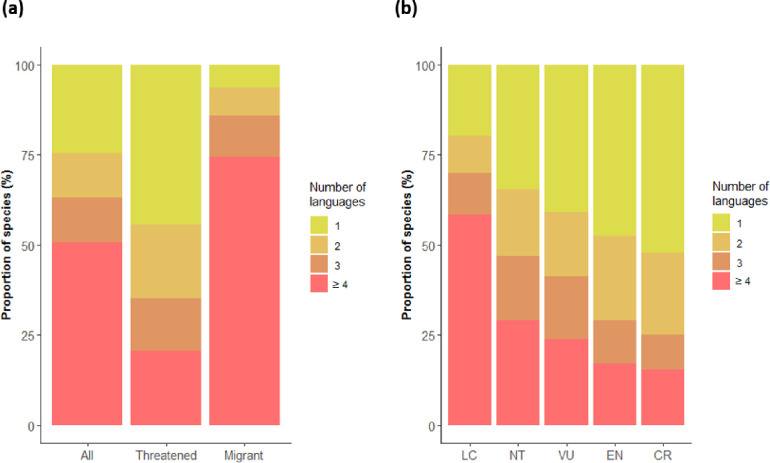
Fig 1
Fig 1. Language diversity among bird distributions.
(a) Number of official languages within the distributions of all bird species (n = 10,863), threatened species (n = 1427) and migratory species (n = 1939). (b) Number of official languages spoken in the distributions of bird species by threat category (as assessed by the International Union for Conservation of Nature). See S2 Fig for data on the most spoken language in each country.
Fig 2
Fig 2
(a) Relationship between bird species’ distribution range size and the number of official languages within their distribution. International Union for Conservation of Nature (IUCN) threat categories are shown in different colours. Number of official languages spoken within each species’ distribution by (b) migratory status and IUCN threat categories, and by (c) taxonomic order. See S3 Fig for the same figure but based on the most spoken language in each country.
Fig 3
Fig 3. Species richness of birds associated with each of the top six official languages with the highest number of species.
See https://translatesciences.shinyapps.io/bird_language_diversity/ for the results of other languages. Earth and countries outline were obtained from the Natural Earth public domain map dataset (http://www.naturalearthdata.com/).
Fig 4
Fig 4
Bivariate maps showing the number of species (species richness) and the mean number of languages within the distribution of species found within each 30km × 30km grid cell for (a) all bird species, (b) threatened bird species, and (c) migratory bird species. The number of languages within each species’ distribution was calculated using the official languages in each country. See S5 Fig for the same figure but using the dataset of the most spoken language in each country. Earth and countries outline were obtained from the Natural Earth public domain map dataset (http://www.naturalearthdata.com/).

References

    1. Allan JR, Watson JEM, Di Marco M, O’Bryan CJ, Possingham HP, Atkinson SC, et al. Hotspots of human impact on threatened terrestrial vertebrates. PLoS Biol. 2019;17: e3000158. doi: 10.1371/journal.pbio.3000158 - DOI - PMC - PubMed
    1. Ceballos G, García A, Ehrlich PR. The sixth extinction crisis loss of animal populations and species. J Cosmol. 2010;8: 1821–1831. doi: 10.1016/j.patbio.2007.08.005 - DOI - PubMed
    1. Nations United. Intergovernmental Science-Policy Platform on Biodiversity and Ecosystem Services (IPBES). Nature’s Danger Decline ‘Unprecedented’ Species Extinction Rates ‘Accelerating’ Curr. 2019. doi: 10.1016/j.gloenvcha.2014.04.002 - DOI
    1. Kark S, Tulloch A, Gordon A, Mazor T, Bunnefeld N, Levin N. Cross-boundary collaboration: Key to the conservation puzzle. Curr Opin Environ Sustain. 2015;12: 12–24. doi: 10.1016/j.cosust.2014.08.005 - DOI
    1. Mason N, Ward M, Watson JEM, Venter O, Runting RK. Global opportunities and challenges for transboundary conservation. Nat Ecol Evol. 2020;4: 694–701. doi: 10.1038/s41559-020-1160-3 - DOI - PubMed

Publication types
