


Clinical Feature, Therapy, Antimicrobial Resistance Gene Distribution, and Outcome of Nosocomial Meningitis Induced by Multidrug-Resistant Enterobacteriaceae-A Longitudinal Cohort Study From Two Neurosurgical Centers in Northern China
- PMID: 35444955
- PMCID: PMC9013899
- DOI: 10.3389/fcimb.2022.839257
Clinical Feature, Therapy, Antimicrobial Resistance Gene Distribution, and Outcome of Nosocomial Meningitis Induced by Multidrug-Resistant Enterobacteriaceae-A Longitudinal Cohort Study From Two Neurosurgical Centers in Northern China
Abstract
Objectives: This is a comparative cohort study aiming to evaluate the mortality risk factors for patients with nosocomial meningitis (NM) induced by multidrug-resistant Enterobacteriaceae (MDRE) in China. The clinical features and therapies of patients and the resistance mechanisms of MDRE pathogens were also assessed.
Methods: MDRE-NM patients from two neurosurgical centers in China from 2014 to 2019 were included in this study. Clinical features were extracted from the medical record databases of the two centers. The molecular mechanisms underlying the microbiological resistance mechanisms of each MDRE pathogen were determined, Kaplan-Meier survival analysis was conducted, and multivariable analyses were performed using a Cox proportional hazard model.
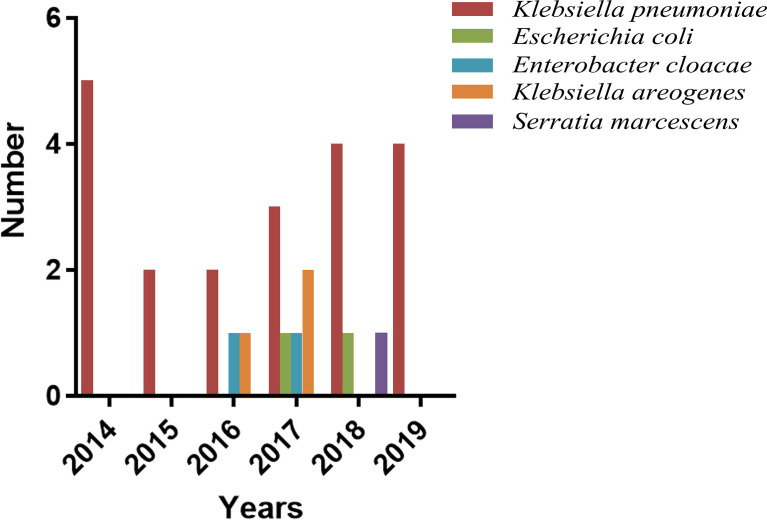
Results: Ninety MDRE-NM patients were included in this study. Klebsiella pneumoniae accounted for the highest proportion of causative pathogens (46/90, 51.1%), and 40 causative pathogens (44.4%) were meropenem-resistant. blaKPC (27/40, 67.5%) was the predominant carbapenem resistance gene. Multivariate Cox analysis showed that external ventricular drainage (EVD) [hazard ratio (HR) = 2.524, 95% confidence interval (CI) = 1.101-5.787, p = 0.029] and a Glasgow Coma Scale (GCS) score ≤;8 (HR = 4.033, 95% CI = 1.526-10.645, p = 0.005) were mortality risk factors for patients with MDRE-NM. A total of 90.0%, 94.4%, and 97.8% of MDRE-NM patients received antibiotic prophylaxis (AP), antibiotic empirical therapy (AET), and antibiotic definitive therapy (ADT), respectively.
Conclusions: NM caused by MDRE is an important sign of the failure of neurosurgery. MDRE possesses multiple drug resistance genotypes, and EVD and a GCS score ≤;8 are independent mortality risk factors for patients with MDRE-NM, which deserve the attention of microbiologists and neurosurgical clinicians.
Keywords: MDRE; antimicrobial resistance genes; clinical feature; nosocomial meningitis; outcome.
Copyright © 2022 Zheng, Shi, Cao, Qian, Lv, Zhang and Zhang.
Conflict of interest statement
The authors declare that the research was conducted in the absence of any commercial or financial relationships that could be construed as a potential conflict of interest.
Figures



References
-
- Abad-Restrepo J., Díaz-Díaz A., Osorio-Cadavid N. (2018). [Post-Surgical Ventriculitis Due To Extensively Resistant Pseudomonas Aeruginosa Treated With Intrathecal Colistin. Pediatric Case Report and Literature Review]. Rev. Chil. Infectol 35, 321–325. doi: 10.4067/s0716-10182018000300321 - DOI - PubMed
-
- Balkhair A., Al-Muharrmi Z., Al'Adawi B., Al Busaidi I., Taher H. B., Al-Siyabi T., et al. (2019). Prevalence and 30-Day All-Cause Mortality Of Carbapenem-And Colistin-Resistant Bacteraemia Caused By Acinetobacter Baumannii, Pseudomonas Aeruginosa, and Klebsiella Pneumoniae: Description Of A Decade-Long Trend. Int. J. Infect. Dis. 85, 10–15. doi: 10.1016/j.ijid.2019.05.004 - DOI - PubMed
-
- Bielli A., Piazza A., Cento V., Comandatore F., Lepera V., Gatti M., et al. (2020). In Vivo Acquisition and Risk Of Inter-Species Spread Of Blakpc-3-Plasmid From Klebsiella Pneumoniae To Serratia Marcescens In The Lower Respiratory Tract. J. Med. Microbiol. 69, 82–86. doi: 10.1099/jmm.0.001113 - DOI - PubMed
Publication types
MeSH terms
Substances
LinkOut - more resources
Full Text Sources
Medical
