


The Effects of Non-pharmaceutical Interventions on COVID-19 Mortality: A Generalized Synthetic Control Approach Across 169 Countries
- PMID: 35444988
- PMCID: PMC9013850
- DOI: 10.3389/fpubh.2022.820642
The Effects of Non-pharmaceutical Interventions on COVID-19 Mortality: A Generalized Synthetic Control Approach Across 169 Countries
Erratum in
-
Erratum: The effects of non-pharmaceutical interventions on COVID-19 mortality: A generalized synthetic control approach across 169 countries.Front Public Health. 2023 Mar 27;11:1186935. doi: 10.3389/fpubh.2023.1186935. eCollection 2023. Front Public Health. 2023. PMID: 37050941 Free PMC article.
Abstract
Importance: Governments have introduced non-pharmaceutical interventions (NPIs) in response to the pandemic outbreak of Coronavirus disease (COVID-19). While NPIs aim at preventing fatalities related to COVID-19, the previous literature on their efficacy has focused on infections and on data of the first half of 2020. Still, findings of early NPI studies may be subject to underreporting and missing timeliness of reporting of cases. Moreover, the low variation in treatment timing during the first wave makes identification of robust treatment effects difficult.
Objective: We enhance the literature on the effectiveness of NPIs with respect to the period, the number of countries, and the analytical approach.
Design setting and participants: To circumvent problems of reporting and treatment variation, we analyse data on daily confirmed COVID-19-related deaths per capita from Our World in Data, and on 10 different NPIs from the Oxford COVID-19 Government Response Tracker (OxCGRT) for 169 countries from 1st July 2020 to 1st September 2021. To identify the causal effects of introducing NPIs on COVID-19-related fatalities, we apply the generalized synthetic control (GSC) method to each NPI, while controlling for the remaining NPIs, weather conditions, vaccinations, and NPI-residualized COVID-19 cases. This mitigates the influence of selection into treatment and allows to model flexible post-treatment trajectories.
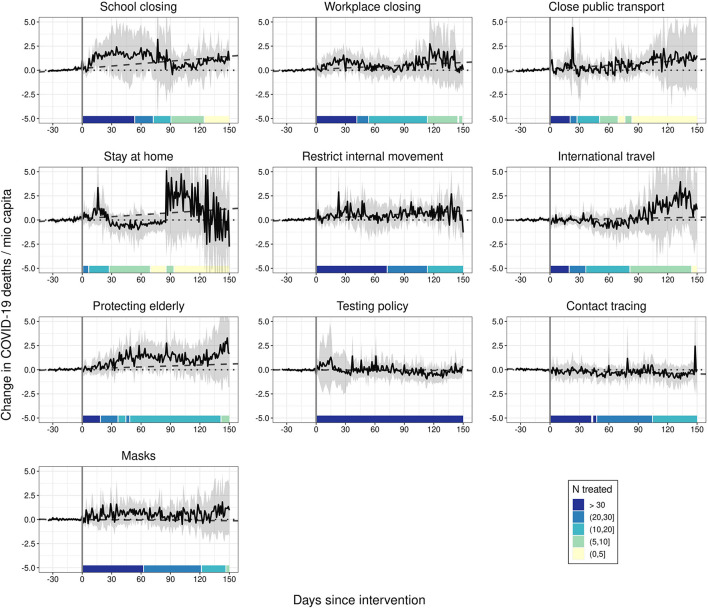
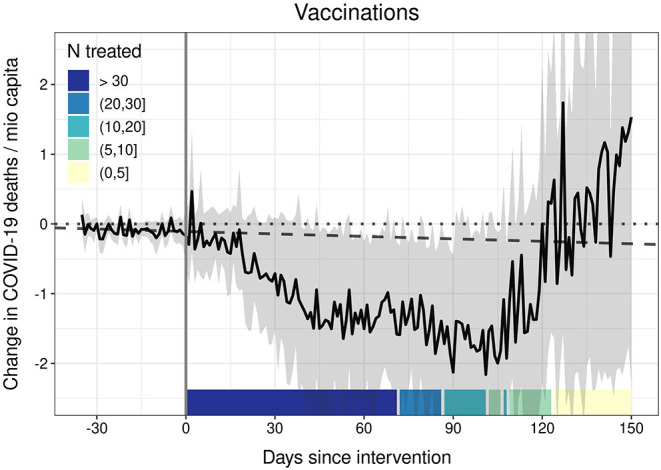
Results: We do not find substantial and consistent COVID-19-related fatality-reducing effects of any NPI under investigation. We see a tentative change in the trend of COVID-19-related deaths around 30 days after strict stay-at-home rules and to a slighter extent after workplace closings have been implemented. As a proof of concept, our model is able to identify a fatality-reducing effect of COVID-19 vaccinations. Furthermore, our results are robust with respect to various crucial sensitivity checks.
Conclusion: Our results demonstrate that many implemented NPIs may not have exerted a significant COVID-19-related fatality-reducing effect. However, NPIs might have contributed to mitigate COVID-19-related fatalities by preventing exponential growth in deaths. Moreover, vaccinations were effective in reducing COVID-19-related deaths.
Keywords: COVID-19; global public health; health policy; lockdown; non-pharmaceutical interventions; vaccination.
Copyright © 2022 Mader and Rüttenauer.
Conflict of interest statement
The authors declare that the research was conducted in the absence of any commercial or financial relationships that could be construed as a potential conflict of interest.
Figures
References
-
- World Health Organization. Non-Pharmaceutical Public Health Measures for Mitigating the Risk and Impact of Epidemic and Pandemic Influenza: Annex: Report of Systematic Literature Reviews. (2019). Available online at: https://www.who.int/influenza/publications/public_health_measures/public... (accessed November 12, 2021).
MeSH terms
LinkOut - more resources
Full Text Sources
Medical
Research Materials
