


L-Theanine: A Unique Functional Amino Acid in Tea (Camellia sinensis L.) With Multiple Health Benefits and Food Applications
- PMID: 35445053
- PMCID: PMC9014247
- DOI: 10.3389/fnut.2022.853846
L-Theanine: A Unique Functional Amino Acid in Tea (Camellia sinensis L.) With Multiple Health Benefits and Food Applications
Abstract
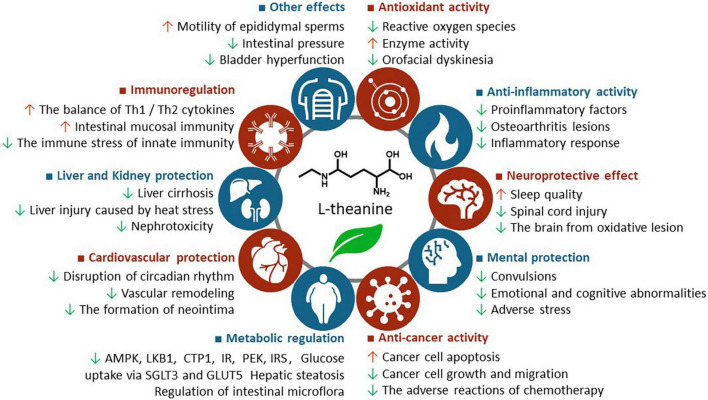
Tea (Camellia sinensis L.) is a very popular health drink and has attracted increasing attention in recent years due to its various bioactive substances. Among them, L-theanine, a unique free amino acid, is one of the most important substances in tea and endows tea with a special flavor. Moreover, L-theanine is also a bioactive compound with plenty of health benefits, including antioxidant, anti-inflammatory, neuroprotective, anticancer, metabolic regulatory, cardiovascular protective, liver and kidney protective, immune regulatory, and anti-obesity effects. Due to the unique characteristics and beneficial functions, L-theanine has potential applications in the development of functional foods. This review summarized the influencing factors of L-theanine content in teas, the main health benefits and related molecular mechanisms of L-theanine, and its applications in food, understanding of which can provide updated information for the further research of L-theanine.
Keywords: L-theanine; food applications; health benefits; mechanisms of action; tea.
Copyright © 2022 Li, Liu, Wu, Kenaan, Geng, Li, Gunaratne, Li and Gan.
Conflict of interest statement
The authors declare that the research was conducted in the absence of any commercial or financial relationships that could be construed as a potential conflict of interest.
Figures
References
-
- Lin FJ, Wei XL, Liu HY, Li H, Xia Y, Wu DT, et al. State-of-the-art review of dark tea: from chemistry to health benefits. Trends Food Sci Technol. (2021) 109:126–38. 10.1016/j.tifs.2021.01.030 - DOI
Publication types
LinkOut - more resources
Full Text Sources
