


Magnitude and Determinants of Under-Nutrition Among Late Adolescent Girls in East Africa: Evidence From Demographic and Health Surveys (2010-2016)
- PMID: 35445058
- PMCID: PMC9014237
- DOI: 10.3389/fnut.2022.763047
Magnitude and Determinants of Under-Nutrition Among Late Adolescent Girls in East Africa: Evidence From Demographic and Health Surveys (2010-2016)
Abstract
Background: Adolescent girls are vulnerable to undernutrition owing to their increased nutrition demand for growth and development, including sexual development and maturation. Despite its public health importance, undernutrition among late adolescent girls has received little attention in health and nutrition policies. Although undernutrition in adolescent girls has been investigated, most of the previous study reports were based on small sample sizes and limited geographic settings. Therefore, we aimed to estimate the prevalence and determinants of undernutrition among late adolescent girls in East Africa.
Methods: Secondary data analysis was conducted among 10 East African countries using the most recent Demographic and Health Survey (DHS) reports. A total of 21,779 adolescent girls aged 15-19 years were included in this study. Descriptive statistics were conducted to describe the study population. The binary logistic regression model was fitted to identify the determinants of undernutrition among late adolescent girls. Variables with a p-value of <0.05 in the multivariate analysis were identified as statistically significant determinants of undernutrition.
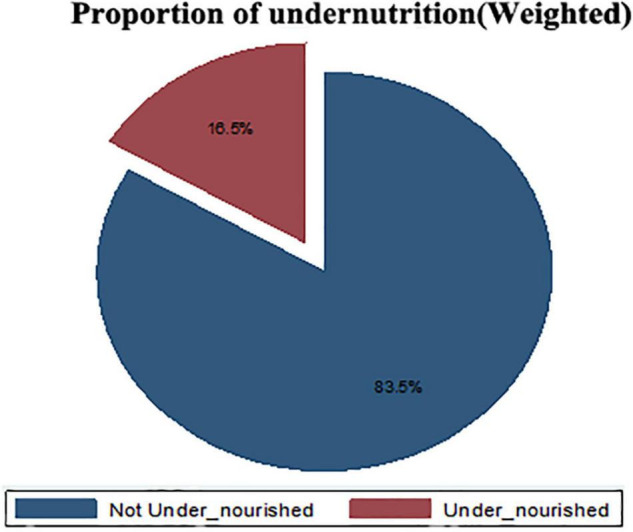
Results: The overall magnitude of undernutrition among late adolescent girls in East Africa was 16.50% (95% CI: 16.00-17.00), whereas the overall magnitude of obesity among late adolescent girls in East Africa was 2.41% (95% CI: 2.21-2.62). In the final model of the multivariate analysis, adolescent girls aged 18-19 years [adjusted odds ratio (AOR) = 0.55; 95% CI: 0.51-0.60], having secondary education (AOR = 0.79; 95% CI: 0.68-0.93), being from a rich wealth index family (AOR = 0.63; 95% CI: 0.56-0.69), and being from a medium wealth index family (AOR = 0.80; 95% CI: 0.72-0.89) were negatively and statistically associated with undernutrition. Likewise, having more than seven household members (AOR = 1.36; 95% CI: 1.10-1.67), walking more than 30 min to a water source (AOR = 1.10; 95% CI: 1.01-1.20), and living in Ethiopia (AOR = 1.75; 95% CI: 1.51-2.03) were positive determinants of undernutrition among late adolescent girls.
Conclusion: In this study, undernutrition in late adolescent girls remains a considerable public health problem in East Africa. Age group, educational status, marital status, family wealth index, family size, time taken to reach a water source, media exposure, and country of resident were significant determinants of undernutrition. Therefore, devising strategies that improve the socioeconomic status of households and/or adolescents would help to reduce the risks of undernutrition in late adolescents.
Keywords: DHS; East Africa; girls; late adolescent; under-nutrition.
Copyright © 2022 Raru, Ayana, Kure, Merga, Yuya and Rob.
Conflict of interest statement
The authors declare that the research was conducted in the absence of any commercial or financial relationships that could be construed as a potential conflict of interest.
Figures


References
-
- USAID. Adolescent Nutrition 2000-2017: DHS Data on Adolescents Age 15-19. Rockville, MD: ICF; (2018).
-
- WHO. Guideline: Implementing Effective Actions for Improving Adolescent Nutrition. Geneva: World Health Organization; (2018).
-
- Stang J, Mt S. Guidelines for Adolescent Nutrition Services. Minneapolis, MN: Center for Leadership, Education and Training in Maternal and Child Nutrition; (2005). p. 1–8.
-
- WHO. Reducing Risks, Promoting Healthy Life. Geneva: World Health Organization; (2002).
LinkOut - more resources
Full Text Sources
