


Lipid Intake and Breast Cancer Risk: Is There a Link? A New Focus and Meta-Analysis
- PMID: 35445180
- PMCID: PMC8987852
- DOI: 10.4274/ejbh.galenos.2021.2021-11-2
Lipid Intake and Breast Cancer Risk: Is There a Link? A New Focus and Meta-Analysis
Abstract
Objective: To determine if there is an association between total lipid intake, saturated fatty acid (SFA), Poly- and Mono-Unsaturated Fatty Acid (PUFA and MUFA) and cholesterol intake and breast cancer risk.
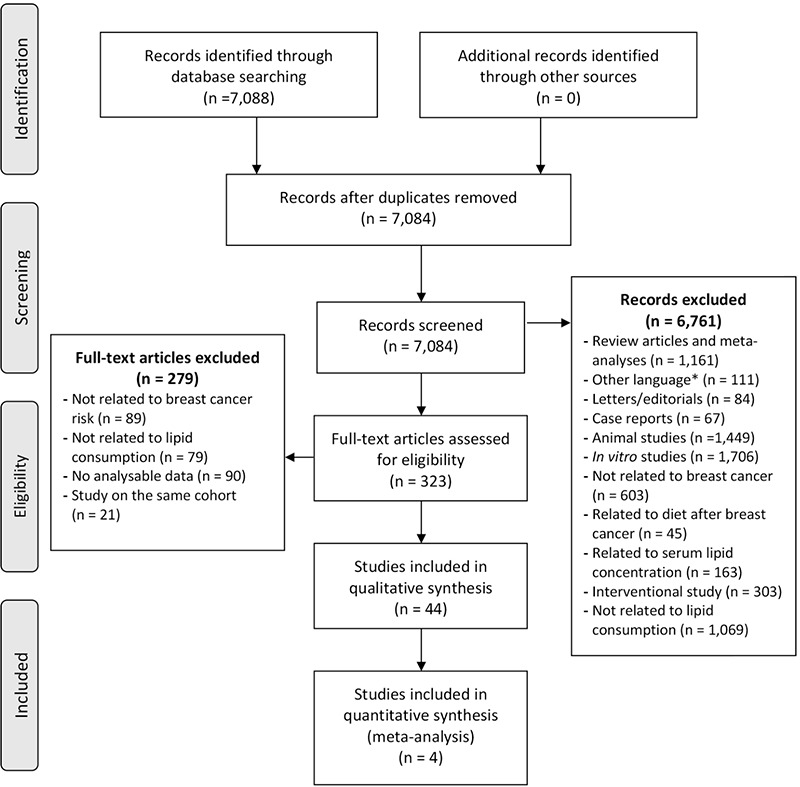
Materials and methods: We conducted a systematic review of the literature and a meta-analysis following Preferred Reporting Items for Systematic Reviews and Meta-Analyses (PRISMA) guidelines. We included all cohort and case-control studies published up to December 2020 with subgroup analysis according to menopausal status.
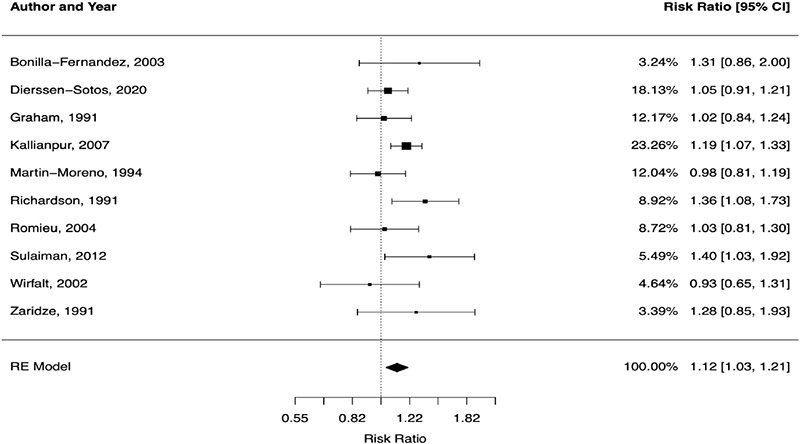
Results: We included 44 articles for analysis. There was no association between total fat, SFA, MUFA, PUFA and cholesterol intake and breast cancer in the general population and in pre-menopausal women. In postmenopausal women, high SFA consumption was associated with increased breast cancer risk in case-control studies [relative risk (RR): 1.12; confidence interval (CI) 95%: 1.03-1.21; p = 0.006 but not in cohort studies (RR: 1.01; CI 95%: 0.85-1.19; p = 0.93).
Conclusion: There was a weak association between high SFA consumption and breast cancer risk in post-menopausal women, however there was high heterogeneity for this analysis. As lipids can have different actions in the same family, studies should rather focus on specific lipid consumption.
Keywords: Breast cancer risk; cholesterol; dietary fat intake; mono-unsaturated fatty acid; saturated fatty acid.
©Copyright 2022 by the the Turkish Federation of Breast Diseases Societies / European Journal of Breast Health published by Galenos Publishing House.
Conflict of interest statement
Conflict of Interest: No conflict of interest was declared by the authors.
Figures
References
-
- Ferlay J, Ervik M, Lam F, Colombet M, Mery L, Piñeros M, et al. Global Cancer Observatory: Cancer Today. Lyon, France: International Agency for Research on Cancer. Available at: accessed [24/01/2021]. 2020. [Internet] https://gco.iarc.fr/today.
-
- Rojas K, Stuckey A. Breast Cancer Epidemiology and Risk Factors. Clin Obstet Gynecol. 2016;59:651–672. - PubMed
-
- Thune I, Brenn T, Lund E, Gaard M. Physical activity and the risk of breast cancer. N Engl J Med. 1997;336:1269–1275. - PubMed
-
- Howe GR, Aronson KJ, Benito E, Castelleto R, Cornée J, Duffy S, et al. The relationship between dietary fat intake and risk of colorectal cancer: evidence from the combined analysis of 13 case-control studies. Cancer Causes Control. 1997;8:215–228. - PubMed
Publication types
LinkOut - more resources
Full Text Sources
Research Materials
