Observational Study
. 2022 Jul 1;8(7):1053-1058.
doi: 10.1001/jamaoncol.2022.0752.

Evaluation of the Durability of the Immune Humoral Response to COVID-19 Vaccines in Patients With Cancer Undergoing Treatment or Who Received a Stem Cell Transplant

Affiliations
Observational Study

Evaluation of the Durability of the Immune Humoral Response to COVID-19 Vaccines in Patients With Cancer Undergoing Treatment or Who Received a Stem Cell Transplant

Qamar J Khan et al. JAMA Oncol. .

Erratum in

  • Errors in Byline and Affiliations.
    [No authors listed] [No authors listed] JAMA Oncol. 2022 Jul 1;8(7):1073. doi: 10.1001/jamaoncol.2022.2977. JAMA Oncol. 2022. PMID: 35861745 Free PMC article. No abstract available.

Abstract

Importance: The durability of the antibody response to COVID-19 vaccines in patients with cancer undergoing treatment or who received a stem cell transplant is unknown and may be associated with infection outcomes.

Objective: To evaluate anti-SARS-CoV-2 spike protein receptor binding domain (anti-RBD) and neutralizing antibody (nAb) responses to COVID-19 vaccines longitudinally over 6 months in patients with cancer undergoing treatment or who received a stem cell transplant (SCT).

Design, setting, and participants: In this prospective, observational, longitudinal cross-sectional study of 453 patients with cancer undergoing treatment or who received an SCT at the University of Kansas Cancer Center in Kansas City, blood samples were obtained before 433 patients received a messenger RNA (mRNA) vaccine (BNT162b2 or mRNA-1273), after the first dose of the mRNA vaccine, and 1 month, 3 months, and 6 months after the second dose. Blood samples were also obtained 2, 4, and 7 months after 17 patients received the JNJ-78436735 vaccine. For patients receiving a third dose of an mRNA vaccine, blood samples were obtained 30 days after the third dose.

Interventions: Blood samples and BNT162b2, mRNA-1273, or JNJ-78436735 vaccines.

Main outcomes and measures: Geometric mean titers (GMTs) of the anti-RBD; the ratio of GMTs for analysis of demographic, disease, and treatment variables; the percentage of neutralization of anti-RBD antibodies; and the correlation between anti-RBD and nAb responses to the COVID-19 vaccines.

Results: This study enrolled 453 patients (mean [SD] age, 60.4 [13,1] years; 253 [56%] were female). Of 450 patients, 273 (61%) received the BNT162b2 vaccine (Pfizer), 160 (36%) received the mRNA-1273 vaccine (Moderna), and 17 (4%) received the JNJ-7846735 vaccine (Johnson & Johnson). The GMTs of the anti-RBD for all patients were 1.70 (95% CI, 1.04-2.85) before vaccination, 18.65 (95% CI, 10.19-34.11) after the first dose, 470.38 (95% CI, 322.07-686.99) at 1 month after the second dose, 425.80 (95% CI, 322.24-562.64) at 3 months after the second dose, 447.23 (95% CI, 258.53-773.66) at 6 months after the second dose, and 9224.85 (95% CI, 2423.92-35107.55) after the third dose. The rate of threshold neutralization (≥30%) was observed in 203 of 252 patients (80%) 1 month after the second dose and in 135 of 166 patients (81%) 3 months after the second dose. Anti-RBD and nAb were highly correlated (Spearman correlation coefficient, 0.93 [0.92-0.94]; P < .001). Three months after the second dose, anti-RBD titers were lower in male vs female patients (ratio of GMTs, 0.52 [95% CI, 0.34-0.81]), patients older than 65 years vs patients 50 years or younger (ratio of GMTs, 0.38 [95% CI, 0.25-0.57]), and patients with hematologic malignant tumors vs solid tumors (ratio of GMTs, 0.40 [95% CI, 0.20-0.81]).

Conclusions and relevance: In this cross-sectional study, after 2 doses of an mRNA vaccine, anti-RBD titers peaked at 1 month and remained stable over the next 6 months. Patients older than 65 years of age, male patients, and patients with a hematologic malignant tumor had low antibody titers. Compared with the primary vaccine course, a 20-fold increase in titers from a third dose suggests a brisk B-cell anamnestic response in patients with cancer.


Conflict of interest statement

Conflict of Interest Disclosures: Dr Zhang reported personal fees from AstraZeneca as a speaker or consultant, grants from AstraZeneca as a principal investigator (PI), personal fees from Bayer as a consultant, grants from Biodesix as a PI, personal fees from Biodesix as a consultant, personal fees from Bristol Myers Squibb as a consultant, personal fees from Cardinal Health as a consultant, personal fees from Daiichi Sankyo as a consultant, personal fees from Hengrui as a consultant, grants from Hengrui as a PI, personal fees from Eli Lilly as a consultant, grants from Mirati as a PI, personal fees from Mirati as a consultant, personal fees from Nexus Health as a consultant, grants from Novartis as a PI, personal fees from Novartis as a consultant, personal fees from Novocure as a consultant, personal fees from Regeneron as a speaker or consultant, personal fees from Sanofi as a speaker or consultant, grants from Genentech as a PI, grants from AbbVie as a PI, grants from BeiGene as a PI, and grants from Nilogen as a PI outside the submitted work. Dr Mcguirk reported personal fees from Kite Pharma, personal fees from Bristol Myers Squibb, personal fees from BioMed, personal fees from GCO, personal fees from G-Med, and personal fees from Mid-America Cancer outside the submitted work. Dr Al-Rajabi reported grants from Bayer for institutional support, grants from NuCana for institutional support, grants from Incyte for institutional support, grants from AstraZeneca for institutional support, grants from Eureka Therapeutics for institutional support, grants from Merck for institutional support, grants from Pfizer for institutional support, holding stockk in Seattle Genetics and Actinium Pharmaceuticals Inc outside the submitted work. Dr Hoffmann reported personal fees from Janssen, personal fees from Pharmacyclics, personal fees from AstraZeneca, personal fees from TG Therapeutics, personal fees from Novartis, and personal fees from BeiGene outside the submitted work. Dr Godwin reported personal fees from Sinochips Diagnostics as the cofounder during the conduct of the study. No other disclosures were reported.

Figures

Figure 1.
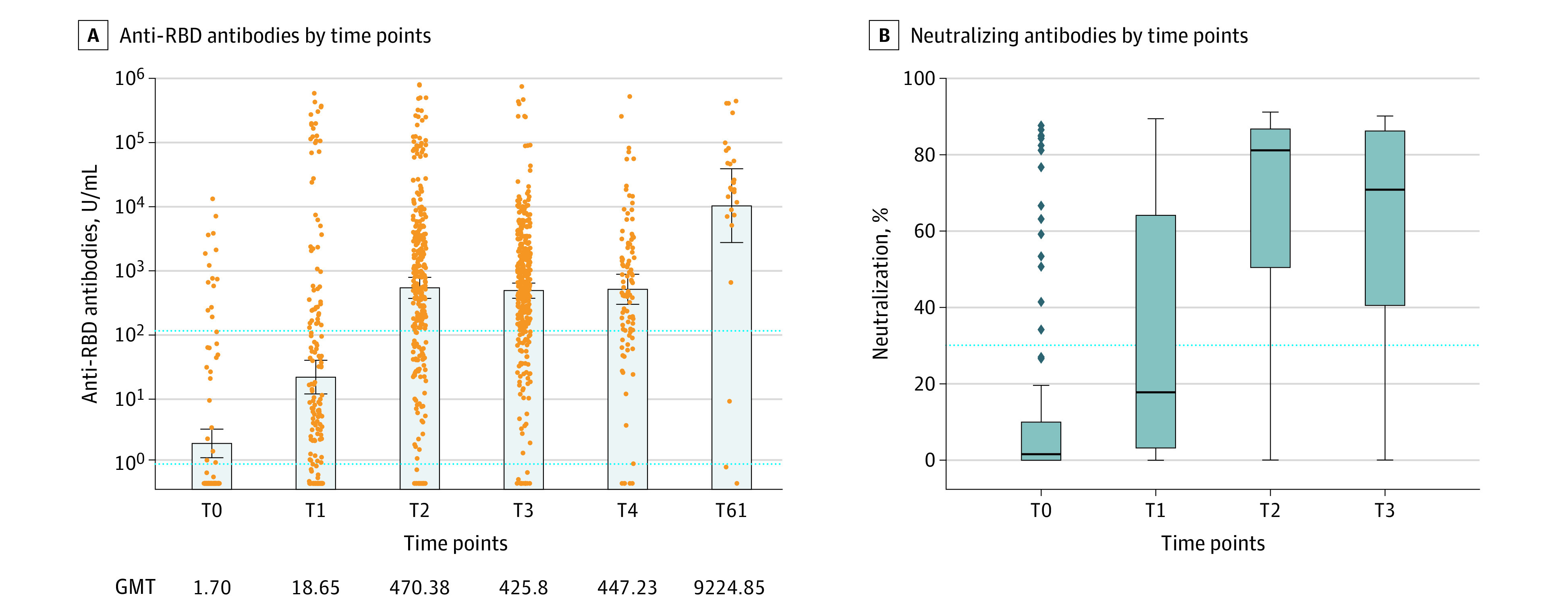
Figure 1.. Anti–SARS-CoV-2 Spike Protein Receptor Binding Domain (Anti-RBD) and Neutralizing Antibody Response to Vaccines
A, Anti-RBD titers for all 453 patients. A total of 1042 blood samples were obtained for antibody testing (112 at T0, 176 at T1, 293 at T2, 336 at T3, 98 at T4, and 27 after the third dose). Each dot represents a patient sample. The x-axis indicates time points for the collection of samples: baseline before vaccination (T0), 14 days after the first dose and before the second dose of a messenger RNA (mRNA) vaccine (T1), 1 month (±1 week) after the second dose of an mRNA vaccine or 2 months after the JNJ-7846735 vaccine (T2), 3 months (±4 weeks) after the second dose of an mRNA vaccine or 4 months after the JNJ-7846735 vaccine (T3), 6 months (±4 weeks) after the second dose of an mRNA vaccine or 7 months after the JNJ-7846735 vaccine (T4), and 4 weeks after the booster (third dose of an mRNA vaccine [T61]). The lower horizontal dotted line indicates seropositivity (0.8 U/mL), and the upper horizontal dotted line indicates the threshold value of 100 U/mL. The error bars indicate geometric mean titers (GMTs) with 95% CIs (whiskers). The GMTs are also displayed numerically. There was a 20-fold increase in titers 1 month after a booster compared with T2 (1 month after completion of the primary vaccination). Only 3 patients had titers lower than 100 U/mL after the booster, and all of them had a hematologic malignant tumor. B, Box-and-whisker plots of the percentage of neutralization using the Surrogate Viral Neutralization Test. The whiskers indicate the range, the boxes indicate the IQR, and the horizontal line within each box indicates the median. The dots indicate the outliers. The horizontal dotted line indicates threshold of neutralization (30%). The median percentage of neutralization was 1% at T0, 18% at T2, 81% at T2, and 71% at T3.
Figure 2.
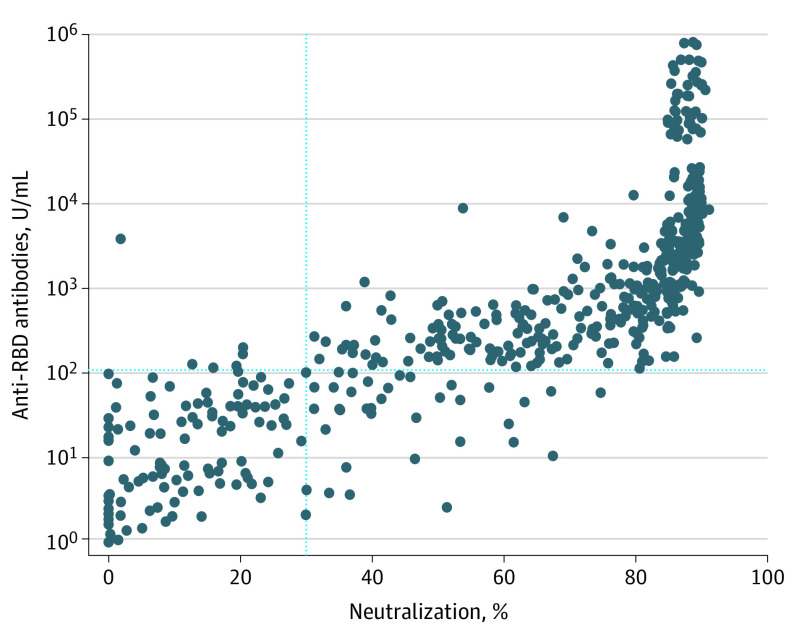
Figure 2.. Correlation Between Anti–SARS-CoV-2 Spike Protein Receptor Binding Domain (Anti-RBD) Antibody and Neutralizing Antibody Levels
The correlation between anti-RBD antibody titers (y-axis) and percentage of neutralization by neutralizing antibody (x-axis) in 619 blood samples is shown. The vertical dotted line indicates the threshold of 30% neutralization; the horizontal dotted line indicates the threshold of 100 U/mL for the anti-RBD antibody. The Spearman correlation coefficient between the percentage of neutralization and the anti-RBD is 0.93, and it is statistically significant at P < .001.

References

    1. Bakouny Z, Hawley JE, Choueiri TK, et al. COVID-19 and cancer: current challenges and perspectives. Cancer Cell. 2020;38(5):629-646. - PMC - PubMed
    1. Al-Shamsi HO, Alhazzani W, Alhuraiji A, et al. A practical approach to the management of cancer patients during the novel coronavirus disease 2019 (COVID-19) pandemic: an international collaborative group. Oncologist. 2020;25(6):e936-e945. - PMC - PubMed
    1. Sharma A, Bhatt NS, St Martin A, et al. Clinical characteristics and outcomes of COVID-19 in haematopoietic stem-cell transplantation recipients: an observational cohort study. Lancet Haematol. 2021;8(3):e185-e193. - PMC - PubMed
    1. Boyarsky BJ, Werbel WA, Avery RK, et al. Immunogenicity of a single dose of SARS-CoV-2 messenger RNA vaccine in solid organ transplant recipients. JAMA. 2021;325(17):1784-1786. - PMC - PubMed
    1. Hall VG, Ferreira VH, Ku T, et al. Randomized trial of a third dose of mRNA-1273 vaccine in transplant recipients. N Engl J Med. 2021;385(13):1244-1246. - PMC - PubMed

Publication types