


Identifying indicators influencing emergency department performance during a medical surge: A consensus-based modified fuzzy Delphi approach
- PMID: 35446857
- PMCID: PMC9022798
- DOI: 10.1371/journal.pone.0265101
Identifying indicators influencing emergency department performance during a medical surge: A consensus-based modified fuzzy Delphi approach
Abstract
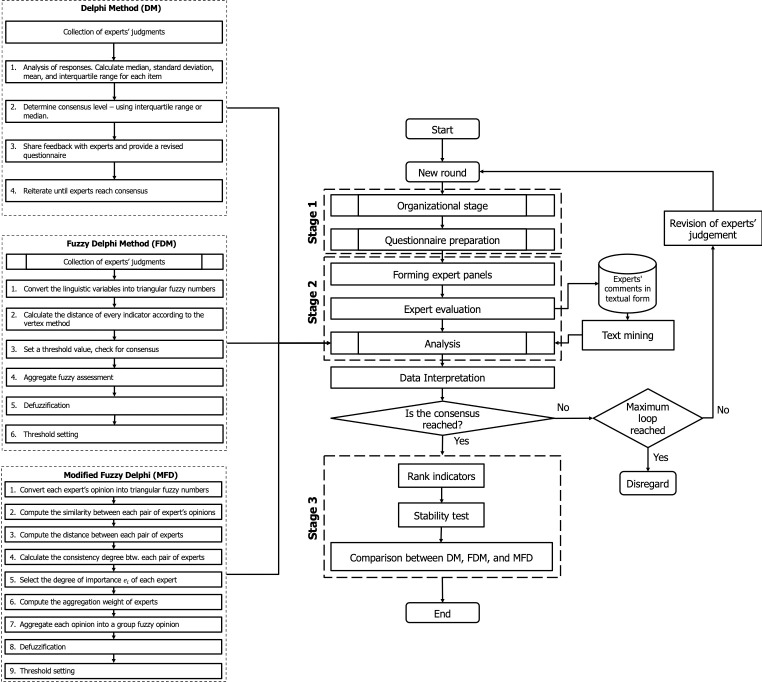
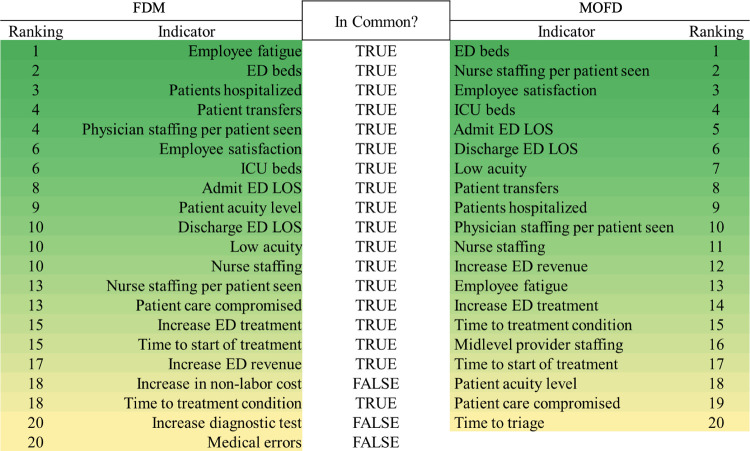
During a medical surge, resource scarcity and other factors influence the performance of the healthcare systems. To enhance their performance, hospitals need to identify the critical indicators that affect their operations for better decision-making. This study aims to model a pertinent set of indicators for improving emergency departments' (ED) performance during a medical surge. The framework comprises a three-stage process to survey, evaluate, and rank such indicators in a systematic approach. The first stage consists of a survey based on the literature and interviews to extract quality indicators that impact the EDs' performance. The second stage consists of forming a panel of medical professionals to complete the survey questionnaire and applying our proposed consensus-based modified fuzzy Delphi method, which integrates text mining to address the fuzziness and obtain the sentiment scores in expert responses. The final stage ranks the indicators based on their stability and convergence. Here, twenty-nine potential indicators are extracted in the first stage, categorized into five healthcare performance factors, are reduced to twenty consentaneous indicators monitoring ED's efficacy. The Mann-Whitney test confirmed the stability of the group opinions (p < 0.05). The agreement percentage indicates that ED beds (77.8%), nurse staffing per patient seen (77.3%), and length of stay (75.0%) are among the most significant indicators affecting the ED's performance when responding to a surge. This research proposes a framework that helps hospital administrators determine essential indicators to monitor, manage, and improve the performance of EDs systematically during a surge event.
Conflict of interest statement
The authors have declared that no competing interests exist.
Figures
References
-
- Fagbuyi DB, Brown KM, Mathison DJ, Kingsnorth J, Morrison S, Saidinejad M, et al. A rapid medical screening process improves emergency department patient flow during surge associated with novel H1N1 influenza virus. Annals of emergency medicine. 2011;57(1):52–9. doi: 10.1016/j.annemergmed.2010.08.026 - DOI - PubMed
Publication types
MeSH terms
LinkOut - more resources
Full Text Sources
Medical
