Review
. 2022 Apr 8;13(4):368.
doi: 10.3390/insects13040368.

Enantiomeric Discrimination in Insects: The Role of OBPs and ORs

Affiliations
Review

Enantiomeric Discrimination in Insects: The Role of OBPs and ORs

Cassie Sims et al. Insects. .

Abstract

Olfaction is a complex recognition process that is critical for chemical communication in insects. Though some insect species are capable of discrimination between compounds that are structurally similar, little is understood about how this high level of discrimination arises. Some insects rely on discriminating between enantiomers of a compound, demonstrating an ability for highly selective recognition. The role of two major peripheral olfactory proteins in insect olfaction, i.e., odorant-binding proteins (OBPs) and odorant receptors (ORs) has been extensively studied. OBPs and ORs have variable discrimination capabilities, with some found to display highly specialized binding capability, whilst others exhibit promiscuous binding activity. A deeper understanding of how odorant-protein interactions induce a response in an insect relies on further analysis such as structural studies. In this review, we explore the potential role of OBPs and ORs in highly specific recognition, specifically enantiomeric discrimination. We summarize the state of research into OBP and OR function and focus on reported examples in the literature of clear enantiomeric discrimination by these proteins.

Keywords: chemical ecology; chemosensory; chiral; enantiomeric discrimination; insect; odorant receptors; odorant-binding proteins; olfaction.


Conflict of interest statement

The authors declare no conflict of interest.

Figures

Figure 1
Figure 1
Early synthesized enantiomerically pure pheromones, Atta texana alarm pheromone (S)-4-methyl-3-heptanone 1, Lymantria dispar sex pheromone (7R,8S)-(+)-disparlure 2 and Dendroctonus brevicomis aggregation pheromone (1S,5R)-frontalin 3 .
Figure 2
Figure 2
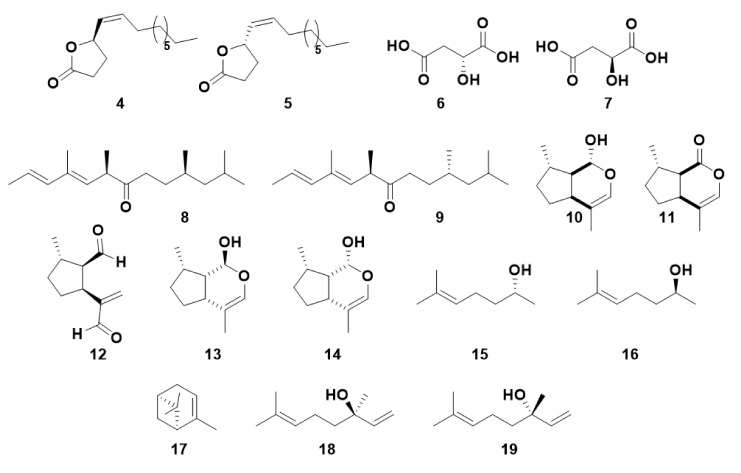
The chemical structures of a selection of chiral insect pheromones and semiochemicals involved in insect olfaction.(R)-Japonilure 4, (S)-japonilure 5, (R)-malic acid 6, (S)-malic acid 7, (6R,10R)-matsuone 8, (6R,10S)-matsuone 9, (1R,4aS,7S,7aR)-nepetalactol 10, (4aS,7S,7aR)-nepetalactone 11, (1R,2S,5S)-dolichodial 12, (1S,4aR,7S,7aS)-nepetalactol 13 and (1R,4aR,7S,7aS)-nepetalactol 14, (R)-sulcatol 15, (S)-sulcatol 16, α-pinene 17, (R)-linalool 18 and (S)-linalool 19.
Figure 3
Figure 3
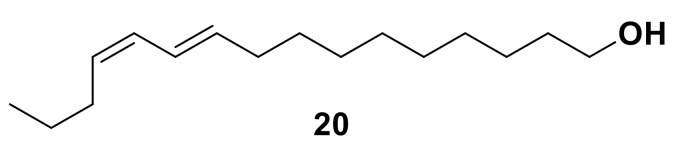
The chemical structure of Bombykol 20, the first insect pheromone isolated from the silkworm moth, Bombyx mori.
Figure 4
Figure 4
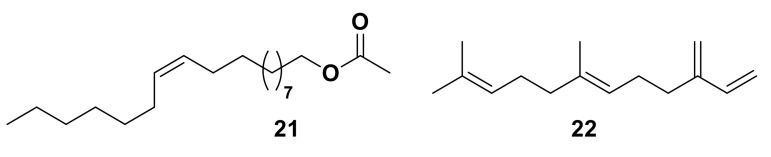
The chemical structure of (Z)-vaccenyl acetate (VA) 21, the male sex pheromone of D. melanogaster, and (E)-β-farnesene 22, the aphid alarm pheromone.
Figure 5
Figure 5
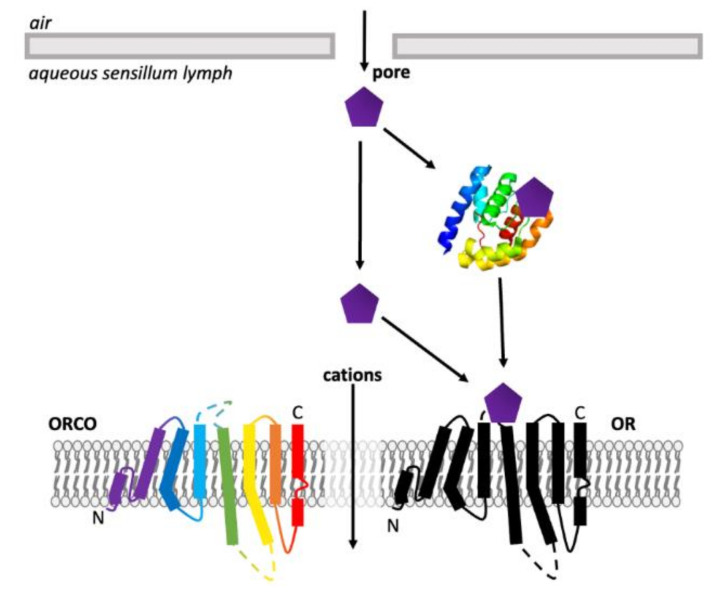
General olfactory processing in insects. Within the antennal sensilla, odorant-binding proteins (OBPs) play a role in allowing odorants to activate odorant receptors (ORs) which are co- expressed with the olfactory receptor co-receptor (ORCO). Once activated, an action potential travels along the odorant receptor neuron (ORN) to the antennal lobe.
Figure 6
Figure 6
The chemical structures of (7R,8S)-(+)-disparlure 2 and (7S,8R)-(−)-disparlure 23.
Figure 7
Figure 7
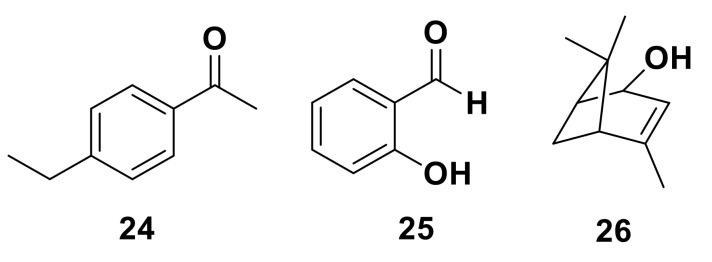
The chemical structure of 4-ethylacetophenone 24, salicylaldehyde 25 and (S)-cis-verbenol 26, compounds shown to elicit a response to the broadly tuned OR ApisOR4 from A. pisum.
Figure 8
Figure 8
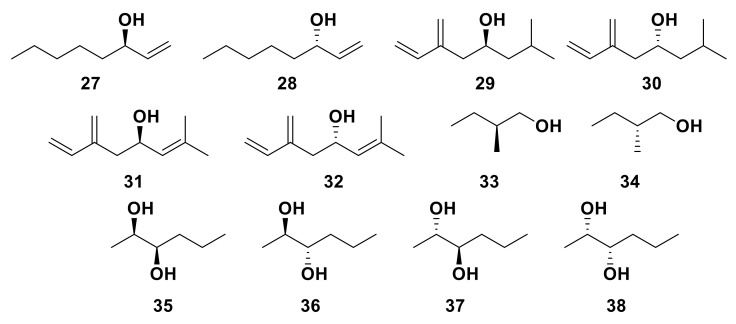
The chemical structures of A. aegypti kairomone (R)-1-octen-3-ol 27 and (S)-1-octen-3-ol 28, the pheromone components (S)-ipsenol 29, (R)-ipsenol 30, (R)-ipsdienol 31 and (S)-ipsdienol 32 of the Eurasian spruce bark beetle, Ips typographus and the pheromone components (S)-2-methyl-1-butanol 33, (R)-2-methyl-1-butanol 34, (2R,3R)-2,3,-hexanediol 35, (2R,3S)-2,3-hexanediol 36, (2S,3R)-2,3-hexandiol 37 and (2S,3S)-2,3-hexandiol 38 of the cerambycid beetle Megacyllene caryae.
Figure 9
Figure 9
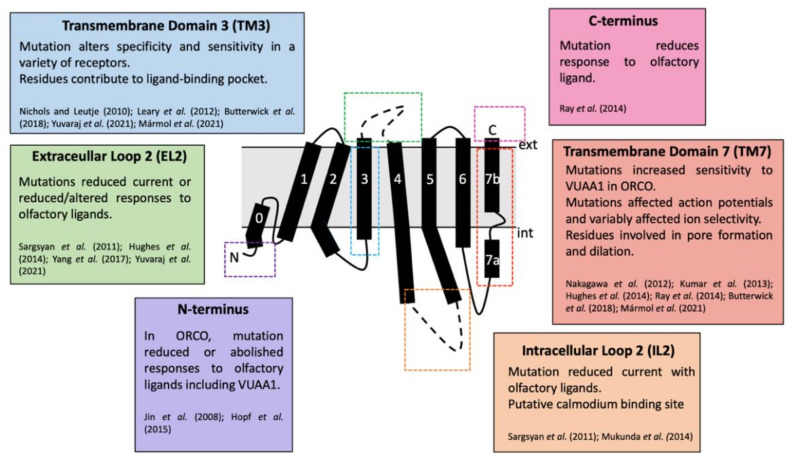
Topology of an ORCO subunit with key loci for activity highlighted [1,7,9,104,124,126,127,136–142]. Not included are transmembrane domains 2,4,5 and 6, extracellular loop 3 and intracellular loop 3, which all possess additional roles in affecting sensitivity to ligands, ion selectivity and response ratios [9,96,123,127,138,143].

References

    1. Sánchez-Gracia A., Vieira F.G., Rozas J. Molecular evolution of the major chemosensory gene families in insects. Heredity. 2009;103:208–216. doi: 10.1038/hdy.2009.55. - DOI - PubMed
    1. Rytz R., Croset V., Benton R. Ionotropic Receptors (IRs): Chemosensory ionotropic glutamate receptors in Drosophila and beyond. Insect Biochem. Mol. Biol. 2013;43:888–897. doi: 10.1016/j.ibmb.2013.02.007. - DOI - PubMed
    1. Reisenman C.E., Lei H., Guerenstein P.G. Neuroethology of olfactory-guided behavior and its potential application in the control of harmful insects. Front. Physiol. 2016;7:271. doi: 10.3389/fphys.2016.00271. - DOI - PMC - PubMed
    1. Witzgall P., Kirsch P., Cork A. Sex pheromones and their impact on pest management. J. Chem. Ecol. 2010;36:80–100. doi: 10.1007/s10886-009-9737-y. - DOI - PubMed
    1. Touchet S., Chamberlain K., Woodcock C.M., Miller D.J., Birkett M.A., Pickett J.A., Allemann R.K. Novel olfactory ligands via terpene synthases. Chem. Commun. 2015;51:7550–7553. doi: 10.1039/C5CC01814E. - DOI - PubMed

LinkOut - more resources