


Motivation to Consent and Adhere to the FORT Randomized Controlled Trial
- PMID: 35448206
- PMCID: PMC9025660
- DOI: 10.3390/curroncol29040232
Motivation to Consent and Adhere to the FORT Randomized Controlled Trial
Abstract
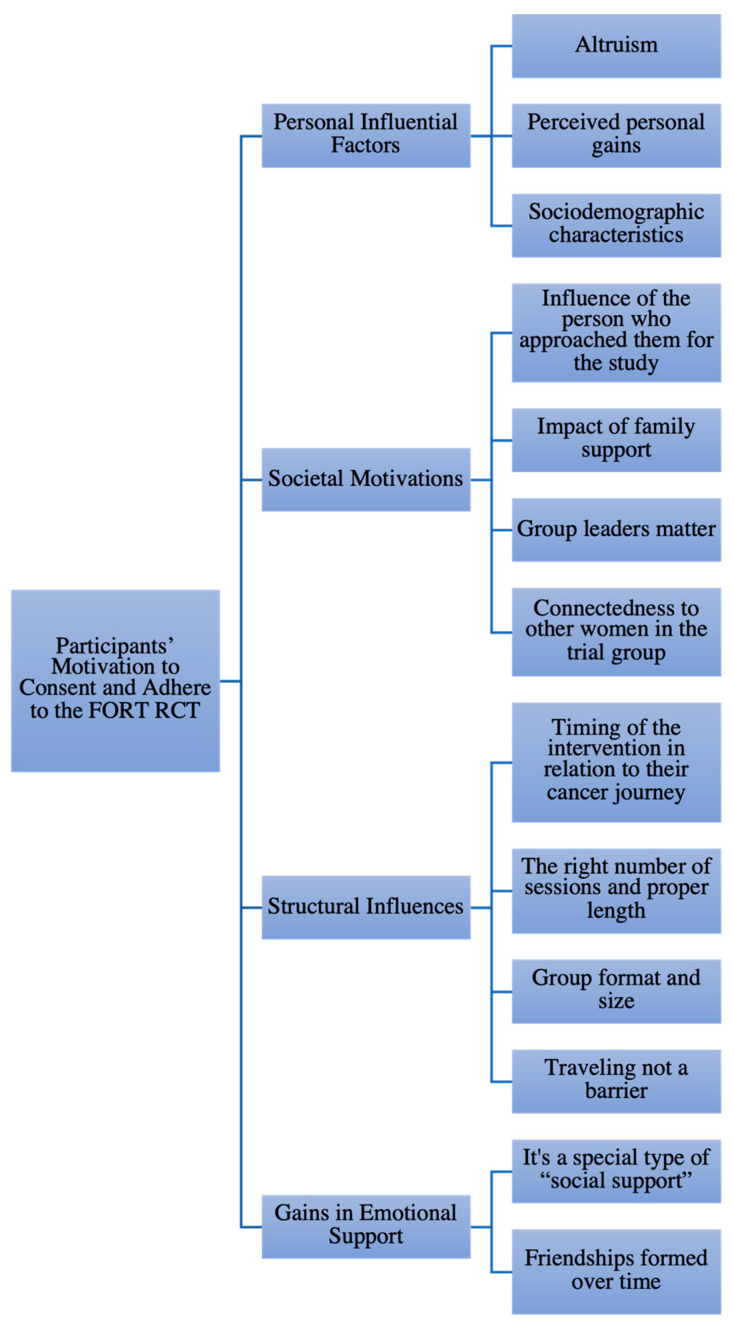
The aim of this qualitative study was to identify the motivational factors that influence cancer survivors to participate and adhere to the fear of cancer recurrence (FCR) FORT randomized controlled trial (RCT). Fifteen women diagnosed with breast and gynecological cancer who took part in the FORT RCT were interviewed about their experience to consent and adhere to the trial. The transcribed interviews were content analyzed within a relational autonomy framework. The analysis revealed that the participants' motivation to consent and adhere to the FORT RCT was structured around thirteen subthemes grouped into four overarching themes: (1) Personal Influential Factors; (2) Societal Motivations; (3) Structural Influences; and (4) Gains in Emotional Support. The unique structures of the trial such as the group format, the friendships formed with other participants in their group and with the group leaders, and the right timing of the trial within their cancer survivorship trajectory all contributed to their motivation to consent and adhere to the FORT RCT. While their initial motivation to participate was mostly altruistic, it was their personal gains obtained over the course of the trial that contributed to their adherence. Potential gains in emotional and social support from psycho-oncology trials should be capitalized when approaching future participants as a mean to improve on motivations to consent and adhere.
Keywords: breast and gynecological cancer; clinical trial; cognitive-existential approach; fear of cancer recurrence; group intervention; interpretive description.
Conflict of interest statement
The authors declare no conflict of interest. The funders had no role in the design of the study; in the collection, analyses, or interpretation of data; in the writing of the manuscript, or in the decision to publish the results.
Figures
References
-
- Lebel S., Ozakinci G., Humphris G., Mutsaers B., Thewes B., Prins J., Dinkel A., Butow P., Univ on behalf of the University of Ottawa Fear of Cancer Recurrence Colloquium attendees From normal response to clinical problem: Definition and clinical features of fear of cancer recurrence. Support. Care Cancer. 2016;24:3265–3268. doi: 10.1007/s00520-016-3272-5. - DOI - PubMed
-
- Canadian Partnership against Cancer . In: Living with Cancer: A Report on the Patient Experience. Canadian Partnership against Cancer, editor. Canadian Partnership against Cancer; Toronto, ON, Canada: 2018. p. 50.
Publication types
MeSH terms
LinkOut - more resources
Full Text Sources
Medical
