


Exploring a New Theoretical Model to Explain the Behavior of Medication Adherence
- PMID: 35448702
- PMCID: PMC9025348
- DOI: 10.3390/pharmacy10020043
Exploring a New Theoretical Model to Explain the Behavior of Medication Adherence
Abstract
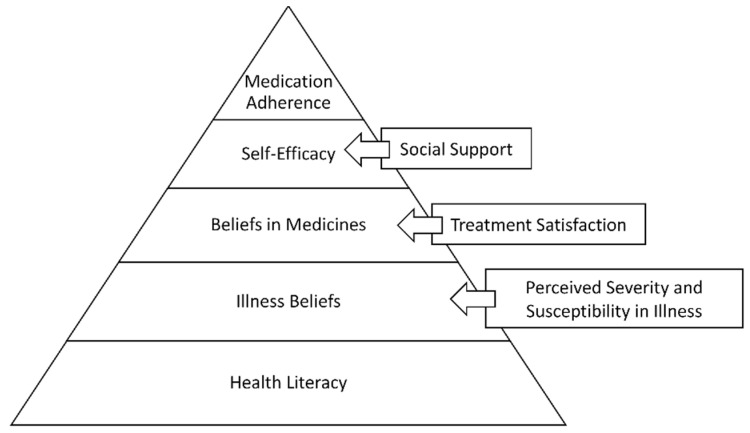
Medication adherence is essential for optimal therapeutic outcomes. However, non-adherence with long-term therapy is at 50%. Several theoretical models have identified several key factors that could explain medication adherence. Though numerous interventions have been developed based on these theoretical models, the success rates with interventions are not the best. This paper proposes a new Hierarchical Model for Medication Adherence. In this model, we propose medication adherence as a five-tier model with medication adherence as the desirable behavior on the top of the pyramid. From the bottom of the hierarchy upwards, the skills/beliefs/behaviors to be achieved are: health literacy, belief in illness (impacted by perceived susceptibility and severity of illness), belief in medicines (impacted by treatment satisfaction), and self-efficacy (impacted by social support). The model further proposes that each individual will achieve or already have these skills/beliefs/behaviors at various levels. Screening patients for these benchmarks will enable providers to decide where to target interventions.
Keywords: health literacy; hierarchical model; illness beliefs; medication adherence; medication beliefs; self-efficacy; theoretical model.
Conflict of interest statement
The authors declare no conflict of interest.
Figures
References
-
- World Health Organization . In: Adherence to Long-Term Therapies: Evidence for Action. Sabaté E., editor. World Health Organization; Geneva, Switzerland: 2003. - PubMed
-
- Horne R., Chapman S., Parham R., Freemantle N., Forbes A., Cooper V. Understanding Patients’ Adherence-Related Beliefs about Medicines Prescribed for Long-Term Conditions: A Meta-Analytic Review of the Necessity-Concerns Framework. PLoS ONE. 2013;8:e80633. doi: 10.1371/journal.pone.0080633. - DOI - PMC - PubMed
-
- Viswanathan M., Golin C.E., Jones C.D., Ashok M., Blalock S.J., Wines R.C., Coker-Schwimmer E.J., Rosen D.L., Sista P., Lohr K.N. Interventions to improve adherence to self-administered medications for chronic diseases in the United States: A systematic review. Ann. Intern. Med. 2012;157:785–795. doi: 10.7326/0003-4819-157-11-201212040-00538. - DOI - PubMed
Publication types
LinkOut - more resources
Full Text Sources
