. 2022 Mar 31;14(4):248.
doi: 10.3390/toxins14040248.

The Enzymatic Core of Scorpion Venoms

Affiliations

The Enzymatic Core of Scorpion Venoms

Gustavo Delgado-Prudencio et al. Toxins (Basel). .

Abstract

Enzymes are an integral part of animal venoms. Unlike snakes, in which enzymes play a primary role in envenomation, in scorpions, their function appears to be ancillary in most species. Due to this, studies on the diversity of scorpion venom components have focused primarily on the peptides responsible for envenomation (toxins) and a few others (e.g., antimicrobials), while enzymes have been overlooked. In this work, a comprehensive study on enzyme diversity in scorpion venoms was performed by transcriptomic and proteomic techniques. Enzymes of 63 different EC types were found, belonging to 330 orthogroups. Of them, 24 ECs conform the scorpion venom enzymatic core, since they were determined to be present in all the studied scorpion species. Transferases and lyases are reported for the first time. Novel enzymes, which can play different roles in the venom, including direct toxicity, as venom spreading factors, activators of venom components, venom preservatives, or in prey pre-digestion, were described and annotated. The expression profile for transcripts coding for venom enzymes was analyzed, and shown to be similar among the studied species, while being significantly different from their expression pattern outside the telson.

Keywords: enzymatic core; proteomics; scorpion venom; transcriptomics; venom enzyme.


Conflict of interest statement

The authors declare no conflict of interest. The funders had no role in the design of the study; in the collection, analyses, or interpretation of data; in the writing of the manuscript, or in the decision to publish the results.

Figures
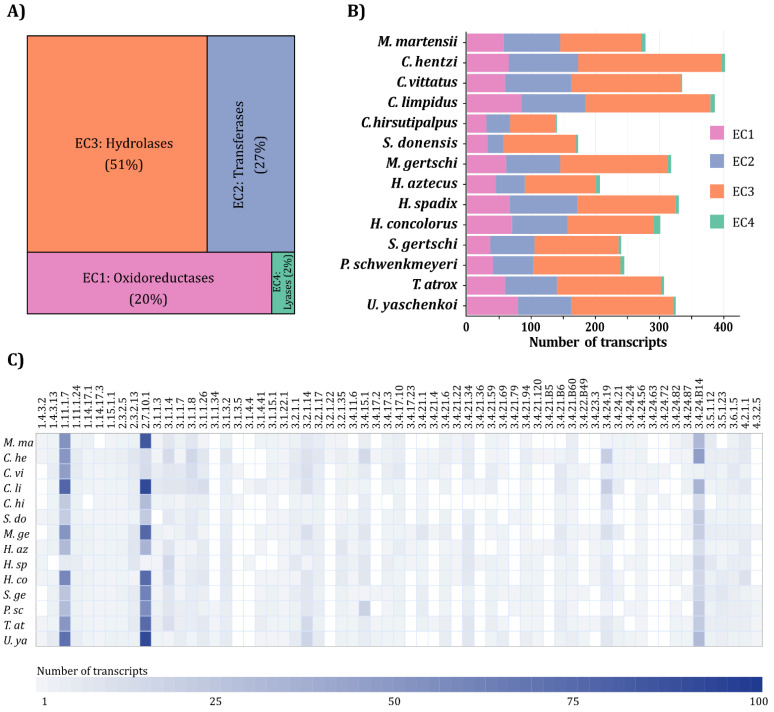
Figure 1
Figure 1
Classification of putative enzymes derived from scorpion venom gland transcriptomes: (A) Tree map showing the relative diversity of recovered enzyme-coding transcripts, grouped by enzyme class; (B) Bar plot showing the total number of the different enzyme-coding transcripts per scorpion species; (C) Heatmap of the different ECs identified in this study and the number of transcripts per species. In (A,B), colors identify transcripts coding for enzymes of the following EC classes: ■ oxidoreductases (EC1), ■ transferases (EC2), ■ hydrolases (EC3), ■ lyases (EC4). In (C), the blue gradient indicates the number of transcripts annotated per EC identifier.
Figure 2
Figure 2
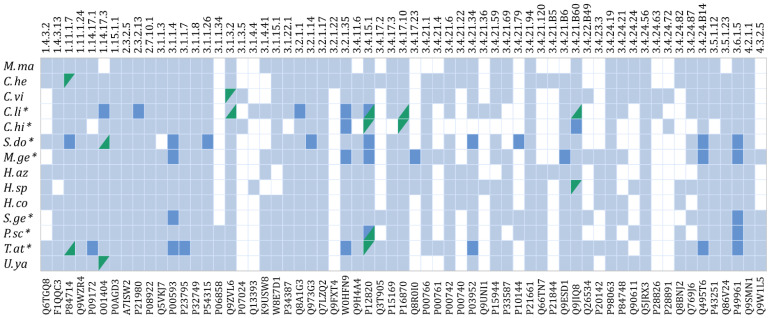
Presence/absence profile of enzyme-coding transcripts in transcriptomes and enzymes in proteomes, per species. Translated sequences from each transcriptome were cross-matched against the seven available proteomes. An asterisk next to the species name indicates that the proteome is available and was analyzed. Boxes in light blue identify sequences found only in the transcriptome, and boxes in dark blue identify sequences found in both the transcriptome and the proteome of the same species. Several transcripts matched heterologously with venom proteins from a different species, and are indicated in split boxes in green. A box with a green upper left side specifies the transcript and a box with a green lower right side in the same column indicates the matching protein (for EC 3.4.15.1, the cognate pairs are between buthids (C. hirsutipalpus and C. limpidus) and between vaejovids (T. atrox y P. schwenkmeyeri)). In the upper part of the graph, the ECs of the enzymes are indicated, and in the lower part, the corresponding UniProt IDs are given.
Figure 3
Figure 3
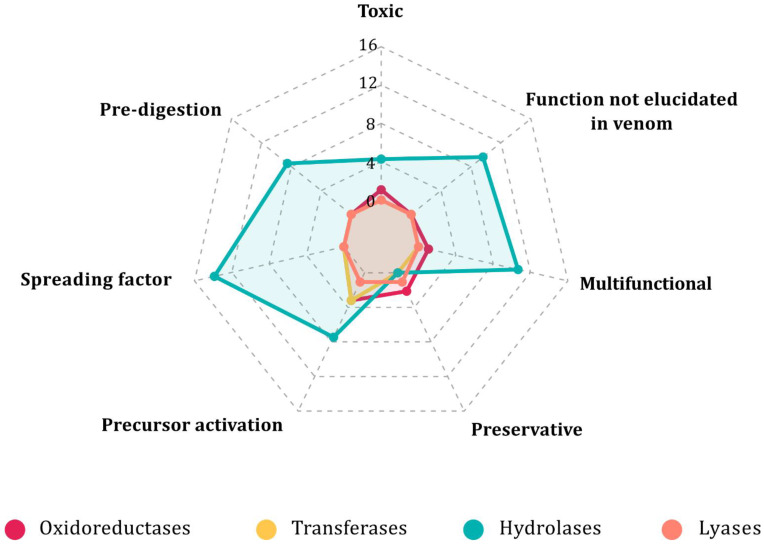
Distribution of enzyme classes according to their physiological function. Counts denote the number of ECs per category.
Figure 4
Figure 4
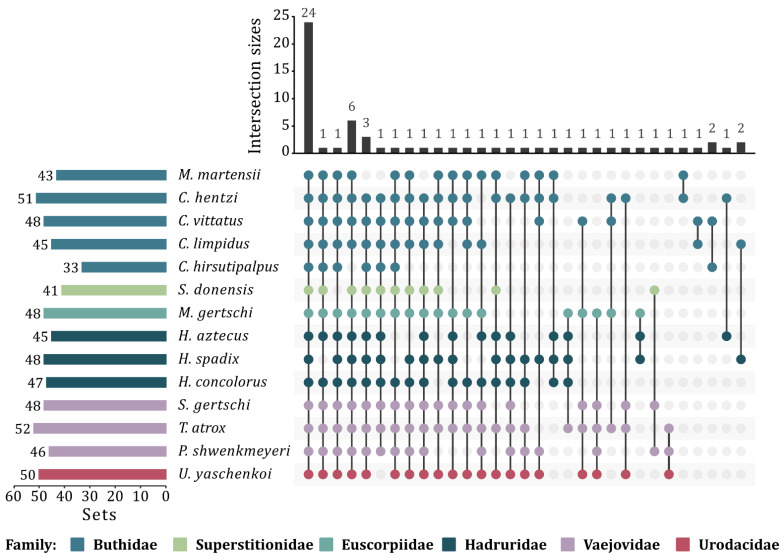
Upset plot showing the graphical representation of the enzymatic core of the venoms of the studied scorpions. The upper bar graph shows the number of ECs contained in each intersection (intersection sizes). The number of sets (left side) indicates the degree of contribution of an EC or the level of interrelationship between species. The dot plot (right side) reflects the contribution of each species to the intersections.
Figure 5
Figure 5
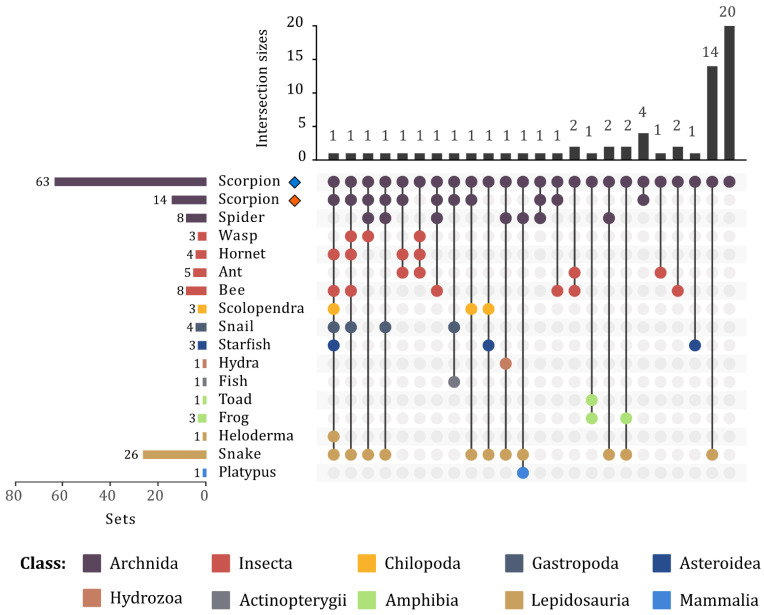
Upset plot of the enzymatic core of animal venoms. The upper bar graph shows the number of ECs contained in each intersection (intersection sizes). The number of sets (left side) indicates the degree of contribution of an EC or the level of interrelationship between each animal category. The dot plot (right side) reflects the contribution of each animal category to the intersections. Scorpion enzymes identified in this study and those obtained from existing databases are shown separately (as indicated by a blue or a red diamond, respectively).
Figure 6
Figure 6
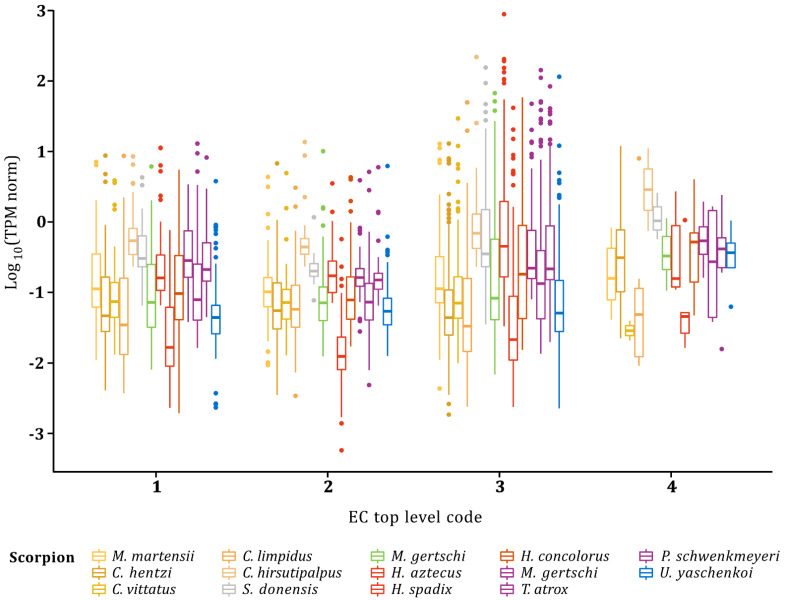
RNA-seq profile for transcripts related to enzymes in scorpion venom glands. Transcripts are grouped according to EC top level codes. Normalized transcripts per million (TPM) are shown on a Log10 scale. Color gamut represents different scorpion families: yellow, family Buthidae; gray, family Superstitionidae; green, family Euscorpiidae; red, family Hadruridae; purple, family Vaejovidae and blue, family Urodacidae.
Figure 7
Figure 7
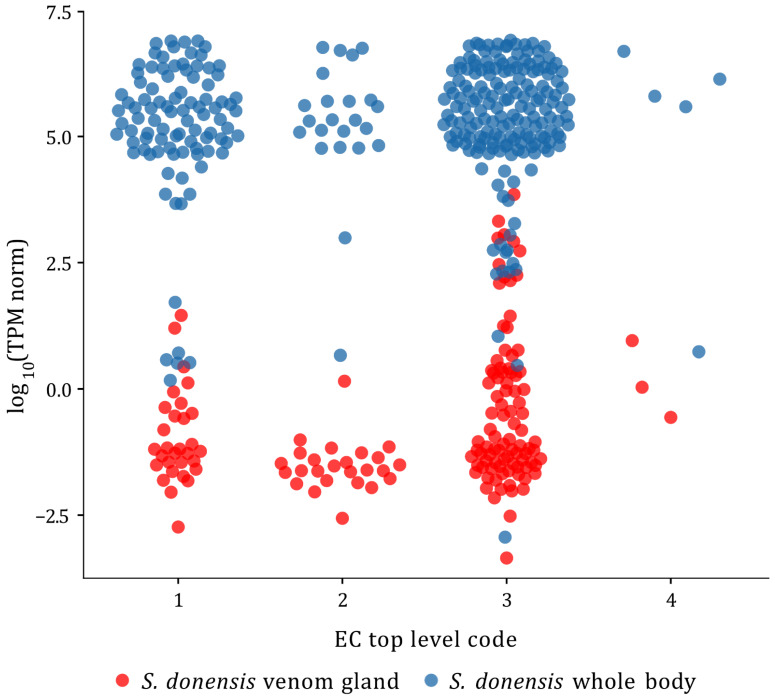
Quantitation of the transcripts coding for potentially secreted enzymes of venom gland vs. whole body in S. donensis. Transcripts are grouped according to EC top level codes. Normalized transcripts per million (TPM) are shown on a Log10 scale. Transcripts from the whole-body transcriptome are shown in blue and transcripts from the venom gland transcriptome are shown in red.
Figure 8
Figure 8
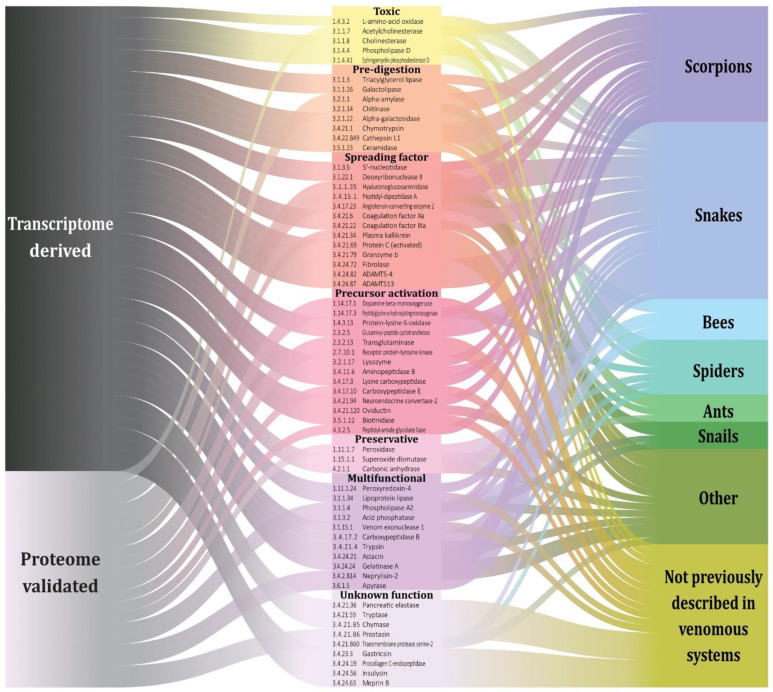
Sankey plot showing the relationship between venom enzymes identified in this study, their associated function in the venom and their presence in animal venoms. The left side segregates enzymes predicted from transcripts only, from those also validated in proteomes. At the right side, enzymes previously reported in animal venoms are shown, with the lowermost category showing novel ECs with no known counterpart in any animal venom.

References

    1. Ortiz E., Gurrola G.B., Schwartz E.F., Possani L.D. Scorpion venom components as potential candidates for drug development. Toxicon. 2015;93:125–135. doi: 10.1016/j.toxicon.2014.11.233. - DOI - PMC - PubMed
    1. Ahmadi S., Knerr J.M., Argemi L., Bordon K.C.F., Pucca M.B., Cerni F.A., Arantes E.C., Caliskan F., Laustsen A.H. Scorpion venom: Detriments and benefits. Biomedicines. 2020;8:118. doi: 10.3390/biomedicines8050118. - DOI - PMC - PubMed
    1. Delgado-Prudencio G., Possani L.D., Becerril B., Ortiz E. The dual alpha-amidation system in scorpion venom glands. Toxins. 2019;11:425. doi: 10.3390/toxins11070425. - DOI - PMC - PubMed
    1. Oliveira-Mendes B.B.R., Miranda S.E.M., Sales-Medina D.F., Magalhaes B.F., Kalapothakis Y., Souza R.P., Cardoso V.N., de Barros A.L.B., Guerra-Duarte C., Kalapothakis E., et al. Inhibition of Tityus serrulatus venom hyaluronidase affects venom biodistribution. PLoS Negl. Trop. Dis. 2019;13:e0007048. doi: 10.1371/journal.pntd.0007048. - DOI - PMC - PubMed
    1. Borchani L., Sassi A., Shahbazzadeh D., Strub J.M., Tounsi-Guetteti H., Boubaker M.S., Akbari A., Van Dorsselaer A., El Ayeb M. Heminecrolysin, the first hemolytic dermonecrotic toxin purified from scorpion venom. Toxicon. 2011;58:130–139. doi: 10.1016/j.toxicon.2011.05.016. - DOI - PubMed

Publication types

LinkOut - more resources