Review
. 2022 Apr 13;14(4):278.
doi: 10.3390/toxins14040278.

Cocaine: An Updated Overview on Chemistry, Detection, Biokinetics, and Pharmacotoxicological Aspects including Abuse Pattern

Affiliations
Review

Cocaine: An Updated Overview on Chemistry, Detection, Biokinetics, and Pharmacotoxicological Aspects including Abuse Pattern

Rita Roque Bravo et al. Toxins (Basel). .

Abstract

Cocaine is one of the most consumed stimulants throughout the world, as official sources report. It is a naturally occurring sympathomimetic tropane alkaloid derived from the leaves of Erythroxylon coca, which has been used by South American locals for millennia. Cocaine can usually be found in two forms, cocaine hydrochloride, a white powder, or 'crack' cocaine, the free base. While the first is commonly administered by insufflation ('snorting') or intravenously, the second is adapted for inhalation (smoking). Cocaine can exert local anaesthetic action by inhibiting voltage-gated sodium channels, thus halting electrical impulse propagation; cocaine also impacts neurotransmission by hindering monoamine reuptake, particularly dopamine, from the synaptic cleft. The excess of available dopamine for postsynaptic activation mediates the pleasurable effects reported by users and contributes to the addictive potential and toxic effects of the drug. Cocaine is metabolised (mostly hepatically) into two main metabolites, ecgonine methyl ester and benzoylecgonine. Other metabolites include, for example, norcocaine and cocaethylene, both displaying pharmacological action, and the last one constituting a biomarker for co-consumption of cocaine with alcohol. This review provides a brief overview of cocaine's prevalence and patterns of use, its physical-chemical properties and methods for analysis, pharmacokinetics, pharmacodynamics, and multi-level toxicity.

Keywords: cocaine hydrochloride; crack; drug abuse; drug analysis; pharmacodynamics; pharmacokinetics; sympathomimetics; toxicity.


Conflict of interest statement

The authors declare no conflict of interest.

Figures
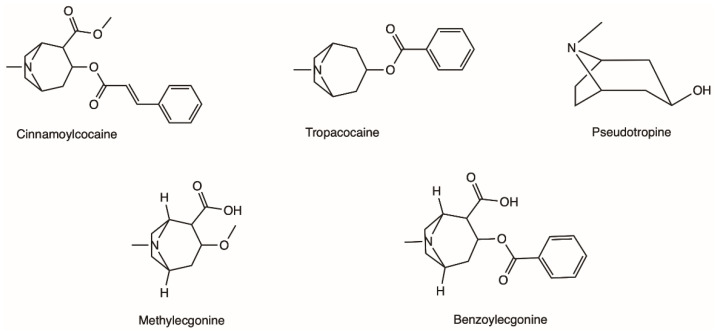
Figure 1
Figure 1
Examples of different alkaloids that can be found in the leaves of the coca plant.
Figure 2
Figure 2
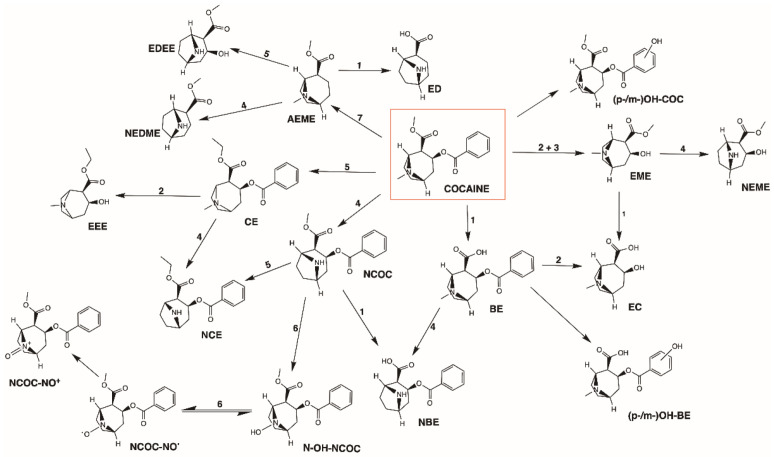
Metabolic pathways of cocaine. Cocaine is mainly metabolized through hydrolysis into benzoylecgonine (BE) and ecgonine methyl ester (EME), both of which can be further hydrolysed to ecgonine (EC). Cocaine may also undergo hydroxylation to yield para-/meta-hydroxycocaine (p-/m-OH-COC). Another minor metabolic reaction is the N-demethylation of cocaine to norcocaine (NCOC). In the presence of ethanol (EtOH), cocaine will undergo transesterification and form cocaethylene (CE). AEME, anhydroecgonine methyl ester; CYP450, cytochrome P450; ED, ecgonidine; EDEE, ecgonidine ethyl ester; EEE, ecgonine ethyl ester; FADM, flavin adenine dinucleotide-containing monooxygenase; hCE1, human carboxylesterase type 1; hCE2, human carboxylesterase type 2; NBE, norbenzoylecgonine; NCE, norcocaethylene; NCOC-NO, norcocaine nitroxide; NCOC-NO+, norcocaine nitrosonium; NEDME, norecgonidine methyl ester; NEME, norecgonine methyl ester; N-OH-NCOC, N-hydroxy-norcocaine; (p-/m-)OH-BE, (para-/meta-)hydroxybenzoylecgonine; PChE, pseudocholinesterase.
Figure 3
Figure 3
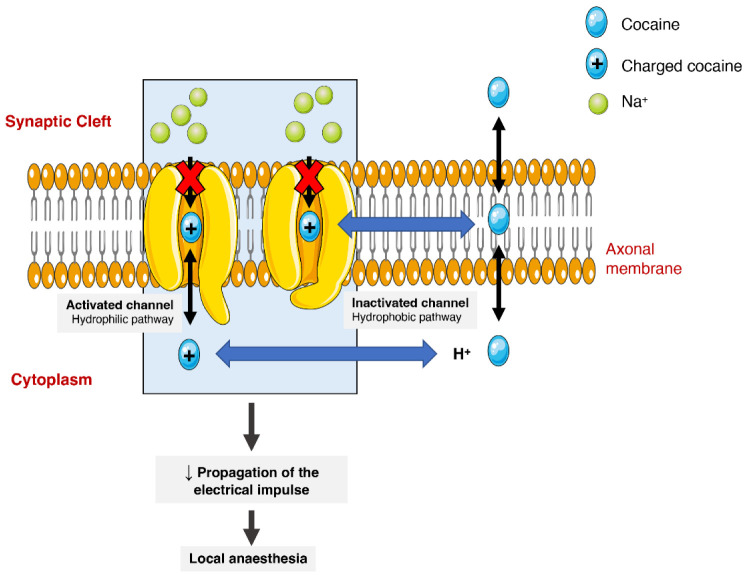
Schematic representation of cocaine’s interaction with voltage-gated sodium channels. Cocaine enters the channels and binds to them by two pathways (hydrophilic and hydrophobic). In the hydrophobic pathway cocaine interacts with the sodium channel at the membrane level, alternatively in hydrophilic pathway, the cocaine is ionized in cytoplasm before the interaction. In both cases, the flow of sodium is blocked, which diminishes the propagation of electrical impulses and causes a local anaesthetic effect.
Figure 4
Figure 4
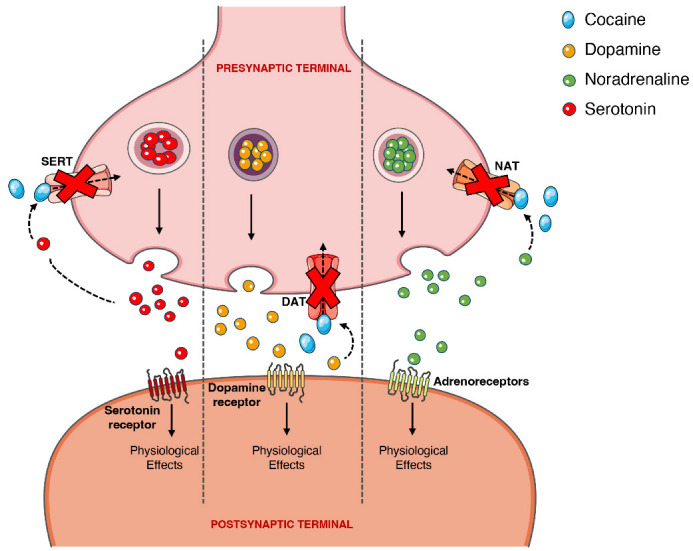
Schematic representation of cocaine’s pharmacodynamics at the noradrenergic, serotonergic or dopaminergic synapse. Cocaine acts by blocking the presynaptic transporters of dopamine, serotonin and noradrenaline, preventing the reuptake of the neurotransmitters into the presynaptic terminal, which will cause intense and prolonged stimulation of the postsynaptic receptors. DAT, dopamine transporter; NAT, noradrenaline transporter; SERT, serotonin transporter.
Figure 5
Figure 5
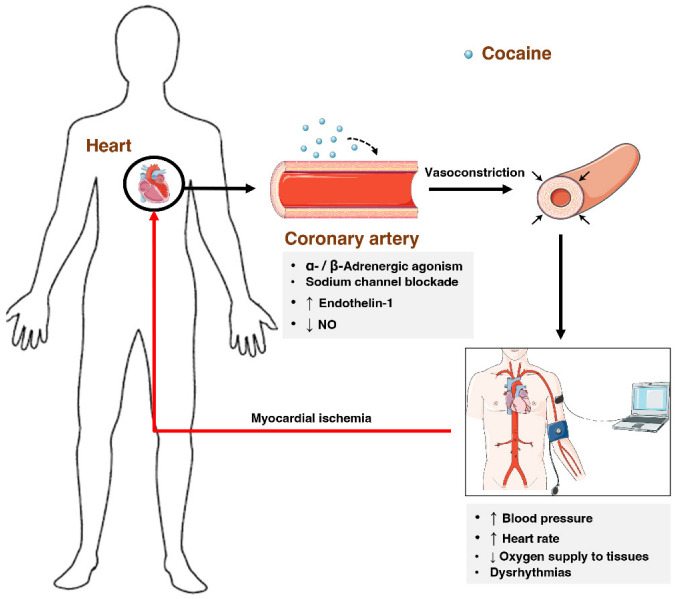
Influence of cocaine over the cardiovascular system. Cocaine promotes vasoconstriction, through indirect agonism of α-/β-adrenergic receptors, blockade of voltage-gated sodium channels, and increases in endothelin-1 and decrease of nitric oxide. These factors will increase the heart rate and blood pressure, decrease the supply of oxygen to tissues, and ultimately induce dysrhythmias.

References

    1. Drake L.R., Scott P.J.H. DARK Classics in Chemical Neuroscience: Cocaine. ACS Chem. Neurosci. 2018;9:2358–2372. doi: 10.1021/acschemneuro.8b00117. - DOI - PMC - PubMed
    1. Phillips K., Luk A., Soor G.S., Abraham J.R., Leong S., Butany J. Cocaine cardiotoxicity: A review of the pathophysiology, pathology, and treatment options. Am. J. Cardiovasc. Drugs. 2009;9:177–196. doi: 10.1007/BF03256574. - DOI - PubMed
    1. Dinis-Oliveira R.J., Carvalho F., Duarte J.A., Proenca J.B., Santos A., Magalhaes T. Clinical and forensic signs related to cocaine abuse. Curr. Drug. Abuse. Rev. 2012;5:64–83. doi: 10.2174/1874473711205010064. - DOI - PubMed
    1. Wang J., Deng X., Wu Y., Huang Y., Hou S., Zhang Y., Qiu T., Tong J., Chen X. Sub-lethal toxicity and elimination of the cocaine metabolite, benzoylecgonine: A narrative review. Ann. Palliat. Med. 2021;10:6936–6947. doi: 10.21037/apm-21-243. - DOI - PubMed
    1. UNODC . World Drug Report 2021. United Nations; Vienna, Austria: 2021.

Publication types

LinkOut - more resources