


What works in appraisal meetings for newly graduated doctors? - and what doesn't?
- PMID: 35448978
- PMCID: PMC9027894
- DOI: 10.1186/s12909-022-03357-z
What works in appraisal meetings for newly graduated doctors? - and what doesn't?
Abstract
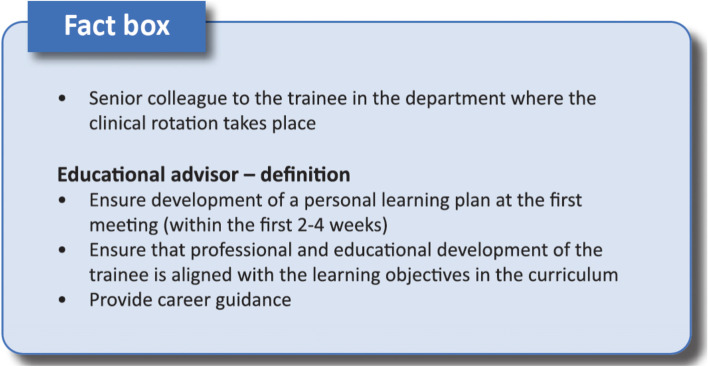
Background: In Denmark a national formal advisory program (NFAP) is mandatory in Postgraduate Medical Education (PGME). According to this, an educational advisor is assigned to each doctor in every clinical rotation to guide and oversee the work and learning progress of the trainee. This study explores why newly graduated trainees evaluated the appraisal meetings in the advisory program as either beneficial (successes) or not beneficial (non-successes).
Methods: Inspired by the Success Case Method, a survey was conducted among all 129 doctors employed in their first six-month clinical rotation of postgraduate medical education (PGY1) in the Central Denmark Region. A cluster analysis resulted in a group with eight successes respectively seven non-successes. Semi-structured interviews were conducted with six successes and five non-successes.
Results: In contrast to non-successes, the successes had longer appraisal meetings and their advisor introduced them to purpose and process of meetings including use of the personal learning plan. Successes received feedback on clinical skills, overall global performance and career plans. The successes perceived their advisors as prepared, skilled and motivated and the advisor acted as a contact person. To the successes, the appraisal meetings fostered clarification of and reflections on educational goals, progress and career as well as self-confidence and a sense of security.
Conclusion: Success with appraisal meetings seemed to depend on advisor's skills and motivation including willingness to prioritize time for this task. The results from this study indicate the importance of faculty development. It also raises the question if all doctors should serve as advisors or if this task should be assigned to the most motivated candidates.
Keywords: Advisory program; Appraisal meetings; Educational advisor; Faculty development; Learning plans; Postgraduate medical education.
© 2022. The Author(s).
Conflict of interest statement
The authors declare that they have no competing interests.
Figures
References
-
- Bleakley A, Bligh J, Browne J. Medical education for the future. Identity, power and location. New York: Springer; 2011.
-
- Forrest CN. Essential Guide to educational supervision in postgraduate medical education: Blackwell Publishing Ltd; 2009. isbn:978-1-405-17071-0.
-
- National Health Services, UK: Health Education England: SupervisionReport_FINAL1.pdf (hee.nhs.uk). retrived 211201.
-
- National Health Service, UK. Enhancing supervision for postgraduate doctors in training | Health Education England (hee.nhs.uk). retrived 211201.
MeSH terms
Grants and funding
LinkOut - more resources
Full Text Sources
