. 2022 Apr 5:9:874254.
doi: 10.3389/fnut.2022.874254. eCollection 2022.

A Novel Theanine Complex, Mg-L-Theanine Improves Sleep Quality via Regulating Brain Electrochemical Activity

Affiliations

A Novel Theanine Complex, Mg-L-Theanine Improves Sleep Quality via Regulating Brain Electrochemical Activity

Muhammed Furkan Dasdelen et al. Front Nutr. .

Abstract

L-Theanine is commonly used to improve sleep quality through inhibitory neurotransmitters. On the other hand, Mg2+, a natural NMDA antagonist and GABA agonist, has a critical role in sleep regulation. Using the caffeine-induced brain electrical activity model, here we investigated the potency of L-theanine and two novel Mg-L-theanine compounds with different magnesium concentrations on electrocorticography (ECoG) patterns, GABAergic and serotonergic receptor expressions, dopamine, serotonin, and melatonin levels. Furthermore, we evaluated the sleep latency and duration in the pentobarbital induced sleep model. We herein showed that L-theanine, particularly its various complexes with magnesium increases the expression of GABAergic, serotonergic, and glutamatergic receptors, which were associated with decreased ECoG frequency, increased amplitude, and enhanced delta wave powers. Besides increased dopamine, serotonin, and melatonin; decreased MDA and increased antioxidant enzyme levels were also observed particularly with Mg-complexes. Protein expression analyses also showed that Mg-L-theanine complexes decrease inducible nitric oxide synthase (iNOS) and endothelial nitric oxide synthase (eNOS) levels significantly. In accordance with these results, Mg complexes improved the sleep latency and duration even after caffeine administration. As a result, our data indicate that Mg-L-theanine compounds potentiate the effect of L-theanine on sleep by boosting slow-brain waves, regulating brain electrical activity, and increasing neurotransmitter and GABA receptor levels.

Keywords: GABA receptors; L-theanine; magnesium; neurotransmitters; sleep.


Conflict of interest statement

SS, JK, and SO were employed by Nutrition21, LLC. The remaining authors declare that the research was conducted in the absence of any commercial or financial relationships that could be construed as a potential conflict of interest.

Figures
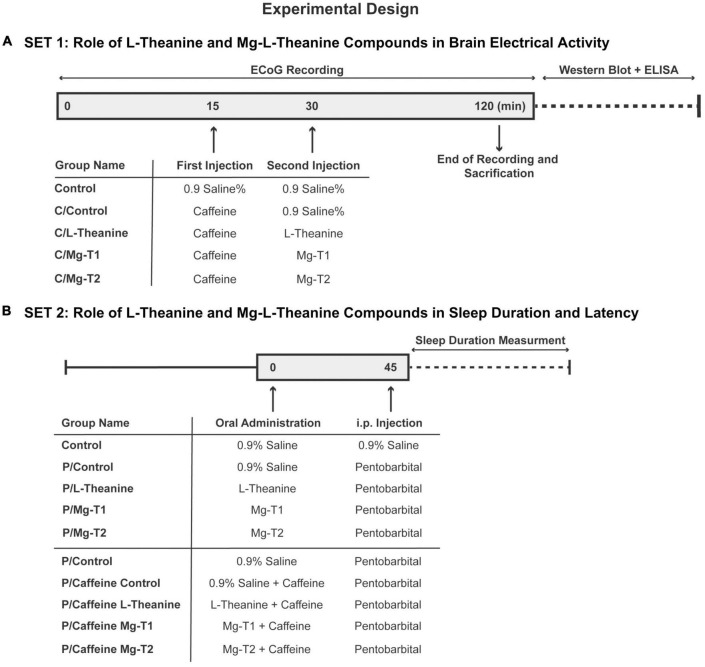
FIGURE 1
FIGURE 1
Experimental design. Experimental design and animal groups, n = 6 for the first set (A), n = 8 for the second set (B).
FIGURE 2
FIGURE 2
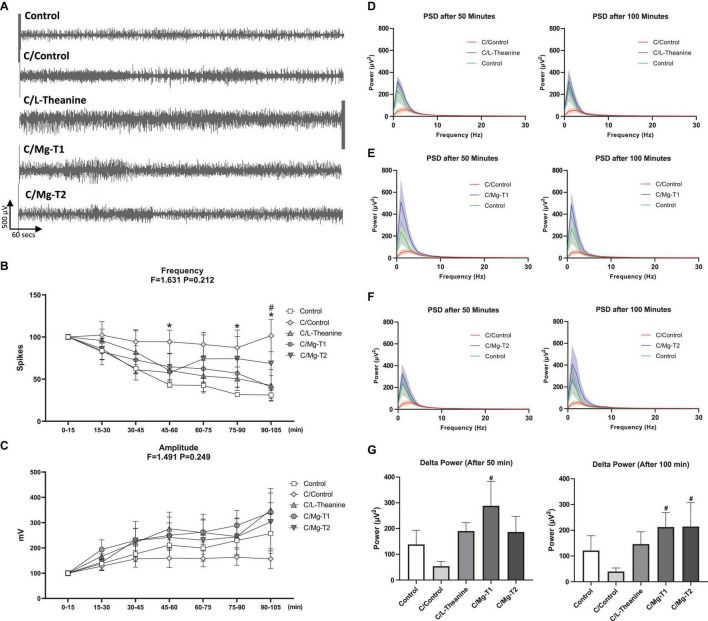
Effect of L-theanine and Mg-L-theanine compounds on brain electrical activity. Representative ECoG recordings for each group (A) and analyses of spike frequency (B) and amplitude (C) on ECoG. Values are represented as mean ± SEM for each group, n = 6. Symbols indicate significance by Fisher’s LSD as *p < 0.05 between Control and C/Control, #p < 0.05 between C/Control and C/Mg-T1 groups. Frequency-power graphs of L-theanine (D), Mg-T1 (E), and Mg-T2 (F) at 50th and 100th minutes for 0–30 Hz range show restoration of slow brain waves after caffeine-induced decline which is then separately graphed for comparison of delta power between groups (G). Average of the 1200 FFTs (10 min following 50th and 100th minutes) were calculated for each animal. #p < 0.05 compared to C/Control group. All values are represented as mean ± SEM.
FIGURE 3
FIGURE 3
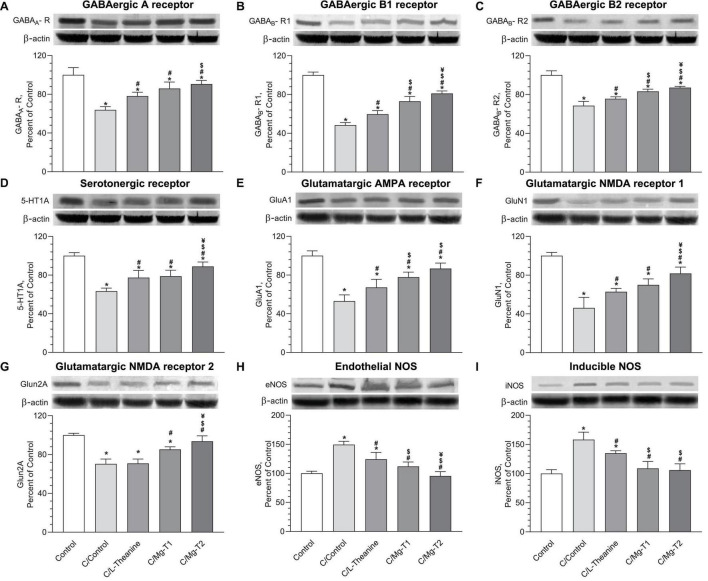
L-Theanine and Mg-L-theanine compounds reverse caffeine’s effect on inhibitory and glutamate receptors. Western blot results of GABAergic receptors GABAA-R (A), GABAB-R1 (B), GABAB-R2 (C), serotonergic receptor 5-HT1A (D), glutamatergic receptors GluA1 (E), GluN1 (F), GluN2A (G), and nitric oxide synthases, eNOS (H), and iNOS (I). All groups normalized according to housekeeping protein β-actin (three β-actin blots were performed for GABAergic and serotonergic receptors; glutamatergic receptors; and NOS), and one-way ANOVA with Tukey’s HSD was performed for multiple comparisons. Values are represented as mean ± SD. *p < 0.05: compared to control, #p < 0.05: compared to caffeine control, $p < 0.05: compared to L-theanine, ¥p < 0.05: compared to Mg-T1.
FIGURE 4
FIGURE 4
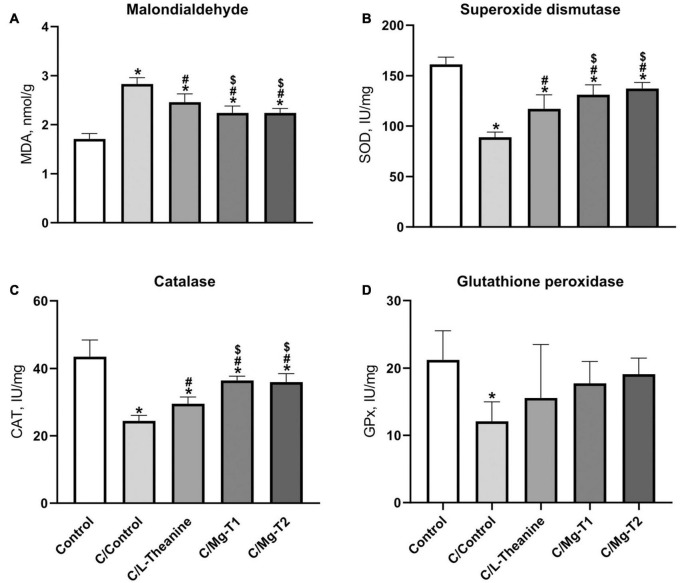
L-Theanine and Mg-L-theanine compounds exhibit antioxidant effects. MDA (A), SOD (B), CAT (C), and GPx (D) levels in the brain. One-way ANOVA with Tukey’s HSD was performed for multiple comparisons and values are represented as mean ± SD. *p < 0.05: compared to control, #p < 0.05: compared to caffeine control, $p < 0.05: compared to L-theanine.
FIGURE 5
FIGURE 5
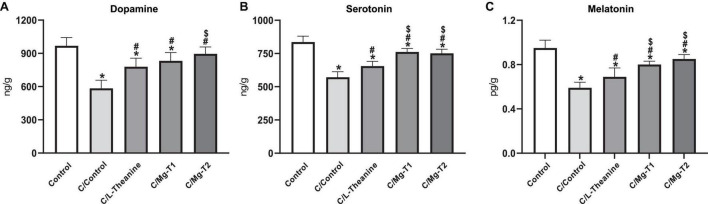
L-Theanine and Mg-L-theanine compounds improve sedative neurotransmitters. Dopamine (A), serotonin (B), and melatonin (C) levels in the brain. One-way ANOVA with Tukey’s HSD was performed for multiple comparisons and values are represented as mean ± SD. *p < 0.05: compared to control, #p < 0.05: compared to caffeine control, $p < 0.05: compared to L-theanine.
FIGURE 6
FIGURE 6
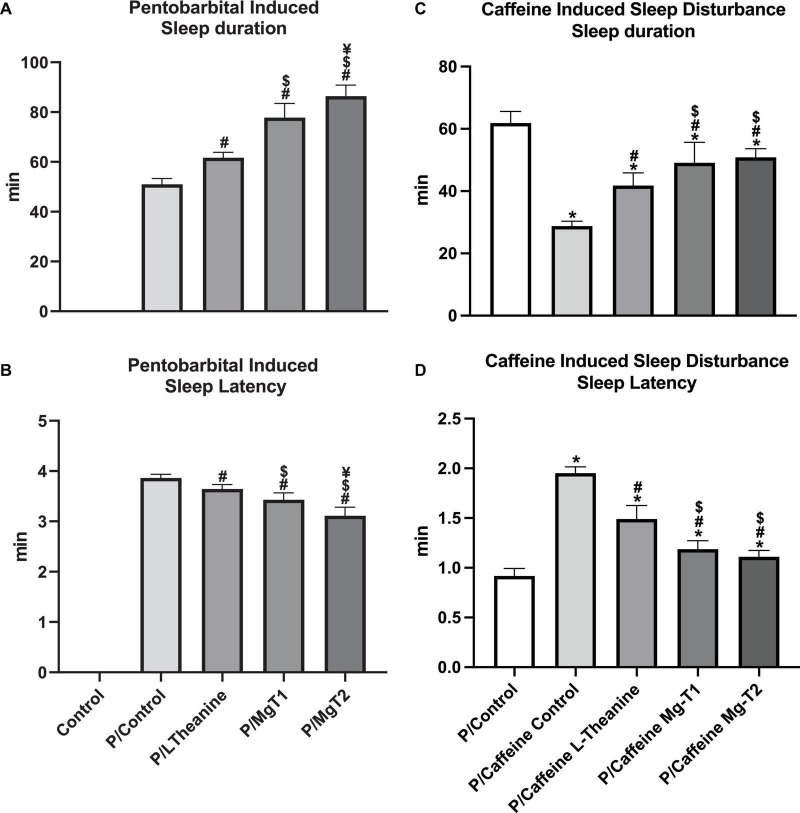
L-Theanine and Mg-L-theanine compounds increase sleep duration and de-crease sleep latency. Effects of L-theanine and Mg-T compounds on sleep duration (A) and sleep latency (B) after pentobarbital administration. The same test was applied in the caffeine-induced sleep disturbance model (C,D). ANOVA with Tukey’s HSD was performed for multiple comparisons and values are represented as mean ± SD. *p < 0.05: compared to control, #p < 0.05: compared to caffeine control, $p < 0.05: compared to L-theanine, ¥p < 0.05: compared to Mg-T1.

References

    1. Léger D, Poursain B, Neubauer D, Uchiyama M. An international survey of sleeping problems in the general population. Curr Med Res Opin. (2008) 24:307–17. 10.1185/030079907X253771 - DOI - PubMed
    1. Colten HR, Altevogt BM. Extent and health consequences of chronic sleep loss and sleep disorders. In Colten HR, Altevogt BM. Sleep Disorders and Sleep Deprivation: An Unmet Public Health Problem. Washington, DC: Institute of Medicine of the National Academies; (2006). 55–135. - PubMed
    1. Longo LP, Johnson B. Addiction: part I. Benzodiazepines–side effects, abuse risk and alternatives. Am Fam Phys. (2000) 61:2121–8. - PubMed
    1. Greenblatt DJ. Pharmacokinetic determinants of dynamic differences among three benzodiazepine hypnotics. Arch Gen Psychiatry. (1989) 46:326. 10.1001/archpsyc.1989.01810040032006 - DOI - PubMed
    1. Roehrs T, Roth T. Insomnia pharmacotherapy. Neurotherapeutics. (2012) 9:728–38. 10.1007/s13311-012-0148-3 - DOI - PMC - PubMed