


Organoid Models for Precision Cancer Immunotherapy
- PMID: 35450073
- PMCID: PMC9016193
- DOI: 10.3389/fimmu.2022.770465
Organoid Models for Precision Cancer Immunotherapy
Abstract
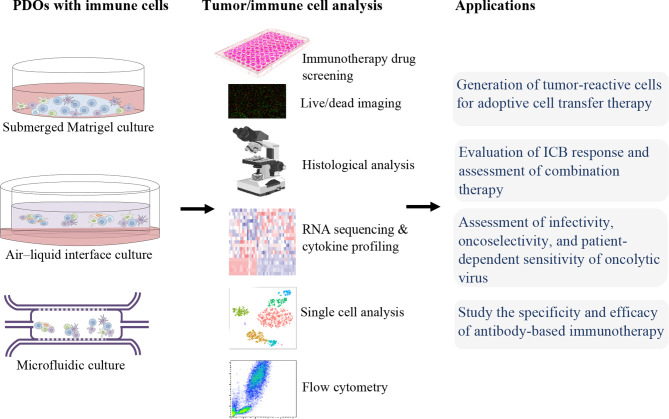
Cancer immunotherapy is exploited for the treatment of disease by modulating the immune system. Since the conventional in vivo animal and 2D in vitro models insufficiently recapitulate the complex tumor immune microenvironment (TIME) of the original tumor. In addition, due to the involvement of the immune system in cancer immunotherapy, more physiomimetic cancer models, such as patient-derived organoids (PDOs), are required to evaluate the efficacy of immunotherapy agents. On the other hand, the dynamic interactions between the neoplastic cells and non-neoplastic host components in the TIME can promote carcinogenesis, tumor metastasis, cancer progression, and drug resistance of cancer cells. Indeed, tumor organoid models can properly recapitulate the TIME by preserving endogenous stromal components including various immune cells, or by adding exogenous immune cells, cancer-associated fibroblasts (CAFs), vasculature, and other components. Therefore, organoid culture platforms could model immunotherapy responses and facilitate the immunotherapy preclinical testing. Here, we discuss the various organoid culture approaches for the modeling of TIME and the applications of complex tumor organoids in testing cancer immunotherapeutics and personalized cancer immunotherapy.
Keywords: cancer; immunotherapy; organoid; precision medicine; tumor microenvironment.
Copyright © 2022 Sun, Lan, Fang, Yang and Jin.
Conflict of interest statement
The authors declare that the research was conducted in the absence of any commercial or financial relationships that could be construed as a potential conflict of interest.
Figures
References
Publication types
MeSH terms
LinkOut - more resources
Full Text Sources
Medical
