. 2022 Apr 15:15:1845-1855.
doi: 10.2147/IDR.S356489. eCollection 2022.

A Cross-Sectional Study to Evaluate Antimicrobial Susceptibility of Uropathogens from South Punjab, Pakistan

Affiliations

A Cross-Sectional Study to Evaluate Antimicrobial Susceptibility of Uropathogens from South Punjab, Pakistan

Muhammad Mubashar Idrees et al. Infect Drug Resist. .

Abstract

Background: Urinary tract infections (UTIs) are a common infection caused by uropathogenic bacteria. Drug resistance against common antibiotics is a leading cause of treatment failure in UTIs.

Objective: This study was conducted to check the prevalence of antimicrobial susceptibility against uropathogens and identify the best treatment option against UTIs.

Methods: In this cross-sectional study, urine samples (n = 1000) were collected and cultured for pure bacterial growth by using cysteine-lactose-electrolyte-deficient (CLED) media. After physical and biochemical characterization, antibacterial susceptibility was performed by the Kirby-Bauer disk diffusion method.

Results: Uropathogenic bacteria were successfully isolated in 57% (n = 572) of total tested samples (n = 1000). Escherichia coli 51.2% (n = 293/572), Klebsiella species 15.4% (n = 88/572), Enterococcus species 15.4% (n = 88/572), Pseudomonas species 9.4% (n = 54/572), Staphylococcus aureus 3.2% (n = 18/572), coagulase-negative Staphylococci (CoNS) 3.0% (n = 17/572) and Proteus species 2.4% (n = 14/572) were the most prevalent organism in UTIs. Prevalence of Gram-negative rods (GNRs) was 78.5% (n = 449/572) among UTI patients as compared to Gram-positive cocci (GPCs) 21.5% (n = 123/572). Escherichia coli 65.3% (n = 293/449), Klebsiella species 19.6% (n = 88/449), Pseudomonas species 12.0% (54/449) and Proteus species 3.1% (n = 14/449) were the most prevalent GNRs in UTIs, while Enterococcus species 71.5% (n = 88/123), Staphylococcus aureus 14.6% (n = 18/123) and coagulase-negative Staphylococci (CoNS) 13.8% (17/123) were the most prevalent GPCs in UTIs. The majority of isolated uropathogens showed resistance against routinely used antibiotics. However, teicoplanin and linezolid were the most effective drugs against GPCs and piperacillin/tazobactam, meropenem and imipenem were the most effective drugs against GNRs. Nitrofurantoin and fosfomycin were shown to be most effective against both GNRs and GPCs.

Conclusion: In conclusion, Escherichia coli (GNRs) and Enterococcus species (GPCs) are the most prevalent organisms among UTIs patients, which are shown to be antibiotic-resistant to the most commonly used antibiotics. However, nitrofurantoin and fosfomycin are the most effective drugs against uropathogens in UTIs.

Keywords: UTIs; antibacterial drugs; biochemical analysis; uropathogens.


Conflict of interest statement

No potential conflict of interest in this work was reported by the authors.

Figures
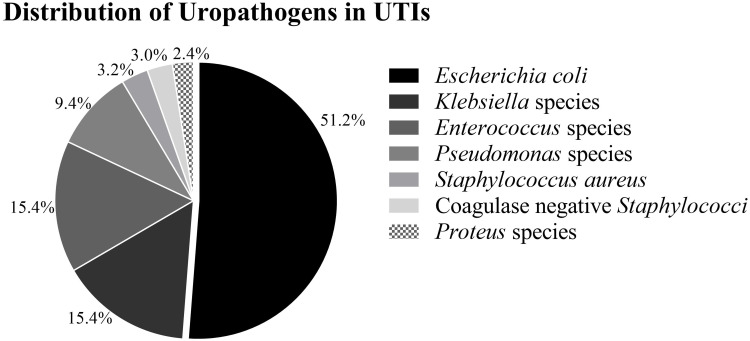
Figure 1
Figure 1
Distribution and prevalence of bacterial isolates in UTIs. Distribution of most prevalent (%) uropathogenic bacteria among the total number of isolates (n=572) from UTIs. Escherichia coli were the most prevalent (51.2%) among the UTIs pathogens followed by Klebsiella species (15.4%), Enterococcus species (15.4%), Pseudomonas species (9.4%), Staphylococcus aureus (3.2%), Coagulase-negative Staphylococci (CoNS) (3.0%) and Proteus species (2.4%) Bacterial isolates presented were significantly associated with UTI (p-value was < 0.000).
Figure 2
Figure 2
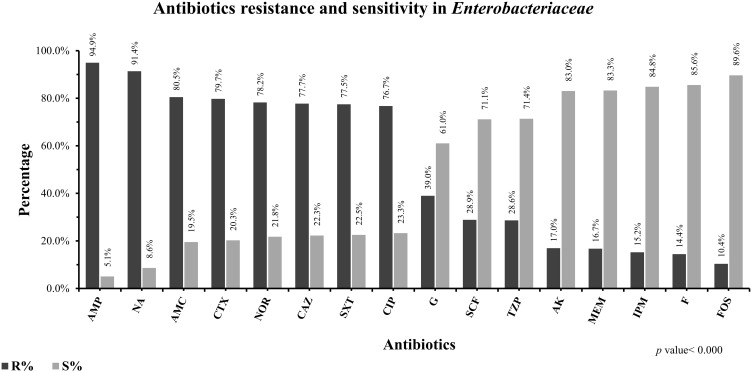
The pattern of antibiotics resistance and susceptibility against Enterobacteriaceae. Frequency of antimicrobial resistance and susceptibility of antibiotics including ampicillin (AMP), nalidixic acid (NA), augmentin (AMC), cefotaxime (CTX), norfloxacin (NOR), ceftazidime (CAZ), co-trimoxazole (SXT), ciprofloxacin (CIP), gentamicin (G), sulbactam/cefoperazone (SCF), piperacillin/tazobactam (TZP), meropenem (MEM), imipenem (IPM), amikacin (AK), nitrofurantoin (F), fosfomycin (FOS) were presented in percentages against Enterobacteriaceae. Resistance (black bars) and susceptibility (grey bars) of all antibiotics mentioned in this graph were significantly associated with UTIs caused by bacterial isolates belonging to Enterobacteriaceae such as Escherichia coli, Klebsiella species, and Proteus species (p-value was < 0.000).
Figure 3
Figure 3
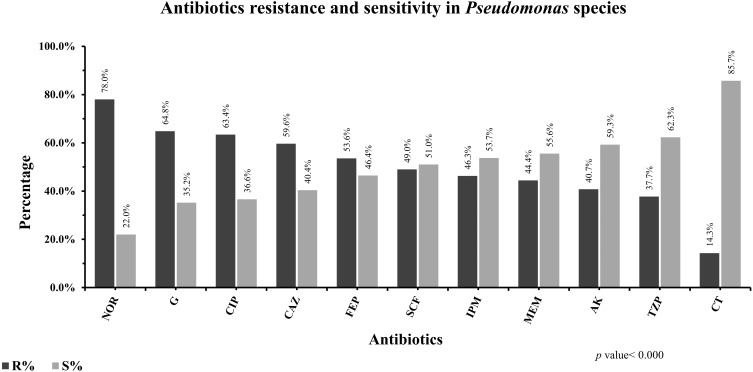
The pattern of antibiotics effectiveness against Pseudomonas species in UTIs. Frequency of antimicrobial resistance and susceptibility of antibiotics including norfloxacin (NOR), gentamicin (G), ciprofloxacin (CIP), ceftazidime (CAZ), cefepime (FEP), sulbactam/cefoperazone (SCF), imipenem (IPM), meropenem (MEM), amikacin (AK), piperacillin/tazobactam (TZP), colistin (CT) were presented in percentage against Pseudomonas species. Resistance (black bars) and susceptibility (grey bars) of these antibiotics mentioned in this graph were significantly associated with UTIs associated caused by Pseudomonas species (p-value was < 0.000).
Figure 4
Figure 4
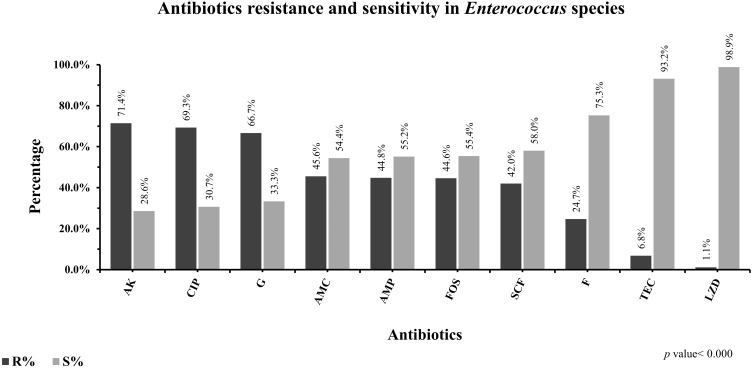
The pattern of antibiotics effectiveness against Enterococcus species in UTIs. Frequency of antimicrobial resistance and susceptibility of antibiotics including amikacin (AK), ciprofloxacin (CIP), gentamicin (G), augmentin (AMC), ampicillin (AMP), fosfomycin (FOS), sulbactam/cefoperazone (SCF), nitrofurantoin (F), teicoplanin (TEC), linezolid (LZD) were presented in percentage against Enterococcus species. Resistance (black bars) and susceptibility (grey bars) of all antibiotics mentioned in this graph were significantly associated with UTIs caused by Enterococcus species (p-value was < 0.000).
Figure 5
Figure 5
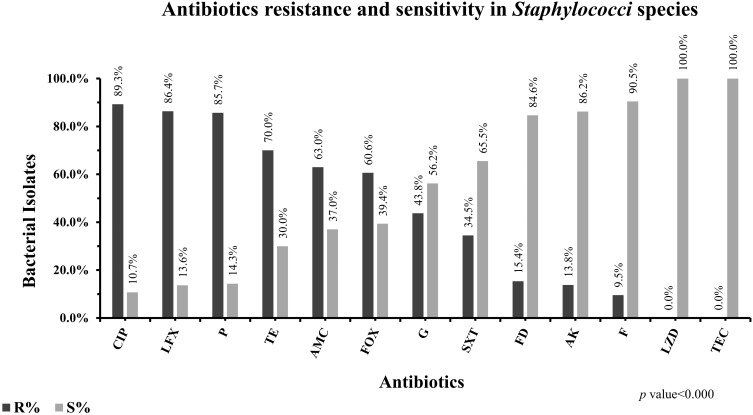
The pattern of antibiotics effectiveness against Staphylococci species in UTIs. Frequency of antimicrobial susceptibility of antibiotics including ciprofloxacin (CIP), levofloxacin (LFX), penicillin (P), tetracycline (TE), augmentin (AMC), fosfomycin (FOS), gentamicin (G), co-trimoxazole (SXT), fusidic acid (FD), amikacin (AK), nitrofurantoin (F), linezolid (LZD), teicoplanin (TEC) was presented in percentage against Staphylococci species. Resistance (black bars) and susceptibility (grey bars) of all antibiotics mentioned in this graph were significantly associated with UTIs caused by Staphylococci species (p-value was < 0.000).

References

    1. Flores-Mireles AL, Walker JN, Caparon M, Hultgren SJ. Urinary tract infections: epidemiology, mechanisms of infection and treatment options. Nat Rev Microbiol. 2015;13(5):269–284. doi:10.1038/nrmicro3432 - DOI - PMC - PubMed
    1. McLellan LK, Hunstad DA. Urinary tract infection: pathogenesis and outlook. Trends Mol Med. 2016;22(11):946–957. doi:10.1016/j.molmed.2016.09.003 - DOI - PMC - PubMed
    1. Heffner VA, Gorelick MH. Pediatric urinary tract infection. Clin Pediatr Emerg Med. 2008;9(4):233–237. doi:10.1016/j.cpem.2008.09.009 - DOI
    1. Schaeffer A, Rajan N, Cao Q, et al. Host pathogenesis in urinary tract infections. Int J Antimicrob Agents. 2001;17(4):245–251. doi:10.1016/S0924-8579(01)00302-8 - DOI - PubMed
    1. Behzadi P, Behzadi E. The microbial agents of urinary tract infections at central laboratory of Dr. Shariati Hospital, Tehran, Iran. Turk Klin Tip Bilim. 2008;28(4):445.

LinkOut - more resources