


Forecasting Obesity and Type 2 Diabetes Incidence and Burden: The ViLA-Obesity Simulation Model
- PMID: 35450123
- PMCID: PMC9016163
- DOI: 10.3389/fpubh.2022.818816
Forecasting Obesity and Type 2 Diabetes Incidence and Burden: The ViLA-Obesity Simulation Model
Abstract
Background: Obesity is a major public health problem affecting millions of Americans and is considered one of the most potent risk factors for type 2 diabetes. Assessing future disease burden is important for informing policy-decision making for population health and healthcare.
Objective: The aim of this study was to develop a computer model of a cohort of children born in Los Angeles County to study the life course incidence and trends of obesity and its effect on type 2 diabetes mellitus.
Methods: We built the Virtual Los Angeles cohort-ViLA, an agent-based model calibrated to the population of Los Angeles County. In particular, we developed the ViLA-Obesity model, a simulation suite within our ViLA platform that integrated trends in the causes and consequences of obesity, focusing on diabetes as a key obesity consequence during the life course. Each agent within the model exhibited obesity- and diabetes-related healthy and unhealthy behaviors such as sugar-sweetened beverage consumption, physical activity, fast-food consumption, fresh fruits, and vegetable consumption. In addition, agents could gain or lose weight and develop type 2 diabetes mellitus with a certain probability dependent on the agent's socio-demographics, past behaviors and past weight or type 2 diabetes status. We simulated 98,230 inhabitants from birth to age 65 years, living in 235 neighborhoods.
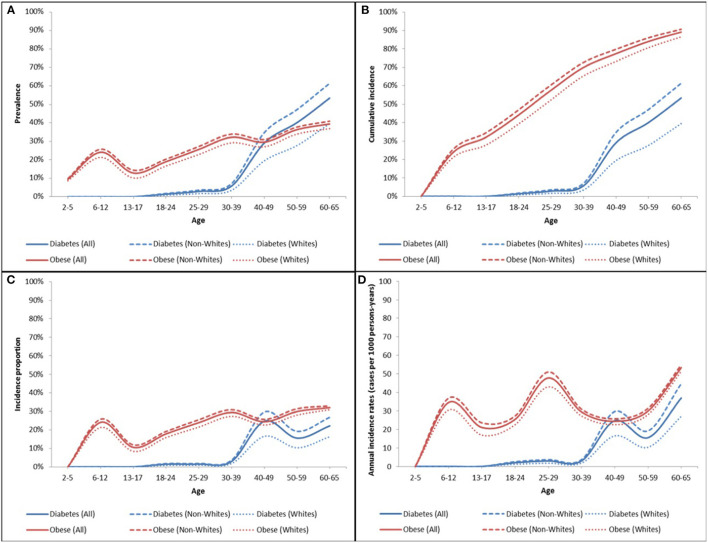
Results: The age-specific incidence of obesity generally increased from 10 to 30% across the life span with two notable peaks at age 6-12 and 30-39 years, while that of type 2 diabetes mellitus generally increased from <2% at age 18-24 to reach a peak of 25% at age 40-49. The 16-year risks of obesity were 32.1% (95% CI: 31.8%, 32.4%) for children aged 2-17 and 81% (95% CI: 80.8%, 81.3%) for adults aged 18-65. The 48-year risk of type 2 diabetes mellitus was 53.4% (95% CI: 53.1%, 53.7%) for adults aged 18-65.
Conclusion: This ViLA-Obesity model provides an insight into the future burden of obesity and type 2 diabetes mellitus in Los Angeles County, one of the most diverse places in the United States. It serves as a platform for conducting experiments for informing evidence-based policy-making.
Keywords: agent-based model; obesity; prediction; simulation; type 2 diabetes.
Copyright © 2022 Nianogo and Arah.
Conflict of interest statement
The authors declare that the research was conducted in the absence of any commercial or financial relationships that could be construed as a potential conflict of interest.
Figures
References
-
- Hammond RA. Complex systems modeling for obesity research. Prev Chronic Dis. (2009) 6:A97. Available online at: http://www.cdc.gov/pcd/issues/2009/jul/09_0017.htm (accessed March 11, 2022). - PMC - PubMed
-
- Huang TT, Drewnosksi A, Kumanyika S, Glass TA. A systems-oriented multilevel framework for addressing obesity in the 21st century. Prev Chronic Dis. (2009) 6:A82. Available online at: http://www.cdc.gov/pcd/issues/2009/jul/09_0013.htm (accessed March 11, 2022). - PMC - PubMed
-
- Bronfenbrenner U. Ecological models of human development. Int Encycl Educ. (1994) 3:37–43.
Publication types
MeSH terms
Grants and funding
LinkOut - more resources
Full Text Sources
Medical
Miscellaneous
