New Insights of Early Brain Injury after Subarachnoid Hemorrhage: A Focus on the Caspase Family
- PMID: 35450528
- PMCID: PMC10190145
- DOI: 10.2174/1570159X20666220420115925
New Insights of Early Brain Injury after Subarachnoid Hemorrhage: A Focus on the Caspase Family
Abstract
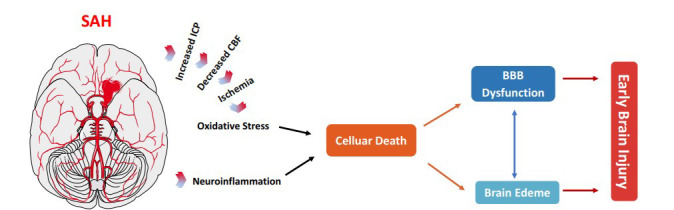
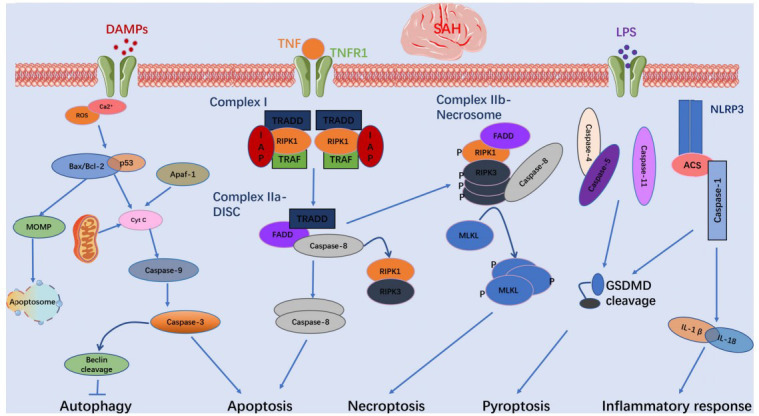
Spontaneous subarachnoid hemorrhage (SAH), primarily caused by ruptured intracranial aneurysms, remains a prominent clinical challenge with a high rate of mortality and morbidity worldwide. Accumulating clinical trials aiming at the prevention of cerebral vasospasm (CVS) have failed to improve the clinical outcome of patients with SAH. Therefore, a growing number of studies have shifted focus to the pathophysiological changes that occur during the periods of early brain injury (EBI). New pharmacological agents aiming to alleviate EBI have become a promising direction to improve outcomes after SAH. Caspases belong to a family of cysteine proteases with diverse functions involved in maintaining metabolism, autophagy, tissue differentiation, regeneration, and neural development. Increasing evidence shows that caspases play a critical role in brain pathology after SAH. Therefore, caspase regulation could be a potential target for SAH treatment. Herein, we provide an overview pertaining to the current knowledge on the role of caspases in EBI after SAH, and we discuss the promising therapeutic value of caspase-related agents after SAH.
Keywords: Subarachnoid hemorrhage; caspase regulation; caspase-related agents; caspases; cerebral vasospasm; early brain injury.
Copyright© Bentham Science Publishers; For any queries, please email at epub@benthamscience.net.
Conflict of interest statement
The authors declare no conflict of interest, financial or otherwise.
Figures
References
MeSH terms
Substances
Grants and funding
LinkOut - more resources
Full Text Sources