Review
. 2022 Apr 1;15(4):dmm049390.
doi: 10.1242/dmm.049390. Epub 2022 Apr 22.

The clinical manifestations, molecular mechanisms and treatment of craniosynostosis

Affiliations
Review

The clinical manifestations, molecular mechanisms and treatment of craniosynostosis

Eloise Stanton et al. Dis Model Mech. .

Abstract

Craniosynostosis is a major congenital craniofacial disorder characterized by the premature fusion of cranial suture(s). Patients with severe craniosynostosis often have impairments in hearing, vision, intracranial pressure and/or neurocognitive functions. Craniosynostosis can result from mutations, chromosomal abnormalities or adverse environmental effects, and can occur in isolation or in association with numerous syndromes. To date, surgical correction remains the primary treatment for craniosynostosis, but it is associated with complications and with the potential for re-synostosis. There is, therefore, a strong unmet need for new therapies. Here, we provide a comprehensive review of our current understanding of craniosynostosis, including typical craniosynostosis types, their clinical manifestations, cranial suture development, and genetic and environmental causes. Based on studies from animal models, we present a framework for understanding the pathogenesis of craniosynostosis, with an emphasis on the loss of postnatal suture mesenchymal stem cells as an emerging disease-driving mechanism. We evaluate emerging treatment options and highlight the potential of mesenchymal stem cell-based suture regeneration as a therapeutic approach for craniosynostosis.

Keywords: Animal models; Craniosynostosis; Environmental factors; Human genetics; Mesenchymal stem cells; Tissue regeneration.


Conflict of interest statement

Competing interests The authors declare no competing or financial interests.

Figures
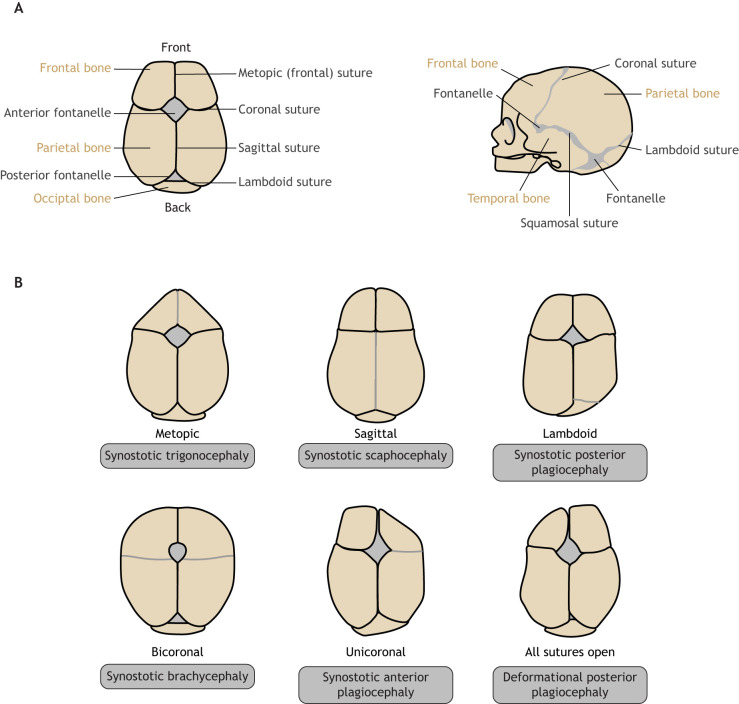
Fig. 1.
Fig. 1.
Cranial sutures and craniosynostosis in humans. (A) A normal human infant skull shown from above (left) and human infant skull shown from the side (right). (B) Skull deformities caused by different forms of craniosynostosis. See Glossary (Box 1) for description of medical terms. Figure adapted from Buchanan et al. (2017) under the terms of the CC BY-NC 3.0 license.
Fig. 2.
Fig. 2.
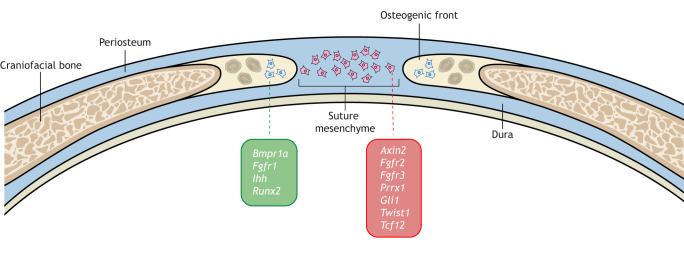
Suture development at postnatal stage. A cross-section schematic of the coronal suture that highlights some genes that are expressed in the suture mesenchyme versus the ones that are expressed at the osteogenic front. These gene expression patterns are dynamic and may change throughout postnatal suture development.
Fig. 3.
Fig. 3.
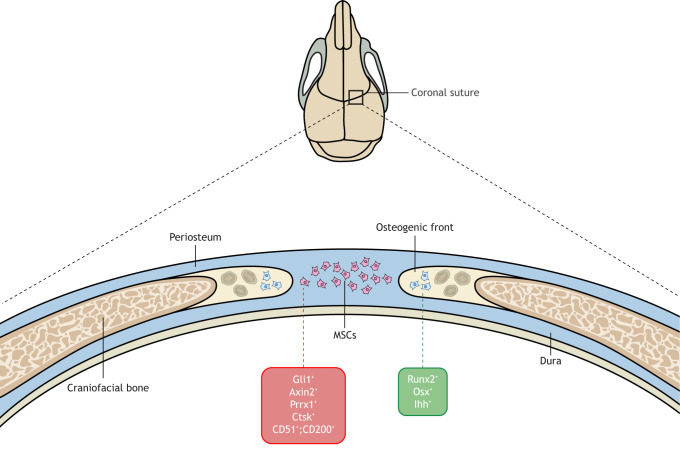
Suture MSCs and their loss in animal models of craniosynostosis. A cross-section schematic of the coronal suture of a mouse, showing cells in the suture mesenchyme and in the osteogenic front. Genetic lineage tracing and surface marker purification studies have identified multiple populations of suture mesenchymal stem cells (MSCs), including Gli1+, Axin2+, Prrx1+, Ctsk+ and CD51+;CD200+ cells. These cells maintain suture patency and coordinate appropriate development. Twist1+/− craniosynostosis mouse embryos lose Gli1+ and CD51+;CD200+ suture MSCs during postnatal stages of development, and suture MSCs undergo premature differentiation into osteogenic cells, which results in premature suture synostosis.
Fig. 4.
Fig. 4.
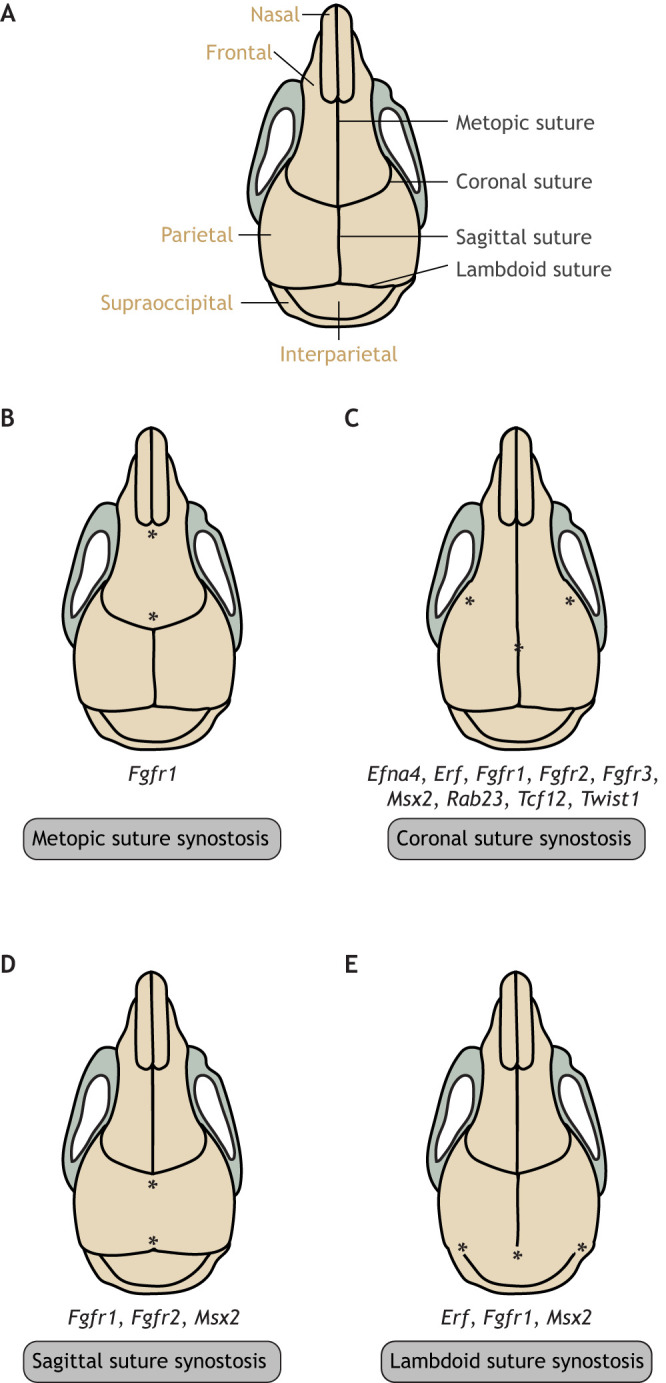
The mutations associated with suture fusion in an adult mouse. (A) Normal adult mouse skull. (B) Metopic (interfrontal) suture synostosis can be caused by Fgfr1 mutation. (C) Coronal suture synostosis can be caused by mutation in Efna4, Erf, Fgfr1, Fgfr2, Fgfr3, Msx2, Rab23, Tcf12 or Twist1. (D) Sagittal suture synostosis can be caused by mutation in Fgfr1, Fgfr2 or Msx2. (E) Lambdoid suture synostosis can be caused by mutation in Erf, Fgfr1 or Msx2. Asterisks indicate the corresponding fused sutures.
Fig. 5.
Fig. 5.
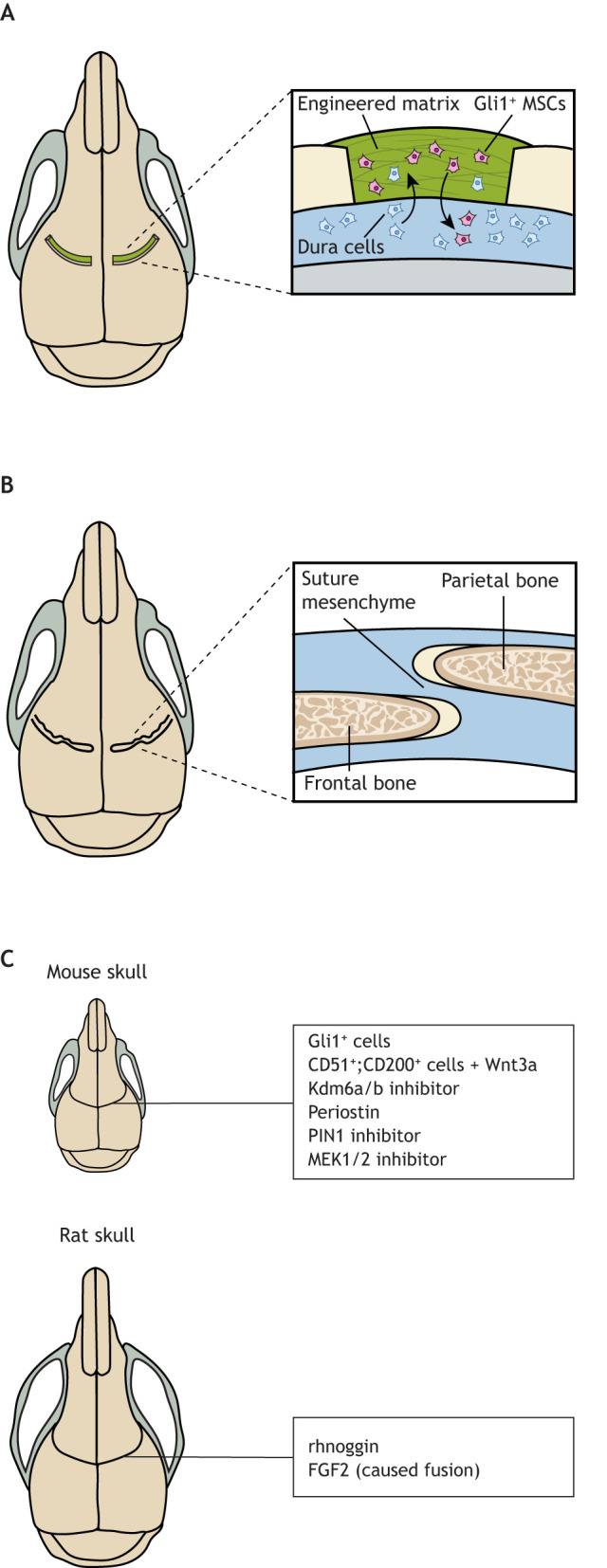
Gli1+ MSC-mediated suture regeneration mitigates skull defects in craniosynostosis. (A) A rectangular 0.3-0.4 mm-wide incision was made over each of the fused coronal sutures in Twist1+/− mice. Ex vivo Gli1+ MSCs were mixed with an engineered matrix composed of methacrylated gelatin, Matrigel and collagen I. This cell–matrix mixture was implanted into the incision. (B) The cell–matrix implant rescued skull deformity and, additionally, ameliorated defective brain structure and function in Twist1+/− mice with craniosynostosis. Moreover, this intervention regenerated normal suture morphology, and the regenerated sutures recapitulated those of wild-type mice in terms of their gene expression patterns and functions. Please see Yu et al. (2021) for more detail. (C) Various therapeutic approaches have been tested in mouse and rat models and have been shown to regenerate cranial sutures or prevent suture fusion. Specifically, Gli1+ MSCs or CD51+;CD200+ stem cells plus Wnt3a can support cranial suture regeneration in Twist1+/− mice. The Kdm6a/b inhibitor GSK-J4, recombinant periostin, the PIN1 inhibitor juglone, and the MEK1/2 inhibitor U0126 can prevent cranial suture fusion in mice. In the rat model, recombinant human (rh)noggin can prevent coronal suture fusion, whereas increased FGF2 activity can lead to (premature) suture fusion.

References

    1. Agochukwu, N. B., Solomon, B. D. and Muenke, M. (2014). Hearing loss in syndromic craniosynostoses: otologic manifestations and clinical findings. Int. J. Pediatr. Otorhinolaryngol. 78, 2037-2047. 10.1016/j.ijporl.2014.09.019 - DOI - PubMed
    1. Agthe, M., Brügge, J., Garbers, Y., Wandel, M., Kespohl, B., Arnold, P., Flynn, C. M., Lokau, J., Aparicio-Siegmund, S., Bretscher, C.et al. (2018). Mutations in craniosynostosis patients cause defective interleukin-11 receptor maturation and drive craniosynostosis-like disease in mice. Cell Rep. 25, 10-18.e15. 10.1016/j.celrep.2018.09.005 - DOI - PubMed
    1. Alderman, B. W., Bradley, C. M., Greene, C., Fernbach, S. K. and Barón, A. E. (1994). Increased risk of craniosynostosis with maternal cigarette smoking during pregnancy. Teratology 50, 13-18. 10.1002/tera.1420500103 - DOI - PubMed
    1. Ardalan, M., Rafati, A., Nejat, F., Farazmand, B., Majed, M. and El Khashab, M. (2012). Risk factors associated with craniosynostosis: a case control study. Pediatr. Neurosurg. 48, 152-156. 10.1159/000346261 - DOI - PubMed
    1. Arnaud, E., Renier, D. and Marchac, D. (1995). Prognosis for mental function in scaphocephaly. J. Neurosurg. 83, 476-479. 10.3171/jns.1995.83.3.0476 - DOI - PubMed

Publication types